

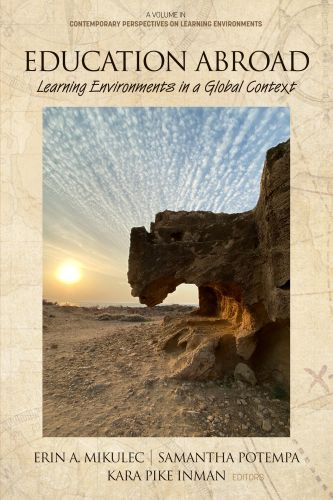
Education Abroad
Learning Environments in a Global Context

This book can be opened with

Note on our eBooks and Audiobooks: you can read our eBooks (ePUB or PDF) and listen to audiobooks on the free Emerald Books app on iOS, Android, and desktop. Or read and listen on Emerald's online reader (ePUB eBooks and audiobooks only). To purchase a digital book you will need to create an account if you don’t already have one. After purchasing you will receive instructions on how to get started.
- Description
- Contents
Education abroad is an essential part of the university student experience. Initiatives such as IIE’s Generation Study Abroad encourage more U.S. undergraduate and graduate students to study abroad. According to the Open Doors 2019 Report by the Institute for International Education (IIE), 341,751 students participated in post-secondary education abroad programs during the 2017/2018 academic year. This figure represents an increase of 2.7% of U.S. students studying abroad from the previous year. Research shows that education abroad provides students with opportunities not only to see the world but also to develop intercultural competence, which is increasingly crucial in the 21st century workplace. There are also numerous studies that show gains in autonomy, confidence, and tolerance for ambiguity in students who complete some type of study abroad experience. In sum, the education abroad experience in itself represents a powerful learning environment that continues to support personal and professional development long after returning home. Nonetheless, these learning environments must be cultivated along with faculty who develop and lead programs, as well as university partners and providers. Furthermore, education abroad programming and assessment is complex and must take into consideration many factors including academic goals, purposeful curricular development, and a balance between academics and leisure activities on site.
This book explores the many aspects of education abroad as a learning environment, such as student learning outcomes, faculty development, and program assessment and evaluation. In addition, several chapters present education abroad experiences as a model for community engagement and activism. The authors represent a diverse range of institutions and perspectives and discuss programs around the globe. The book represents the voices of faculty that lead education abroad programs, students who participate in them, and also those of international students on a U.S. campus reflecting on their personal experiences abroad. Furthermore, this book contributes to the discussion of best practices to assist faculty and program directors in creating robust education abroad programs that meet the needs of their students and institutions.
Introduction.
- Chapter 1. Toward a Glocality of Teacher Education: Professional Development Abroad in the Chilean Context; Kenneth J. Fasching-Varner, Michaela P. Stone, and Tina Vo.
- Chapter 2. It's All in the Mind: Developing New Ways of Thinking and Acting During a Semester Abroad: An Australian Case Study; Beate Mueller.
- Chapter 3. Study Abroad as Community Engagement and Activism: Cultivating a Pedagogy of Place; Gloria Delany-Barmann, Heather McIlvaine-Newsad, and Pedro Bidegaray.
- Chapter 4. Reflective Interventions: Enhancing Students' Learning From Intercultural Experiences Abroad; Veronique Schutjens, Gery Nijenhuis, Elma Zijderveld, and Annelou Ypeij.
- Chapter 5. Abroad in the United States: Reflections From International Students and Scholars; Adrianna Zabrzewska, Ransford Frempong-Manso, Iresha Jayasinghe, Robby Anggriawan, Syed Answer Shah, Aiding Han, and Md Zahidur Rahman.
- Chapter 6. Professional Development Through Leading Study Abroad Programs; Stuart Allen, Jennifer Creamer, Carl Ross, Christine Holtz, Heather Pinson, Jill Kurp, and Dan Shelley.
- Chapter 7. An Initiative in Student Learning Outcome Assessment for Education Abroad; Chris Kjonaas, Stuart Henry, and Joshua J. Mitchell.
- Chapter 8. Assessing Short-Term Study Abroad: A Catalyst for Responsibility, Choices, and Engagement; Dan O. Nyaronga and Cathleen M. Morreale.
- Chapter 9. Study Abroad: Success of a Short-Term Study Abroad Aboard a Cruise Ship; Rachel E. Smith, Minsun Doh, Maren Anderson, and Julie Terstriep.
- Chapter 10. Small Rural Schools Can Make a Big Impact: Building and Growing Transformative International Experiences for Rural, Low-Income Undergraduate Students; Celia A. Evans.
- About the Contributors.