
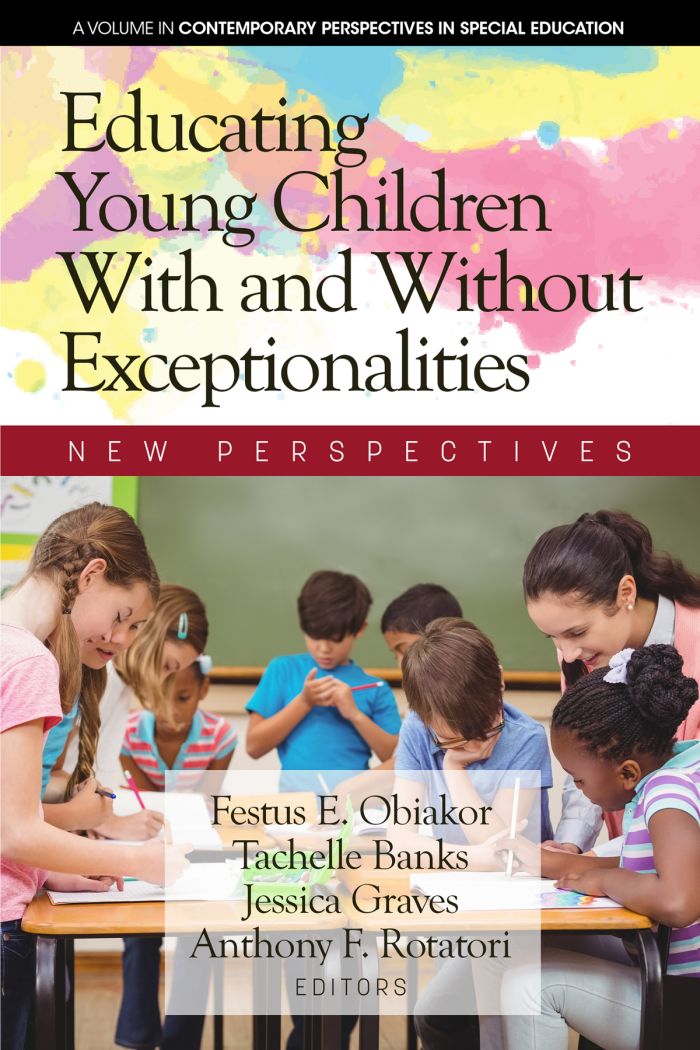
Educating Young Children With and Without Exceptionalities
New Perspectives

This book can be opened with

Note on our eBooks and Audiobooks: you can read our eBooks (ePUB or PDF) and listen to audiobooks on the free Emerald Books app on iOS, Android, and desktop. Or read and listen on Emerald's online reader (ePUB eBooks and audiobooks only). To purchase a digital book you will need to create an account if you don’t already have one. After purchasing you will receive instructions on how to get started.
- Description
- Contents
Early childhood education (ECE) has always been intertwined with the use of developmentally appropriate practice (DAP). To support excellence in ECE, it is critical how the knowledge about individual children and child development principles combined with the knowledge of effective early learning practices. Effective early childhood education involves an interdisciplinary collaborative process that is influenced by many factors. We present these aforementioned realities in Educating Young Children With and Without Exceptionalities: New Perspectives. In addition, we argue that general and special educators need to focus on applying new knowledge to better address critical issues that advance the field of educator preparation and improve educational outcomes for young children.
Early childhood research confirms the need for intensive intervention and remedial education—we need to avoid approaches that are 'too little' or 'too late.' Also proven to yield positive results for children are practices familiar to early childhood educators. These practices include relationship-based teaching and learning; partnering with families; adapting teaching for children from different backgrounds and for individual children; active, meaningful, and connected learning; and smaller class sizes. Evidence of the benefits of these practices suggests that they should be extended more widely into the elementary grades.
Foreword.
- Preface.
- Chapter 1. Educating Young Children With and Without Exceptionalities: The Rationale; Tachelle Banks, Festus E. Obiakor, Anthony F. Rotatori, and Maurice Stinnett.
- Chapter 2. Identification and Assessment Tools for Young Children; Ramel L. Smith, Edgar X. Jordan, and Alan Livingston.
- Chapter 3. Placement of Young Students With Exceptionalities: To Include or Not to Include; Lenwood Gibson Jr.
- Chapter 4. Innovative Teaching Methods for Young Children With and Without Disabilities; Shaunita Strozier, Cindy Head, and Stephanie Marshall.
- Chapter 5. What School Leaders Can Do to Provide Quality Education for Young Children With Autism; Alana Telesford, Floyd D. Beachum, and Carlos R. McCray.
- Chapter 6. Empowering Parents of Young Atypical Learners; Mateba K. Harris.
- Chapter 7. School-Community Partnerships: Educating Young Children; Bridgie A. Ford, Shernavaz Vakil, and Lynn S. Kline.
- Chapter 8. Optimizing the Physical and Mental Health of Young Children With and Without Exceptionalities; Eugene Asola and Sonya Sanderson.
- Chapter 9. Using Technology to Educate Young Children With and Without Disabilities; Emily C. Bouck, Emma Sipila, Sarah Byrnes, and Jeffrey P. Bakken.
- Chapter 10. The Role of Educator Preparation Programs in the Education of Young Children; Ying Hui-Michael, Kalli Kemp, and Beth Pinheiro.
- Chapter 11. Educating Young Learners: Future Perspectives; Sunday O. Obi, Festus E. Obiakor, Jessica Graves, and Bob Algozzine.