
Educating a Working Society
Vocationalism in 20th Century American Schooling

This book can be opened with

Note on our eBooks and Audiobooks: you can read our eBooks (ePUB or PDF) and listen to audiobooks on the free Emerald Books app on iOS, Android, and desktop. Or read and listen on Emerald's online reader (ePUB eBooks and audiobooks only). To purchase a digital book you will need to create an account if you don’t already have one. After purchasing you will receive instructions on how to get started.
- Description
- Contents
The future looks promising for the field of career and technical education (CTE). The Every Student Succeeds Act of 2015 eases the way to create multiple pathways for high school students to get to college and careers. Philanthropic foundations are funding innovations in career preparation. State departments of education are revamping program guidelines and graduation requirements. In many states, governors have made career preparation a priority.
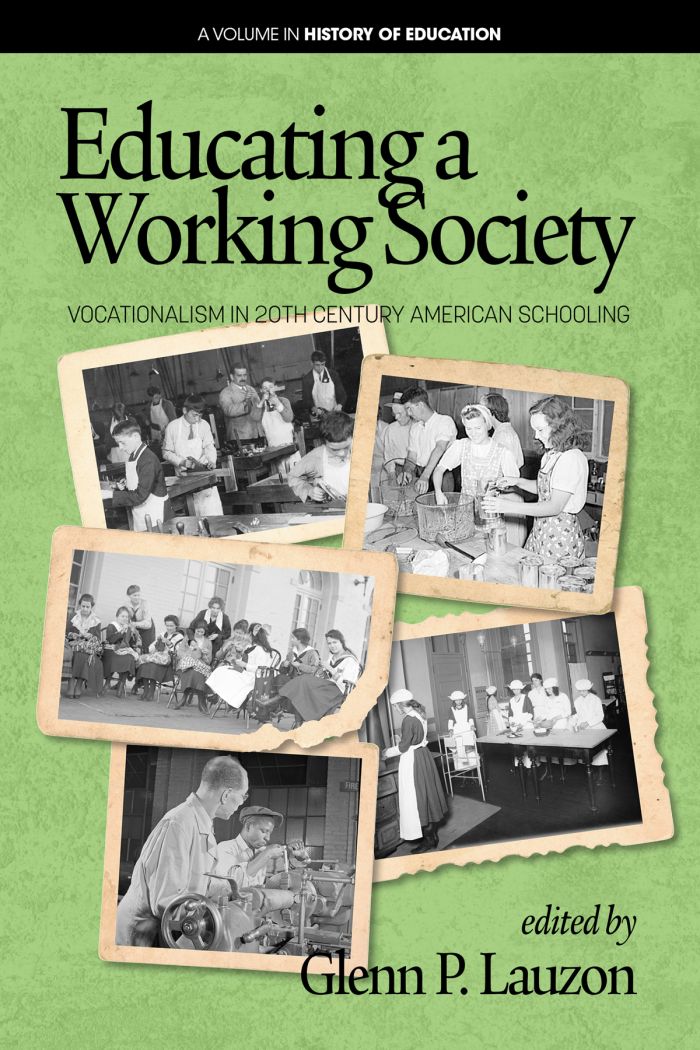
While people plan CTE’s future, Educating a Working Society looks to its past. This book explores twentieth-century efforts to bring schooling and work closer together. Chapters feature timely topics, such as public controversy over vocational programs, the influences of racism in philanthropic giving, students’ choices in course taking, teachers’ efforts to combine the academic and vocational missions of schooling, and contemporary trends in college and career readiness initiatives.
Using schools to prepare youth for work has a long and troubled history. The contributors to this book dive into that history, bringing up compelling issues that challenge conventional wisdom about the history of education.
Preface.
- Introduction; Glenn P. Lauzon.
- Chapter 1. Partitioning Schools: Federal Vocational Policy, Tracking, and the Rise of Twentieth-Century Dogmas; Michael Thier, Joshua Fitzgerald, and Paul Beach.
- Chapter 2. Fitted to Serve Their Community: Race and Power at Penn School and the Transition to Vocational Education; Mary-Lou Breitborde.
- Chapter 3. A School of their Own: Movements to Provide Industrial Education in Columbus, Georgia for Marginalized Students on Both Sides of the Color Line; Lauren Yarnell Bradshaw.
- Chapter 4. Disentangling the Triumph of Vocationalism from the Institutionalization of Vocational Education: A Reexamination of the Douglas Commission Report, Social Efficiency, and the Cooley Controversy; Stephen Provasnik.
- Chapter 5. More Than Mere Book-Learning: Democracy and Vocational Education in the Territory of Hawai'i, 1900-1959; Michelle M. K. Morgan.
- Chapter 6. The Give and Take of Vocationalism at the Local Level: Administrative and Student Perspectives on Milwaukee's Interwar High Schools; Kyle P. Steele.
- Chapter 7. Striving for a Unity of Opposites: The General Education Movement, Vocationalism, and Secondary Education; Kevin S. Zayed.
- Chapter 8. Trending Toward New Vocationalism in College and Career Readiness Definitions; Matthew J. Benus and Catherine L. Livesay.
- Chapter 9. Cutting-Edge (and Dull) Paths Forward: Accountability and Career and Technical Education Under the Every Student Succeeds Act; Paul Beach, Michael Thier, Joshua Fitzgerald, and Christine M. T. Pitts.
- Afterword; Glenn P. Lauzon.
- About the Editor.
- About the Contributors.