
Educated for Change? Muslim Refugee Women in the West

This book can be opened with

Note on our eBooks and Audiobooks: you can read our eBooks (ePUB or PDF) and listen to audiobooks on the free Emerald Books app on iOS, Android, and desktop. Or read and listen on Emerald's online reader (ePUB eBooks and audiobooks only). To purchase a digital book you will need to create an account if you don’t already have one. After purchasing you will receive instructions on how to get started.
- Description
- Contents
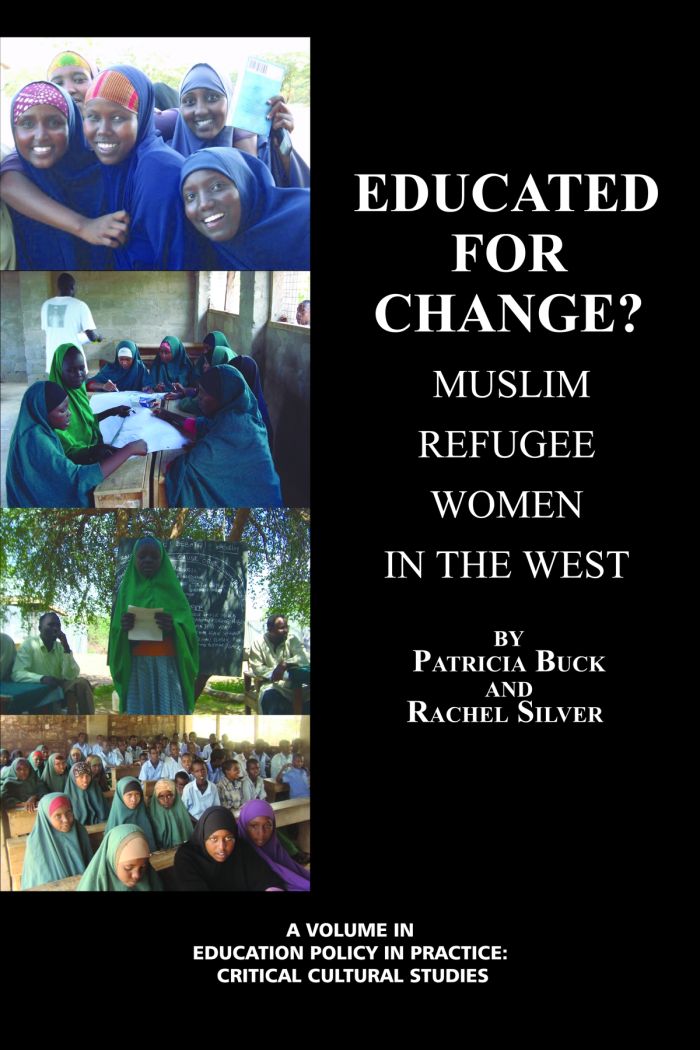
Educated for Change?: Muslim Women in the West inserts Muslim women’s voice and action into the bifurcated, and otherwise male dominated, relations between the West and the Islamic East. A multilayered, multisite, educational ethnography, Buck and Silver’s study takes a novel approach to its feminist charge. Drawing upon thick description of refugee women’s school experiences in two seemingly distinct locations, Educated for Change? engages the dual nature of schooling as at once a disciplinary apparatus of local, national, and international governance, and paradoxically, a space and process through which school community members wield the power to observe, deliberate, and act as agents in the creative and willful endeavor of living. In doing so, the text locates formal schooling as a key location at which one can witness the politics of cultural change that emerge when Western and Islamic communities converge.
Following an initial introduction to the ethno-historical formation and dissolution of the Somali postcolonial state resulting in a prolonged exodus of Somali citizens, the text is divided into two parts. Part One features an examination of young women’s approaches to schooling in the Dadaab refugee camps of northeastern Kenya; Part Two looks at schooling among Somali women resettled in a northern region of the United States. Each part includes a description of the unique, if interconnected, local factors and policies that give rise to particular forms and ends of schooling as designed for refugee women. Several chapters depict women’s strategic use of schooling to respond to structural forces, build intercultural social networks, and negotiate new ways of being Somali women.
Educated for Change? concludes with an analysis of the implications of Somali refugee women’s schooling experiences for working definitions of global social justice that undergird feminist political scholarship and gender-sensitive, humanitarian aid policy and practice.
Foreword; Bradley A. U. Levinson and Margaret Sutton.
- Series Editors' Introduction: Recentering the Critical in Sociocultural Ethnographic Studies; Rodney Hopson & Edmund T. Hamann.
- Chapter 1. In the Confluence of Islamic East and West: Muslim Girls and Women in School
- Chapter 2. Somalia: Tracing a Contested Traditionalism.
- Chapter 3. "If Any Culture Is in Need of Change, It's Somali Culture": Enlightenment and Girls' and Women's Empowerment in the Dadaab Refugee
- Chapter 4. Negotiating the Dadaab Landscape: Refugees Respond to Polarity in Dadaab.
- Chapter 5. Somali Refugee Girls and Women in School.
- Chapter 6. "The Culture Will Change as the World Changes": Using School to Navigate the Global Era.
- Chapter 7. Dialogues of Change.
- Chapter 8. Bridge: From Dadaab to Milltown.
- Chapter 9. The United States and Milltown: Traditionalism, Liberalism, & Nativism
- Chapter 10. Somali Women in U.S. Schools.
- Chapter 11. Crafting Identity Through Community Building.
- Chapter 12. "You Better Say Your Prayers Before Prayers Are Said for You": Negotiating and Regulating Gender Change.
- Chapter 13. Educated for Change?: Some Concluding Thoughts.
- Afterword: Final Reflections on Our Project.
- References.
- About the Authors.