
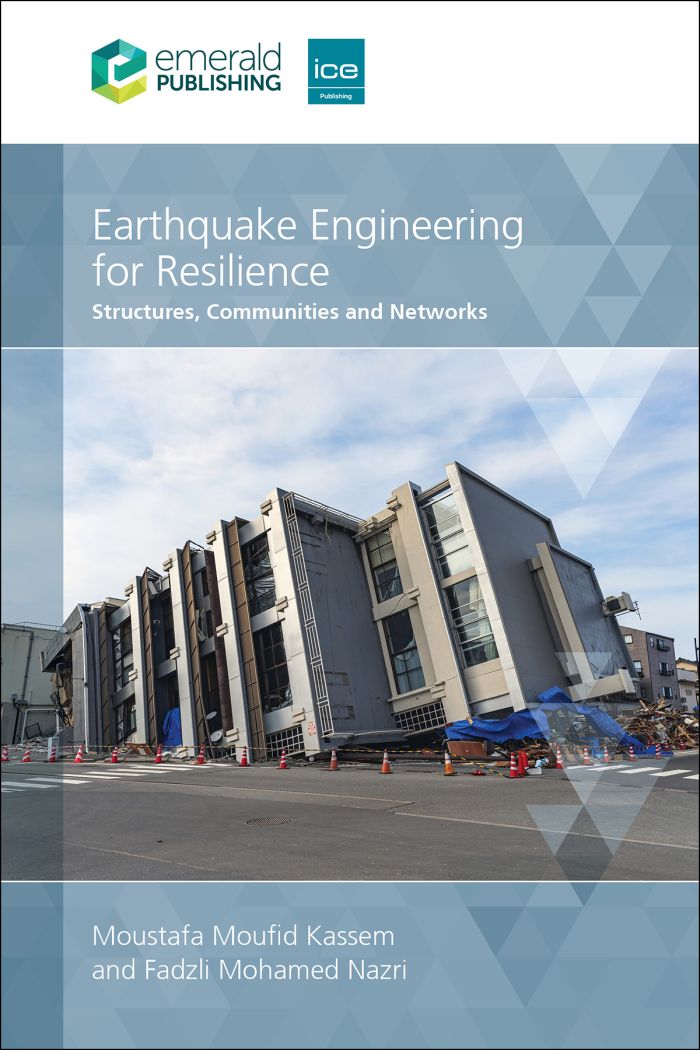
Earthquake Engineering for Resilience
Structures, Communities and Networks

This book can be opened with

Note on our eBooks and Audiobooks: you can read our eBooks (ePUB or PDF) and listen to audiobooks on the free Emerald Books app on iOS, Android, and desktop. Or read and listen on Emerald's online reader (ePUB eBooks and audiobooks only). To purchase a digital book you will need to create an account if you don’t already have one. After purchasing you will receive instructions on how to get started.
- Description
- Contents
- About
Earthquake Engineering for Resilience: Structures, Communities and Networks presents a multi-scale framework for assessing seismic vulnerability and improving resilience across buildings, communities and critical infrastructure networks. Bridging engineering, urban planning, and disaster management perspectives, the framework addresses the full spectrum of earthquake impacts - from immediate structural damage to prolonged service disruption and community recovery.
The book integrates four essential methodologies: analytical modelling, empirical assessment, functionality-based recovery analysis and vulnerability evaluation. Organised across three interconnected levels - structures, communities and infrastructure systems – the chapters offer scalable, practical tools for researchers and practitioners. International case studies, including an example from Penang Island, Malaysia, illustrate how the framework can effectively guide resilience planning in both data-rich and data-scarce contexts.
Combining technical rigor with accessible explanations and real-world applications, Earthquake Engineering for Resilience is suitable for graduate students, researchers and practicing engineers in structural and earthquake engineering, as well as urban planners, disaster risk managers and policymakers.
Preface
- Chapter 1. Earthquake-Resilient Design: Balancing Safety and Analytical Vulnerability Models
- Chapter 2. Empirical Approaches to Structural Seismic Vulnerability: Index-Based Methods and Practical Applications
- Chapter 3. Analytical Approaches to Structural Seismic Vulnerability: Mechanics-Based Modeling and Theoretical Frameworks
- Chapter 4. Frameworks and Challenges in Assessing Community Seismic Resilience
- Chapter 5. Framework for Seismic Risk and Access Disruption Analysis in Road Infrastructure
- Chapter 6. Seismic Resilience: Challenges and Future Directions
Prof. Fadzli Mohamed Nazri is a Professor of Civil Engineering at Universiti Sains Malaysia (USM). His expertise lies in structural and earthquake engineering, with particular emphasis on seismic performance evaluation, resilience-based design, and infrastructure safety. He has led and contributed to numerous research projects related to seismic vulnerability assessment and disaster risk mitigation. Prof. Fadzli has published widely in international journals and has supervised numerous postgraduate students. His work supports the advancement of resilient infrastructure systems and evidence-based seismic design practices.
Dr. Moustafa Moufid Kassem is a Senior Lecturer in the Department of Civil Engineering at Universiti Malaya, Malaysia. His research focuses on earthquake engineering, seismic vulnerability and resilience assessment, and performance-based analysis of buildings and infrastructure systems. He has published extensively on seismic fragility modeling, recovery-based resilience evaluation, and transportation network performance under seismic hazards. Dr. Kassem is actively involved in interdisciplinary research and aims to bridge analytical modeling with practical applications for disaster risk reduction and sustainable infrastructure development.