
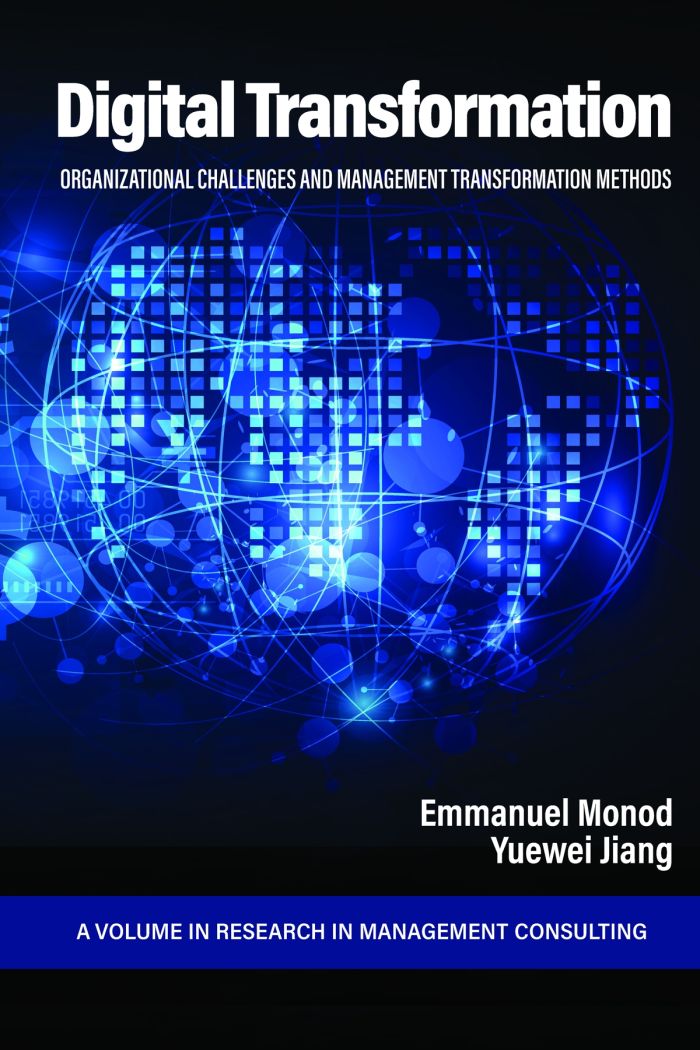
Digital Transformation
Organizational Challenges and Management Transformation Methods

This book can be opened with

Note on our eBooks and Audiobooks: you can read our eBooks (ePUB or PDF) and listen to audiobooks on the free Emerald Books app on iOS, Android, and desktop. Or read and listen on Emerald's online reader (ePUB eBooks and audiobooks only). To purchase a digital book you will need to create an account if you don’t already have one. After purchasing you will receive instructions on how to get started.
- Description
- Contents
Whereas digital transformation, considered from the standpoint of strategy, suggests a direct link with business benefits, questions linger about the implementation of digital technologies that often result in a lack of return on investment. Many consulting trends adopt a technology-centered approach, assuming that AI, IoT, data analytics, or robotics, would lead to business performance. Yet, most of the time, organizational factors are neglected, especially hidden costs or hidden work. Moreover, unexpected consequences are overlooked, such as resistance to change. Digital transformation is a practical problem for managers. Are IS implementation approaches such as agile methods to Socio-Technical Systems (STS) sufficient to tackle these issues? This book suggests starting from organizational transformation, in essence, independently from technology with methods such as Business Process Management (BPM), Socio-Economic Approaches to Management (SEAM) or Organizational Development (OD).
Overall, whereas technology-centered approaches have been associated with numerous unintended consequences and failures with previous generations of technologies (e.g., ERP or KMS), process-centered and human-centered approaches may represent a less risky approach to digital transformation implementation.
This volume focuses on evaluating the potential performance improvements and risks of digital transformation and ways to assess how technology may support work and organizational goals. Therefore, whereas written by both academics and practitioners, this book has been written for all managers in companies and institutions in order to help them achieve digital transformation success.
Editor's Note; David Szabla.
- Foreword: Broadening Our Sight to Digital Transformation in Management Research; H. Aguinis.
- Introduction: Digital Transformation: From Technology to Stakeholders; E. Monod.
- Part I: Digital Transformation: Which Management Methods?
- Chapter 1. Socio-economic Approach To Management (SEAM) Applied To Digitalization Transformation Processes: Qualimetrics Intervention-research Case Studies; Henri Savall, Veronique Zardet, Marc Bonnet, and Anthony F. Buono.
- Chapter 2. Digital Transformation: A Strategic Perspective; Daniel Degravel.
- Chapter 3. Digital Transformation and Organizational Development (OD); Uzonna Olumba.
- Part II: Implementation And Humans In Digital Transformation.
- Chapter 4. AI and Human Resources: Practices and Questions; F. Chevalier.
- Chapter 5. AI Implementation Issues; E. Monod, R. Lissilour, and E. Joyce.
- Chapter 6. Focus on Front-Line Employees When Implementing Digital Transformation; Eric Sanders.
- Chapter 7. AI Talent: From a Technology-Driven Perspective to an Organizational Transformation Perspective; E. Monod, J. Qi, Pan, H., D. Straub, A. Köster, N. Koroktova, and E. Joyce.
- Part III: Digital Healthcare
- Chapter 8. Digital Transformation In Healthcare: Relational Intelligence And Change Management; Shola Ajiboye.
- Chapter 9. Digital Transformation in Healthcare: The Past, Promises, Problems, and Potential; R. Greenhill and E. O'Connor.
- Part IV: Digital Banking And Services.
- Chapter 10. Barriers to a Successful Digital Transformation and How to Mitigate Them: Insights From the Banking Industry; A.-S. Mayer and F. Strich.
- Chapter 11. Digital Language Education: A Case in China; L. Shen.
- Chapter 12. Digital Transformation in Real Estate in China; H. Liu.
- Part V: Digital Manufacturing.
- Chapter 13. AI in Quality Management in Manufacturing Industry: Case Studies in China; Tony Huang and E. Bai.
- Chapter 14. Digital Transformation in Implanted Medical Device Industry in China; Y. (Joe) Tong.
- Part VI: Digital Fashion And AI In Movie Industry.
- Chapter 15. Chinese AI in the Film Industry: A Case Study in China; Y. Yu.
- Chapter 16. AI in the Movie Industry: Risks, Costs, Knowledge-Sharing; L. (Joline) Zhou.
- Chapter 17. Digital Fashion: A Theoretical Overview; Emmanuel Monod.
- Part VII: Epilogue: A Paradox View?
- Chapter 18. Digital Transformation And Institutional Work: A Paradox View; Markus Philipp Zimmer, Abayomi Baiyere, And Hannu Salmela.