
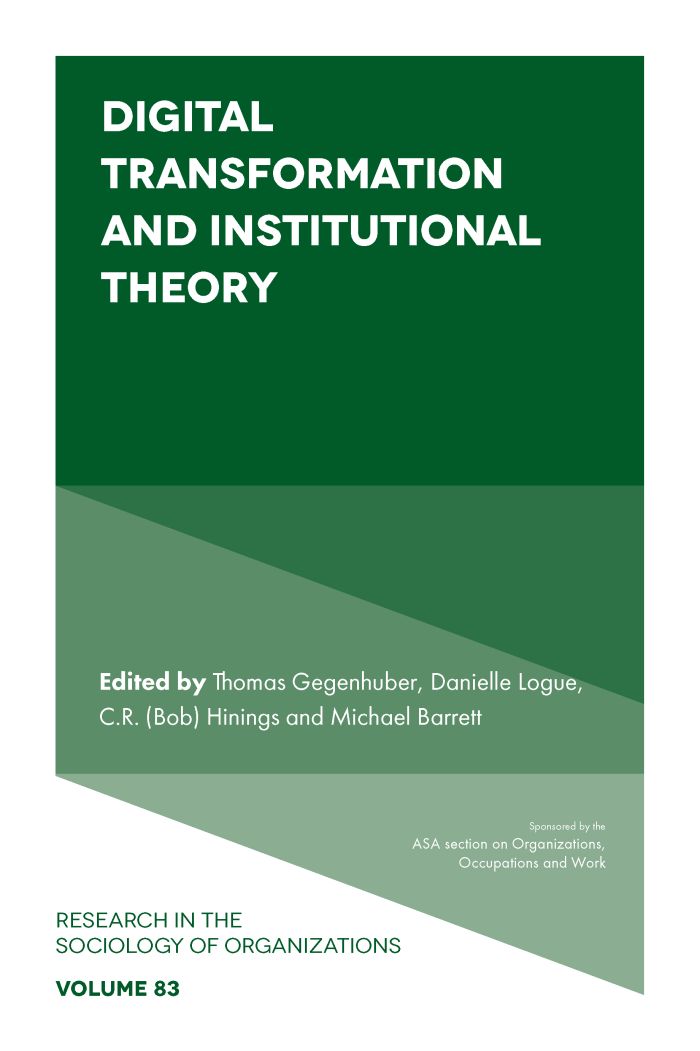

Digital Transformation and Institutional Theory

This book can be opened with

Note on our eBooks and Audiobooks: you can read our eBooks (ePUB or PDF) and listen to audiobooks on the free Emerald Books app on iOS, Android, and desktop. Or read and listen on Emerald's online reader (ePUB eBooks and audiobooks only). To purchase a digital book you will need to create an account if you don’t already have one. After purchasing you will receive instructions on how to get started.
- Description
- Contents
- About
This volume contains two Open Access chapters.
Digital transformation is permeating all domains of business and society. Digital Transformation and Institutional Theory explores how manifestations of digital transformation requires rethinking of our understanding and theorization of institutional processes. Showcasing a collaborative forum of organization and management theory scholars and information systems researchers, the authors enrich institutional theory approaches in understanding digital transformation.
Advancing institutional perspectives with an agenda for future research and methodological reflections, the chapters delve into digital transformations in relation to institutional logics and technological affordances, professional projects and new institutional agents, institutional infrastructure, and field governance. This volume deepens our understanding of the pervasive and increasingly important relationship between technology and institutions and the response of existing professions to the emergence of digital technologies. Moreover, the authors offer a cutting-edge analysis of how new digital organizational forms affect institutional fields, their infrastructure, and thus their governance.
Chapter 1. Institutional Perspectives on Digital Transformation; Thomas Gegenhuber, Danielle Logue, C.R. (Bob) Hinings, and Michael Barrett
- Section A. Empirical Studies
- Chapter 2. Institutional Logics, Technology Affordances and Hybrid Professionals: Developing a Billing App for Hospital Physicians; Robyn King, April L. Wright, David Smith, Alex Chaudhuri, and Leah Thompson
- Chapter 3. Digital Technology and Voice: How Platforms Shape Institutional Processes through Visibilization; Ali Aslan Gümüsay, Mia Raynard, Oana Albu, Michael Etter, and Thomas Roulet OPEN ACCESS
- Chapter 4. Augmenting a Profession: How Data Analytics is Transforming Human Resource Management; Georg Loscher and Verena Bader
- Chapter 5. From Micro-level to Macro-level Legitimacy: Exploring How Judgments in Social Media Create Thematic Broadness at Meso-level; Laura Illia, Michael Etter, Katia Meggiorin, and Elanor Colleoni
- Chapter 6. Digitalisation versus Regulation: How Disruptive Digital Communication Technologies Alter Institutional Contexts through Public Interest Framing; Kerem Gurses, Basak Yakis-Douglas, and Pinar Ozcan
- Chapter 7. Representations of Self in the Digital Public Sphere: The Field of Social Impact Analyzed through Relational and Discursive Moves; Achim Oberg, Walter W. Powell, and Tino Schöllhorn
- Section B. Conceptual Contributions
- Chapter 8. Digital Technologies: Carrier or Trigger for Institutional Change in Digital Transformation?; Nicholas Berente and Stefan Seidel
- Chapter 9. Integrating Information Systems and Institutional Insights: Advancing the Conversation with Examples from Digital Health; Lee C. Jarvis, Rebekah Eden, April L. Wright, and Andrew Burton-Jones
- Chapter 10. The Institutional Logic of Digitalization; Henri Schildt OPEN ACCESS
Thomas Gegenhuber is Professor for the Management of Socio-Technical Transitions at Johannes Kepler University Linz and Visiting Professor at Leuphana University Lüneburg.
Danielle Logue is Associate Professor in Innovation, Entrepreneurship and Management at the University of Technology Sydney.
C.R. (Bob) Hinings is Professor Emeritus at the University of Alberta, Senior Research Mentor at the Haskayne School of Business, University of Calgary, a Fellow of Cambridge Digital Innovation, and an Honorary Research Fellow at the Judge School of Business, University of Cambridge.
Michael Barrett is Professor of Information Systems and Innovation Studies at Cambridge Judge Business School, University of Cambridge. He is also Academic Director of Cambridge Digital Innovation and Distinguished Visiting Professor of Innovation at the Stockholm School of Economics