
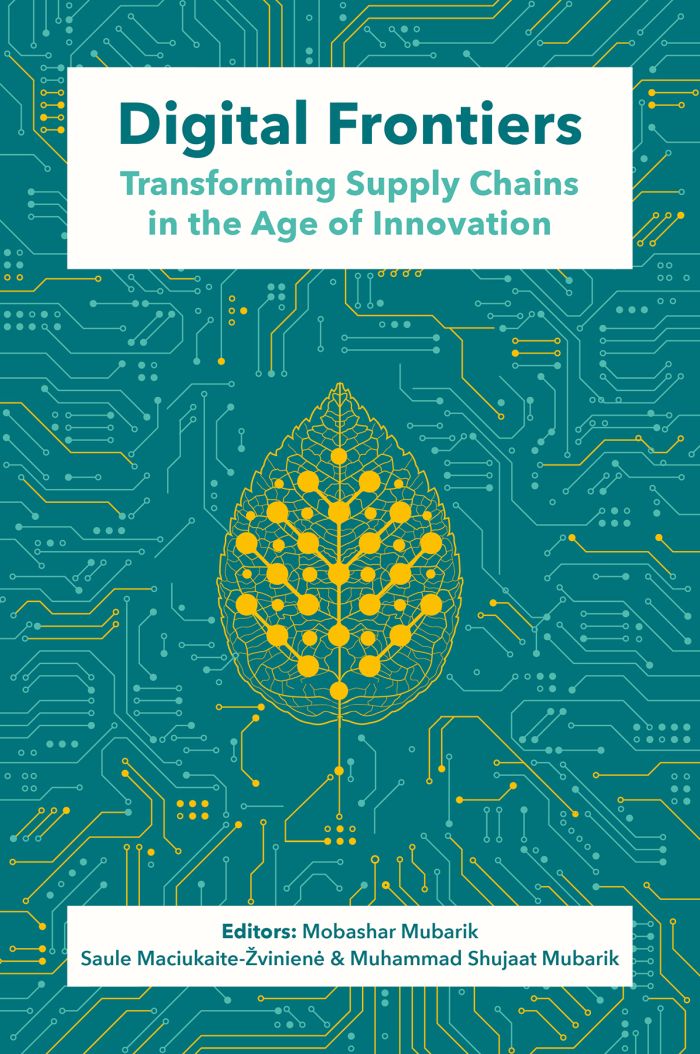
Digital Frontiers
Transforming Supply Chains in the Age of Innovation

This book can be opened with

Note on our eBooks and Audiobooks: you can read our eBooks (ePUB or PDF) and listen to audiobooks on the free Emerald Books app on iOS, Android, and desktop. Or read and listen on Emerald's online reader (ePUB eBooks and audiobooks only). To purchase a digital book you will need to create an account if you don’t already have one. After purchasing you will receive instructions on how to get started.
- Description
- Contents
- About
Digital technologies have become the backbone of modern enterprises, reshaping industries through intelligent automation, smart manufacturing, advanced analytics, and AI-enabled decision-making. They deliver unprecedented gains in efficiency and agility while enabling truly customer-centric operations and new forms of value creation. Among all business domains, supply chain management stands out as the arena where digital transformation is most visible, and most urgent, offering powerful levers to integrate networks, reduce risk, and compete sustainably.
The focus of this volume is on the transformative role of digital technologies in supply chain innovation. It aims to bridge the knowledge gap between existing supply chain innovation practices and the potential advancements digital innovations offer. Targeting both academics and industry professionals, the book explores as to how digital technologies are reshaping supply chain innovation, emphasizing the need for further research into their ethical and sustainability implications. A particular emphasis is placed on the importance of sustainability and ethical practices within digital supply chain innovation, aligning with global trends and helping businesses to not only advance their sustainability efforts but also build trust with consumers.
Section I. Foundations of Digital Supply Chains
- Chapter 1. The Digital Evolution of Supply Chains; Mobashar Mubarik and Saule Maciukaite-Zviniene
- Chapter 2. Blockchain for Transforming Supply Chains; Yağmur Ilayda Bahadi
- Section II. Technologies and Adaptive Networks
- Chapter 3. Role of AI in Global Supply Chain Networks to Navigate Disruption and Complexity; Muhammad Afruzur Rahman, Masood Fathi, Muhammad Faraz Mubarak, and Morteza Ghobakhloo
- Chapter 4. Digital Transformation in Supply Chains: Building Adaptive, Verifiable Supply Networks; Sonia Najam Shaikh, Jan Muhammad Sohu, and Fatima Zahra Kherazi
- Chapter 5. Patterns and Priorities of Upgrading in Supply Chain Networks; Mubarra Shabbir and Monika Petraite
- Section III. Governance, Ethics, and Digital Responsibility
- Chapter 6. Shaping the Digital Path: Leadership, Ethics, and Transparency in Supply Chains; Anna Lašáková and Muhammad Shujaat Mubarik
- Chapter 7. Strengthening Cybersecurity and Data Protection in Digital Supply Chains: Challenges, Strategies, and Future Directions; Silvi Asna Prestianawati, Axellina Muara Setyanti, Muhammad Fawwaz, Amran Rasli, and Rayhan Maulana Ryzan
- Chapter 8. Intellectual Capital and Digital Supply Chain Governance; Muhammad Shujaat Mubarik and Anna Lašáková
- Chapter 9. Open Innovation and Global Value Chains: Concepts, Clusters, and Global Insights; Monika Petraite, Muhammad Faraz Mubarak, Giedrius Jucevicius, and Mohd Abd Hafiz Zakaria
- Section IV. Sustainability, Soft Innovation, and Human-Centric Futures
- Chapter 10. Managing Sustainability Risk in Global Supply Chains: A Conceptual Model Integrating Technology and Stakeholder Engagement; Danguole Ozeliene
- Chapter 11. Soft Innovations for Hard Social Impact: How Communication Drives Sustainability Initiatives in the Supply Chain; Lina Jakučionienė and Renata Matkevičienė
- Chapter 12. Digital Innovations for Zero Waste and Circular Supply Chains; Maryam Khokhar, Yongrui Duan, Ihsan Thaheem, Bashir Muhammad, Anshuman Sharma, and Munaza Bibi
- Chapter 13. Democratized Innovation for Human-Centered Supply Chains in the Age of Digital Transformation; Muhammad Faraz Mubarak, Giedrius Jucevicius, and Richard Evans
- Section V. Strategic Outlook, Regulation, and Future Pathways
- Chapter 14. Climate Change and Early Warning Systems in Supply Chains: The Role of Central Banks; Ahmad Kaab Omeir and Deimante Vasiliauskaite
- Chapter 15. Regulation and Compliance in Digital Supply Chains; Mobashar Mubarik, Saule Maciukaite-Zviniene, Anna Pilkova, Sultan Alghamdi, Silvi Asna Prestianawati, and César Viloria-Núñez
- Chapter 16. Balancing Privacy and Promotion: Direct Marketing Strategies in a Regulated Digital World; Tadas Limba, Aurimas Šidlauskas, and Eglė Juozėnaitė
- Chapter 17. The Future of Digital Supply Chains: Resilience, Sustainability, and Human-Centric Transformation in the Innovation Age; Mobashar Mubarik, Saule Maciukaite-Zviniene, and Muhammad Shujaat Mubarik
Mobashar Mubarik is Assistant Professor at Bahria University in Karachi, Pakistan, and a Postdoctoral Fellow at Vilnius University, Lithuania.
Saule Maciukaite-Zviniene is a distinguished academic and influential figure in the realms of research, education, and policymaking.
Muhammad Shujaat Mubarik is currently serving as an Associate Professor of Logistics and Supply Chain Management at the Edinburgh Business School, Heriot-Watt University, UK. He is also Visiting Scholar at Dept. of Land Economy, University of Cambridge UK.