
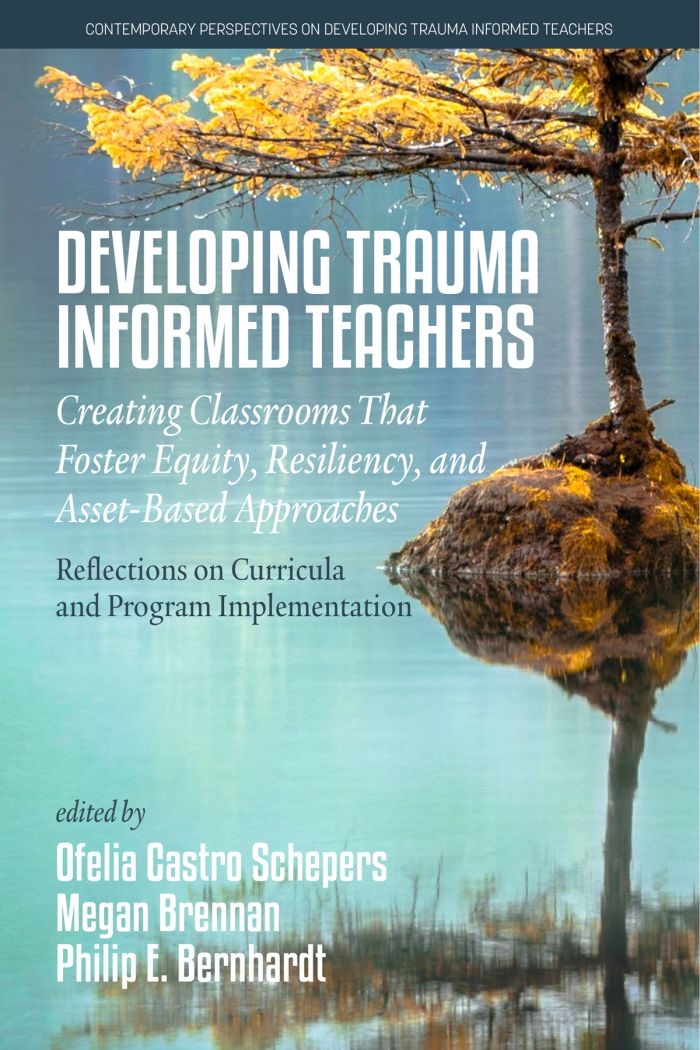
Developing Trauma-Informed Teachers
Creating Classrooms that Foster Equity, Resiliency, and Asset-Based Approaches: Reflections on Curricula and Program Implementation

This book can be opened with

Note on our eBooks and Audiobooks: you can read our eBooks (ePUB or PDF) and listen to audiobooks on the free Emerald Books app on iOS, Android, and desktop. Or read and listen on Emerald's online reader (ePUB eBooks and audiobooks only). To purchase a digital book you will need to create an account if you don’t already have one. After purchasing you will receive instructions on how to get started.
- Description
- Contents
Trauma is a public health crisis. High rates of trauma exposure among youth and the impact that experiences of trauma can have on students’ psychosocial and academic outcomes are well-established. These traumatic events do not live outside of the scope of schools and teaching. As children and teachers develop communities within their classrooms and schools, trauma comes with those who have experienced it, whether invited or not (Bien & Dutro, 2014). This extended time that teachers spend with students inherently provides opportunity to witness students’ lived experiences (Caringi et al., 2015; Motta, 2012). These experiences capture many facets of students’ lives, including traumatic events; however, many teachers indicate that they feel unprepared to address students who have experienced trauma in meaningful and sustainable ways (Caringi et al, 2015). In response, many schools and districts have adopted trauma-informed practices (Overstreet & Chafouleas, 2016).
This text addresses the gap in the literature in embedding trauma-informed practices into pre-service teacher education. This text provides examples of the various ways educator preparation faculty are developing and implementing trauma-informed practices across their programs, instituting broader curricular shifts to incorporate trauma-informed practices, shifting pedagogical practices to include trauma-informed practices and collaborating across disciplines in order to ensure that teacher candidates are thoughtfully prepared to address students’ needs and create classroom environments that are equitable, safe and sustainable for students and teachers.
Foreword; Joyce Dorado and Martha Merchant.
- Introduction.
- Chapter 1. Our Stories Belong Here; Ellie Haberl Foster.
- Chapter 2. Embedding Trauma-Informed Practices in Early Childhood and Elementary Teacher Education Courses; Ingrid Carter and Dorothy Shapland.
- Chapter 3. Putting the Pieces Together: Developing a Trauma-Informed Care Classroom; Tamarine Foreman and Perianne Bates.
- Chapter 4. Trauma-Informed Teacher Education: Blending Restorative Practices, Classroom Community, and Standards for Social and Emotional Learning; Romena M. Garrett Holbert and Amber Boddie.
- Chapter 5. Preparing Preservice Teachers to Develop Elementary Students' Resiliency Through Empathy, Writing, and Diverse Picture Books; Tracey S. Hodges and Holly Hilboldt Swain.
- Chapter 6. The TIP of the Iceberg: Trauma-Informed Practices in Education; Shirley Huisman, Amanda Stefanski, Jenny Johansson, and Jennifer Dollar.
- Chapter 7. Improving the Use of Social Emotional Learning and Trauma-Informed Practices in Teacher Education; Megan N. Lyons, Nigel P. Pierce, and Freda Hicks.
- Chapter 8. Authentic Collaboration in Special Education Teacher Preparation Programs Creates Trauma-Informed Teaching Professionals; Tara Mason.
- Chapter 9. Preparing Preservice Teachers for Complex Emergencies: Learning From Traumatic Events in New Zealand; Carol Mutch, Sophie Peung, and Rori Baird.
- Chapter 10. How a Small, Liberal Arts University Seeks to Create Socially Conscious, Resilient Teachers; Michele M. Nobel.
- Chapter 11. Trauma-Informed Practices in Early Childhood Education: Preparing Those Who Care for Our Youngest Learners; Megan L. Purcell and Karen Ruprecht.
- Chapter 12. Interdisciplinary Personnel Preparation and Positive Change in Trauma-Informed Policy and Practice; Mary Schuh, David Hagner, JoAnne Malloy, Stacy Champey, Theresa Georges, and Stacey Cooper-Jennings.
- Chapter 13. An Excellent TIP for Everyone: Broadening Trauma-Informed Practice With Life-Worlds Pedagogy; Brenda Seals and Greg Seals.
- Chapter 14. Integrating Trauma-Informed Teaching Practices Throughout an Early Childhood Education Program to Support Teacher Education Students; Dorothy Shapland, Rosemarie Allen, Stacy Cook-LaPointe, and Elmer Harris.
- Chapter 15. Introducing a Trauma-Informed Course to Teacher Education in England: Opportunities and Dilemmas; Lynne Truelove and Mark Boylan.
- Chapter 16. Incorporating Trauma-Informed Practices Into One Teacher Education Program: Convenience, Intentionality, and Institutionalization; Kathryn Young, Ofelia Castro Schepers, and Anna Joseph.
- About the Editors.
- About the Contributors.