
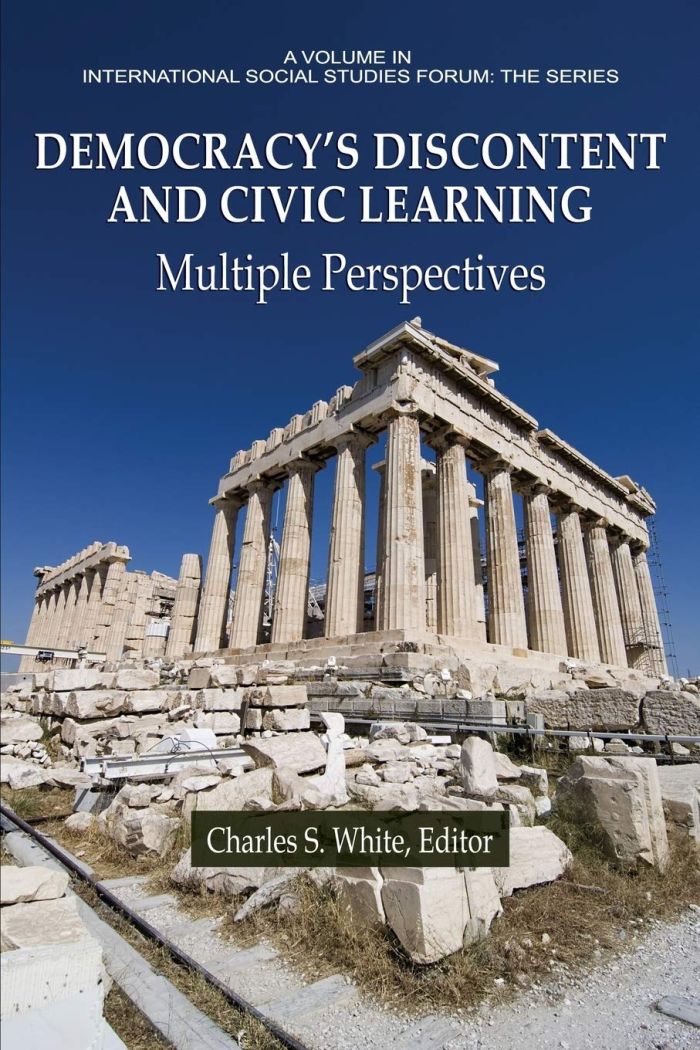
Democracy's Discontent and Civic Learning
Multiple Perspectives

This book can be opened with

Note on our eBooks and Audiobooks: you can read our eBooks (ePUB or PDF) and listen to audiobooks on the free Emerald Books app on iOS, Android, and desktop. Or read and listen on Emerald's online reader (ePUB eBooks and audiobooks only). To purchase a digital book you will need to create an account if you don’t already have one. After purchasing you will receive instructions on how to get started.
- Description
- Contents
Around the globe, democracy is under assault. For a dozen years, global freedom has followed a downward slope, according to Freedom House. Once viewed as the world’s model of freedom, the United States has slipped in world ratings of democracy. For a rising portion of the world’s population, faith in democracy is flagging. At the same time, a wave of nationalism and xenophobia is rising in the West, questioning democracy’s ability to meet the needs of its citizens.
The contributors to this volume examine democracy’s discontent from a variety of perspectives. What forces have produced the extreme partisanship and polarization roiling America’s civic life and politics? How has today’s populist movement challenged democratic norms and institutions? What role has social media played in democracy’s discontent and its defense? How do we overcome persistent racism in the face of emboldened White supremacist and anti-immigrant agitation?
Across the pages of this book, teachers, teacher educators, and education policy makers will recognize a common theme in responding to democracy’s discontent – the need to rebuild the nation’s civic infrastructure. Research on best practices in civic learning and engagement serve as a guide to transforming how we prepare citizens for democratic deliberation and civic action. Creative and effective teaching materials and approaches await only the will to invest the needed time and support. Repairing our civic infrastructure will help to restore confidence in our civic capabilities and trust in our ability to work together for the public good. Without a serious recommitment to the civic mission of schools, the nation will be ill prepared to defend against those within and beyond our borders who are intent on undermining democracy.
Preface.
- Acknowledgments.
- Chapter 1. The Populist Moment; William A. Galston.
- Chapter 2. Populism, Democracy, and the Education of Citizens; Thomas S. Vontz and J. Spencer Clark (with Stephen L. Schechter).
- Chapter 3. Are Europe's Democracies in Danger? A View of the Populist Challenge; Karlheinz Duerr.
- Chapter 4. Confronting a Global Democracy Recession: The Role of United States International Democracy Support Programs; Liza Prendergast.
- Chapter 5. Democracy's Pharmakon: Technology as Remedy and Poison; Charles S. White.
- Chapter 6. Judicial Legitimacy in the Age of Populism; Alison Staudinger.
- Chapter 7. Fulfilling the Promise of Democracy: How Black Lives Matter Can Foster Empowered Civic Engagement; Amy J. Samuels and Gregory L. Samuels.
- Chapter 8. Does P-12 Educational Research Ameliorate or Perpetuate Inequity? Jacob S. Bennett.
- Chapter 9. Democracy's Discontent and Teacher Education: Countering Populism and Cultivating Democracy; Stephanie Schroeder.
- Chapter 10. A Primer on Trump Economics: Populist or Something Else? James E. Davis.
- Chapter 11. Going for Depth in Civic Education: A Design Experiment; Walter C. Parker.
- Reactions to Parker's Going for Depth in Civic Education.
- Chapter 11a. What Public Philosophy Should We Teach? A Reply to Parker; Peter Levine.
- Chapter 11b. Fidelity of Implementation: A Reply to Parker; James E. Davis.
- Chapter 11c. Contrasting Landscapes: A Reply to Parker; Karlheinz Duerr.
- Chapter 12. Resources for the Effective Teaching of Civics and American History.
- Chapter 13. Conclusion.
- Book Review.
- How the Second Cold War Began: A Review of Authoritarianism Goes Global, Larry Diamond, Marc F. Plattner, Christopher Walker; Reviewed by Thomas O. Melia.
- About the Authors.