
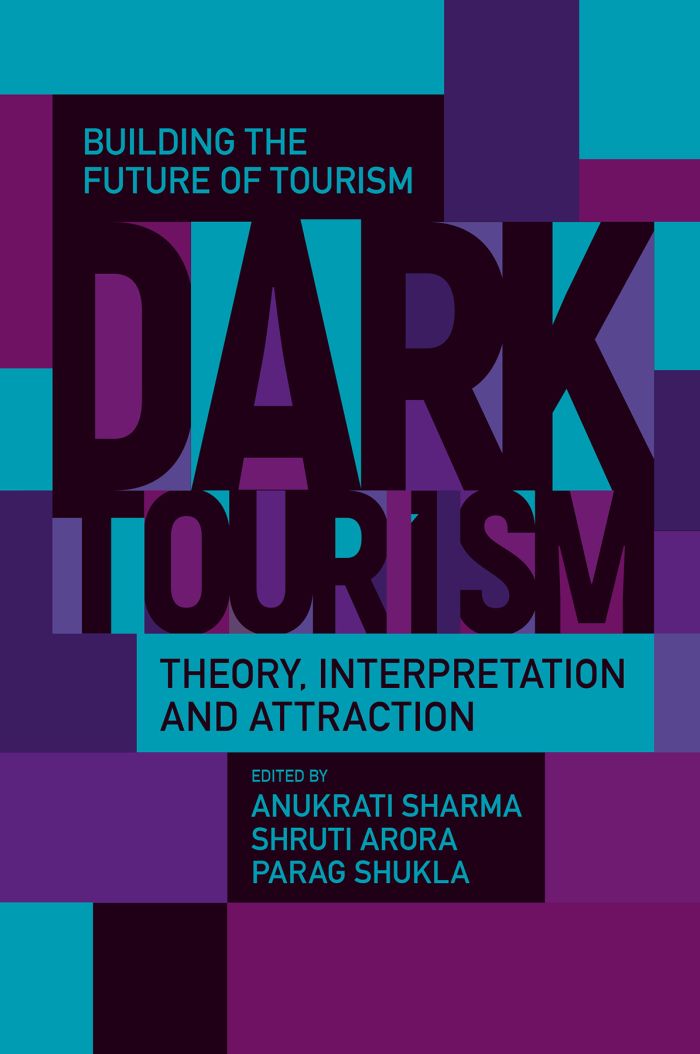

Dark Tourism
Theory, Interpretation and Attraction

This book can be opened with

Note on our eBooks and Audiobooks: you can read our eBooks (ePUB or PDF) and listen to audiobooks on the free Emerald Books app on iOS, Android, and desktop. Or read and listen on Emerald's online reader (ePUB eBooks and audiobooks only). To purchase a digital book you will need to create an account if you don’t already have one. After purchasing you will receive instructions on how to get started.
- Description
- Contents
- About
Dark Tourism has seen a surge in popularity in the last decade as people seek a richer travel experience, choosing to meaningfully engage with humankind’s more troubling heritage, rather than opting for merely escapist vacations. It is a genre of tourism that has received increased attention in recent years, an umbrella concept for travel to sites that are associated with death and suffering, such as battlefields, prisons, and slave forts.
Despite the somewhat morbid nature of many Dark Tourism sites, there is also a positive side. Such sites provide visitors with a chance to reflect on cataclysmic events and draw their own life lessons from events of the past.
Dark Tourism: Theory, Interpretation and Attraction is an edited volume drawing on content from around the world. It is relevant for students, scholars, and academicians associated with the fields of memorialization and morality death studies, history, cultural studies, psychology, business management, museology, and heritage tourism studies, as well as religious studies.
Chapter 1. Unveiling the Significance of Irish Workhouses as Captivating Tourism Destinations; Beth Storey, Sinead O’Leary, and Noëlle O'Connor
- Chapter 2. Dark Tourism, Memory, and the Reproduction of National Identity: The National September 11th Museum; Michael Clancy
- Chapter 3. Dark Tourism: Educational or Exploitative Side of Tourism?; Iti Gaur
- Chapter 4. Prison Tourism: The Emotional Responses to Robben Island, South Africa; Rami K. Isaac
- Chapter 5. Dark Attraction Sites: Understanding Motivations, Intentions, and Behaviors of Tourists; Neelima Modi and Priya Sodani
- Chapter 6. Battlefield Guidance from a New Angle; Seda Sökmen, Aslı Bendenay Çapa, and Semra Günay
- Chapter 7. Exploring Marketing Strategies and Media Influences in Dark Tourism; Jeetesh Kumar, Janitha Kularajasingam, and Zhang Jieyao
- Chapter 8. The Impact of Dark Tourism on Local Communities; Ankit Dhiraj, Sanjeev Kumar, and Divya Rani
- Chapter 9. Dark Tourism, an Absolute Transition, a Great Reset to Propel Reconciliation: The Case of Jaffna War Zones; Suduweli Kondage Lathisha Jayangi Ramanayaka
- Chapter 10. Issues and Challenges of Dark Tourism; Birendra Kishore Roy
- Chapter 11. Dark tourism in Vietnam: A case of Hoa Lo Prison Relic; Hanh Thi Pham
- Chapter 12. Chambal Valley, the Myth, the Curse, the Legend, the Challenges, the Opportunities, for Dark Tourism, Case Study; Shaheed Khan, Freeda Maria Swarna M., and Ajoy K Bhattacharya
- Chapter 13. Marketing Strategies of Dark Tourism: Social Media; Burhan Kiliç and Hande Akyurt Kurnaz
- Chapter 14. Enlightening the “Dark” in Dark Tourism: Re-conceptualising Dark Tourism in the Era of Late Capitalism; Max Hart, Craig Kelly, and Adam Lynes
- Chapter 15. 'Bawaal' Movie an Experience of Dark Tourism for the Indian Audience; Surbhi Sharma
- Chapter 16. Unexplored Avenues of Dark Tourism in Bangladesh; Md. Wasiul Islam, Md. Mahfuz Ur Rahman, and Shakil Ahmed
- Chapter 17. Reviving Forgotten Heritage as a Tourist Destination - A Case Study on Malcha Mahal Haunted Heritage Walks in Delhi; Terrance Ancheary, Puneet Mehta, and Anish Mondal
- Chapter 18. Conceptual Multiplicity and Contradiction that Impede Dark Tourism Promotion; Samik Ray
- Chapter 19. Unearthing the Digital Dark: Enhancing Dark Tourism through Online Platforms; Shruti Sharma and Nidhi Sharma
- Chapter 20. Unveiling Shadows: Prospects for Dark Tourism Development in India; Ravi Kant Modi and Ruchi Garg
- Chapter 21. Uncovering Psychological Shadows: Delving into the Soul of Dark Tourism in India through Narrative Inquiry; Neharshi Srivastava
Anukrati Sharma, Ph.D. is Associate Professor in the Department of Commerce and Management at the University of Kota, Rajasthan, India. She is the Director of the Skill Development Centre of the same University. She is also Dean (Honorary) of Tourism and Hospitality at Vishwakarma Skills University, Jaipur (A Govt. State University). Dr. Sharma is a Routledge featured author. Dr. Sharma is the Book Series Editor for 'Building the Future of Tourism' published by Emerald Publishing. U.K. and Entrepreneurship and Technology in Tourism and Hospitality, Emerald Publishing. U.K. She is also the Book Series Editor of “Routledge Insights in Tourism Series”, Routledge, U.K. She also serves as Book Series Editor for 'CABI Festival and Event Tourism and Hospitality Series (FETHS)' and 'Perspectives and Anthropology in Tourism and Hospitality (PATH)', Apple Academic Press (CRC Press a Taylor and Francis Group).
Shruti Arora, Ph.D., Guest Faculty, Department of Commerce and Management, University of Kota, Rajasthan, India.
Parag Shukla, Ph.D., Assistant Professor, Department of Commerce and Business Management, The Maharaja Sayajirao University of Baroda, Vadodara, Gujarat, India.