
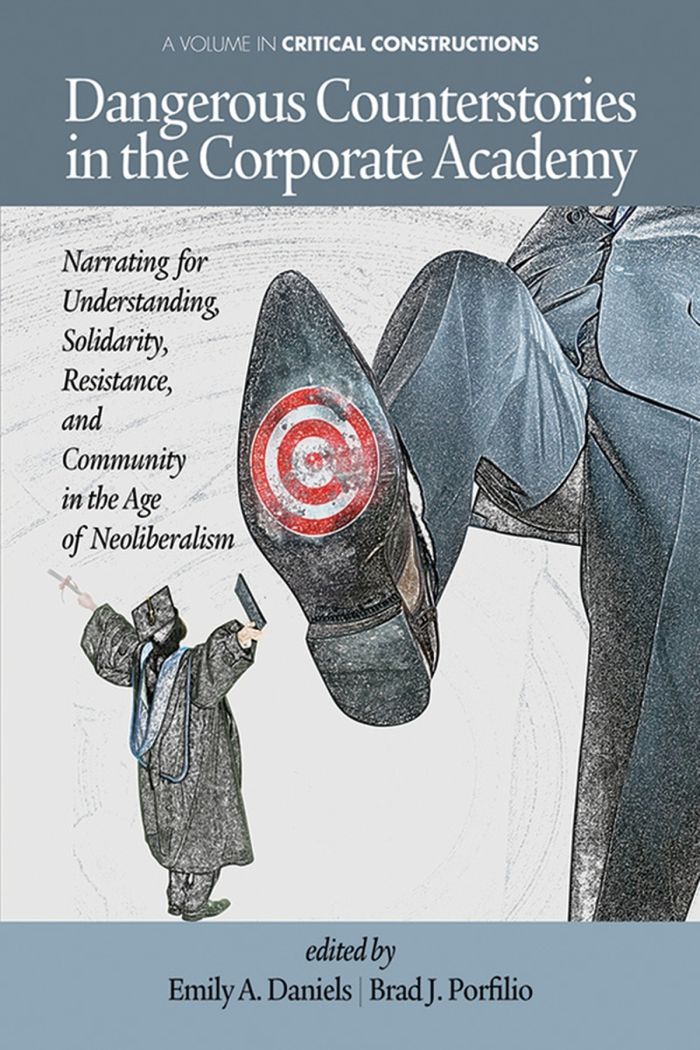
Dangerous Counterstories in the Corporate Academy
Narrating for Understanding, Solidarity, Resistance, and Community in the Age of Neoliberalism

This book can be opened with

Note on our eBooks and Audiobooks: you can read our eBooks (ePUB or PDF) and listen to audiobooks on the free Emerald Books app on iOS, Android, and desktop. Or read and listen on Emerald's online reader (ePUB eBooks and audiobooks only). To purchase a digital book you will need to create an account if you don’t already have one. After purchasing you will receive instructions on how to get started.
- Description
- Contents
Although the social reality is stark for progressive scholars who engage in scholarly activities or are committed to guiding their students to develop a social-just praxis in the circles of higher education, some scholars have found fissures amid the alienating, often hostile academic world to learn, grow, and create transformative communities. Up to this date, however, their stories have not been captured. Therefore, the purpose of this volume is to highlight alternative narratives generated by transformative scholars who have maintained their oppositional identity to the structures that oppress the vast majority of citizens. By bringing together these narratives, we focus on those who have joined with likeminded colleagues to teach, engage in activism, and conduct emancipatory forms of research, learning to negotiate and survive academic and corporate realities in spite of restrictive climates.
Not only are these stories vital for helping students, academics, and the wider community understand how commercialized forces are impacting the professional lives of critical scholars in the academy, they have the power to help current and future critical pedagogues define (and redefine) themselves in a social world which is continually 'promoting a narrow and intellectually stifling agenda for the role of education and turning the public against the very idea of a critical education' (McLaren, 2006). As stated by Bruner (1986) stories give 'a map of possible roles and possible worlds in which action, thought, and self-definition are possible (or desirable)' (p. 2, cited in Collins & Cooper, 2005). These possibilities for definition and redefinition are what we seek to present, explore and understand.
Introduction.
- Part I. Students and the Neoliberal Institution
- Chapter 1. Breaking the Bank: Stories of Financial, Cultural and Academic Struggle from First-generation College Students, Carrie Freie.
- Chapter 2. Fear in the Academy, Tina Wagle.
- Chapter 3. Dangerous White Lady, Shelley Jensen.
- Part II. Surviving the Institution: Classroom Resistance(s)
- Chapter 4. College Curriculum as Counter Discourse: The California Immigration Semester at Occidental College, Richard Mora, Mary Christianakis, & Salvador C. Fernández.
- Chapter 5. A Tale of the Teacher Educator and the Storyteller: Returning Stories to the Social Studies Classroom, Sarah A. Robert, Heather Killelea McEntarfer, & Karima Amin.
- Chapter 6. Our Excellent Adventures with NCATE: Stories of Struggle, Resistance, and Hope, Leigh O'Brien & Sue Novinger.
- Chapter 7. Autoethnography and the Emergent Public: Counterstories from a Community College Classroom, Jeanne Cameron.
- Part III. In the Belly of the Beast: Radical Scholars
- Chapter 8. Radical Scholar as Public Intellectual in a Marketplace of Ideas, Paul L. Thomas.
- Chapter 9. The Skunk in the Yogurt Cup: Postformal Academic Blues as Praxis, Tricia M. Kress.
- Chapter 10. The Personal is Political: Feminist Resistance to Neoliberalism in the Academy, Alison Happel.
- Chapter 11. How Do I Keep My Ideals and Still Teach? E. Wayne Ross, Rich Gibson, Greg Queen, & Kevin D. Vinson.
- Chapter 12. "Won't Back Down:" Counter-narratives of Visibility and Vulnerability in a Bleak House, William M. Reynolds.
- Chapter 13. Reflecting on Insider/Outsider Critiques of Teacher Education, or 'Don't Talk About My Momma', Jason Michael Lukasik & Brian D. Schultz.