
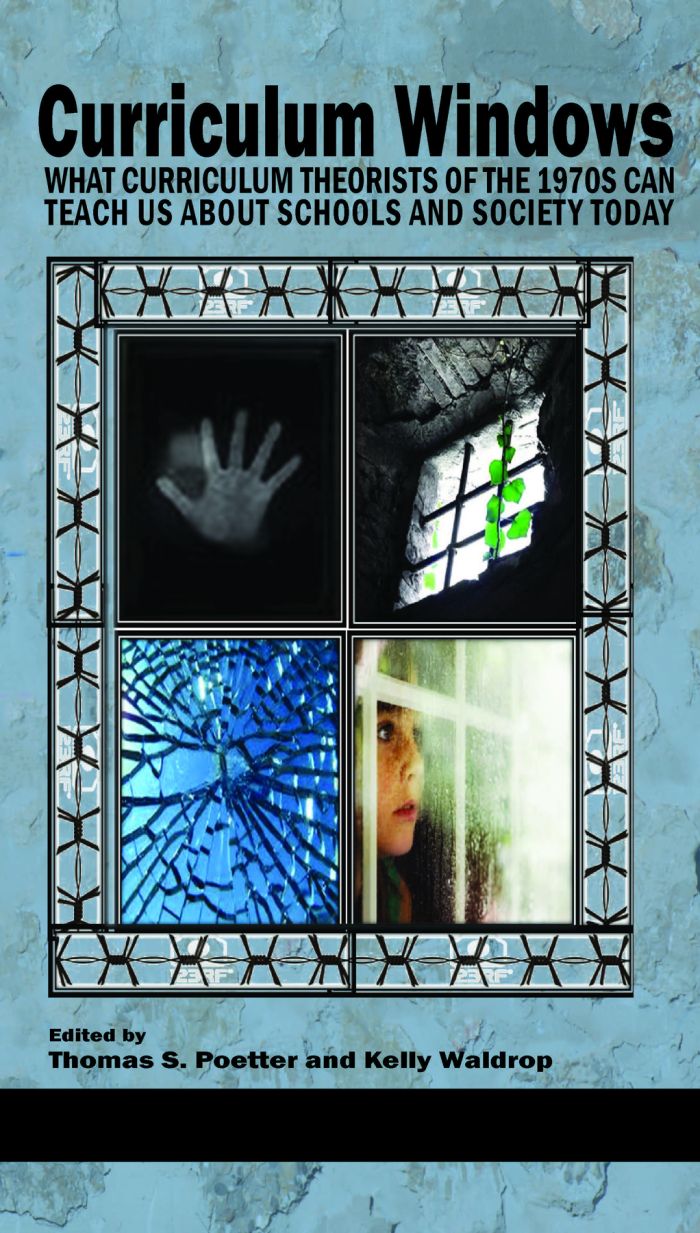
Curriculum Windows
What Curriculum Theorists of the 1970s Can Teach Us about Schools and Society Today

This book can be opened with

Note on our eBooks and Audiobooks: you can read our eBooks (ePUB or PDF) and listen to audiobooks on the free Emerald Books app on iOS, Android, and desktop. Or read and listen on Emerald's online reader (ePUB eBooks and audiobooks only). To purchase a digital book you will need to create an account if you don’t already have one. After purchasing you will receive instructions on how to get started.
- Description
- Contents
Curriculum Windows: What Curriculum Theorists of the 1970s Can Teach Us about Schools and Society Today is an effort by students of curriculum studies, along with their professor, to interpret and understand curriculum texts and theorists of the 1970s in contemporary terms. The authors explore how key books/authors from the curriculum field of the 1970s illuminate new possibilities forward for us as scholar educators today: How might the theories, practices, and ideas wrapped up in curriculum texts of the 1970s still resonate with us, allow us to see backward in time and forward in time – all at the same time? How might these figurative windows of insight, thought, ideas, fantasy, and fancy make us think differently about curriculum, teaching, learning, students, education, leadership, and schools? Further, how might they help us see more clearly, even perhaps put us on a path to correct the mistakes and missteps of intervening decades and of today? The chapter authors and editor revisit and interpret several of the most important works of the 1970s by Norman Overly, Michael Apple, Eliot Eisner, John Goodlad, Louise Berman, William Reid, Bill Pinar, Daniel Tanner, Laurel Tanner, Maxine Greene, James MacDonald, and Joseph Schwab.
Foreword: Meaningful Curriculum Windows from the 1970s, William H. Schubert.
- Preface, Kelly Waldrop.
- Introduction: Curriculum Windows of the 1970s—Coming of Age, Thomas S. Poetter.
- Chapter 1. Revealing the Hidden Through a Curriculum Window, Yue Li.
- Chapter 2. Eyes Wide Shut, Robert Hendricks.
- Chapter 3. The Second Read, Rayshawn L. Eastman.
- Chapter 4. Kaleidoscope Dreams: Amalgamating Tensions, Johnnie Jackson.
- Chapter 5. Mindlessness—It's Not So Crystal Clear, Ashley Nicole Warren.
- Chapter 6. STEAMing STEM: Insights from Joseph Schwab and the Ideal of a Liberal Education, Kurtz K. Miller.
- Chapter 7. In Whose Interest?, Crystal Donnette White.
- Chapter 8. My Lens, My Landscape, Yvania Garcia-Pusateri.
- Chapter 9. Through a Glass Darkly: History-onics and Moderation in Tanner and Tanner's (1975) Curriculum Development, Kelly Waldrop.
- Chapter 10. A Rainbow of Colors: My Life Experience, Currere Moments, and Curriculum Theorizing, Tela Bayamna.
- Chapter 11. Becoming a Whole Human, Angie Meissner.
- Chapter 12. Curriculum Problems and Professional Conscience in a Democratic Society, Angela Trubceac.
- Chapter 13. Open Your Windows—Window Shopper: (Re)Conceptualizing John I. Goodlad's Curriculum Inquiry via Gil Scott Heron and Hip-Hop, Brian W. Collier Jr.
- Chapter 14. Becoming an Educational Critic: Strap on Your Backpack, Ryan Denney.
- Chapter 15. The Two Way Mirror—Hidden Power and Veiled Dominance: A Call for Action, Amy Leonard Baldridge.
- Chapter 16. The Pursuit of Lifelong Learning, Deborah Heard.