
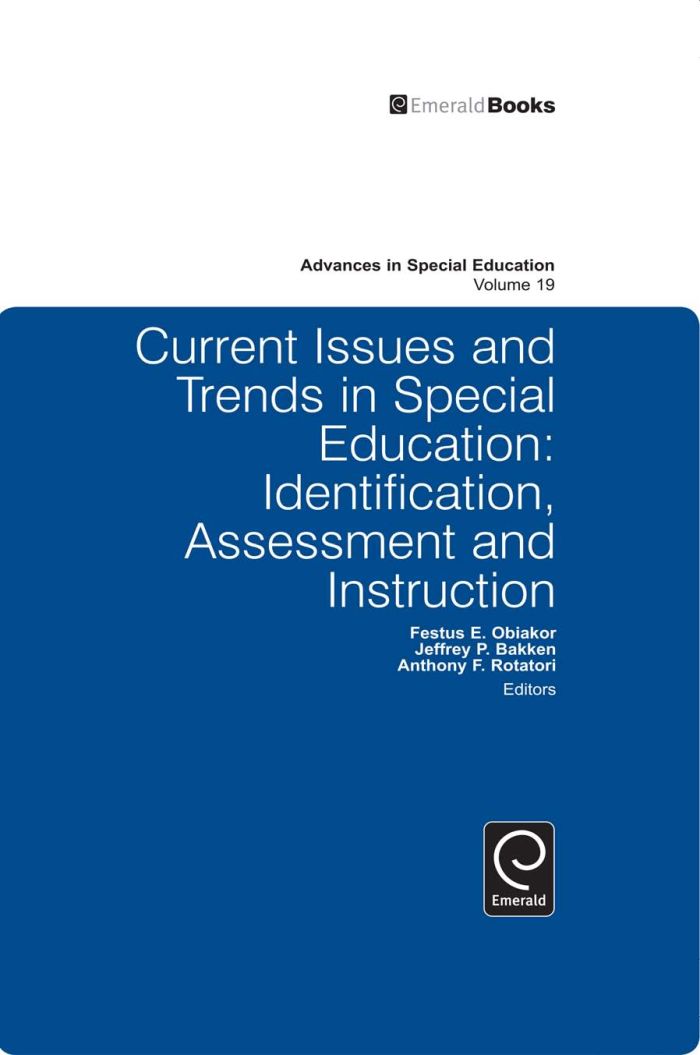
Current Issues and Trends in Special Education.
Identification, Assessment and Instruction

This book can be opened with

Note on our eBooks and Audiobooks: you can read our eBooks (ePUB or PDF) and listen to audiobooks on the free Emerald Books app on iOS, Android, and desktop. Or read and listen on Emerald's online reader (ePUB eBooks and audiobooks only). To purchase a digital book you will need to create an account if you don’t already have one. After purchasing you will receive instructions on how to get started.
- Description
- Contents
List of Contributors. Preface. Chapter 1 Early identification/intervention: The Earlier the better for students with disabilities. Chapter 2 Early identification/intervention: Can misidentification/misintervention impact students, teachers, and families?. Chapter 3 Can underidentification affect exceptional learners?. Chapter 4 Disproportionate representation in special education: Overrepresentation of selected subgroups. Chapter 5 Standardized testing/accountability: Is NCLB fair for students with disabilities?. Chapter 6 Curriculum-based assessment: The most effective way to assess students with disabilities. Chapter 7 Labeling of students with disabilities: Needed for students to get their needs met. Chapter 8 Labeling of students with disabilities: Unwanted and not needed. Chapter 9 The general education classroom: This is not where students with disabilities should be placed. Chapter 10 Beyond traditional placement: Making inclusion work in the general education classroom. Chapter 11 Behaviorism works in special education. Chapter 12 Other innovative techniques: Positive behavior supports and response to intervention. Chapter 13 Scientifically supported interventions. Chapter 14 Scientifically unsupported treatments for students with special needs. Advances in special education. Current Issues and Trends in Special Education: Identification, Assessment and Instruction. Emerald Group Publishing Limited.