
Culture and Political Psychology
A Societal Perspective

This book can be opened with

Note on our eBooks and Audiobooks: you can read our eBooks (ePUB or PDF) and listen to audiobooks on the free Emerald Books app on iOS, Android, and desktop. Or read and listen on Emerald's online reader (ePUB eBooks and audiobooks only). To purchase a digital book you will need to create an account if you don’t already have one. After purchasing you will receive instructions on how to get started.
- Description
- Contents
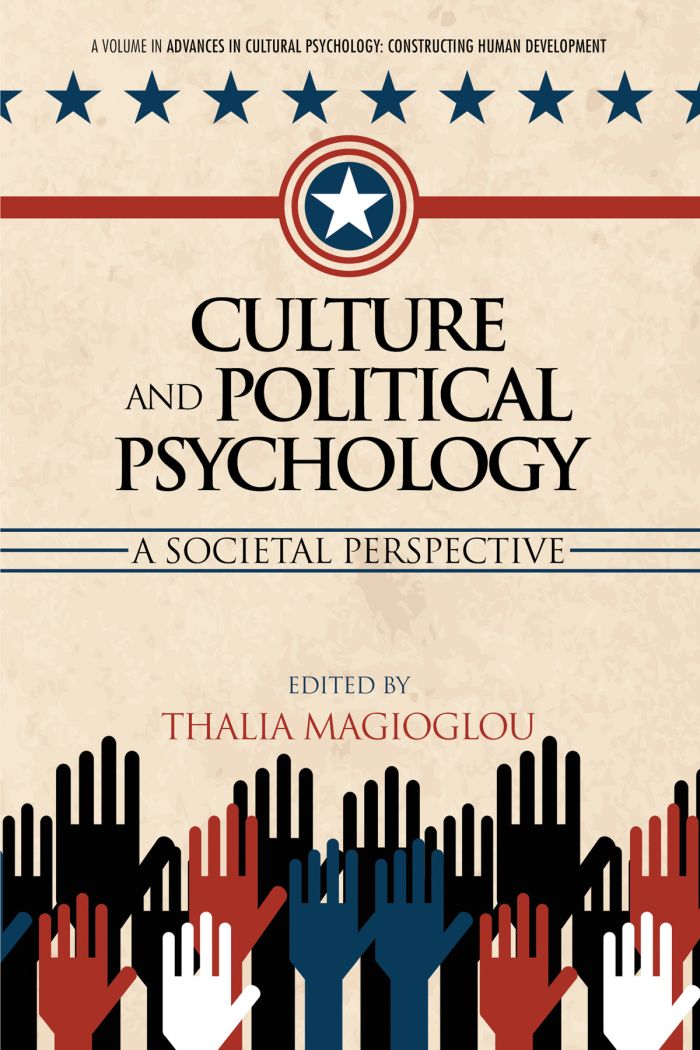
This book is perhaps the first systematic treatment of politics from the perspective of cultural psychology. Politics is a complex that psychology usually fails to understand— as it assumes a position in society that attempts to be free of politics itself. Politics is associated both with an everyday practice, and the dynamics of globalization; with the way group conflicts, ideologies, social representations and identities, are lived and co-constructed by social actors. The authors of the book address these issues through their research grounded in different parts of the world, on democracy and political order, the social representation of power, gender studies, the use of metaphors and symbolic power in political discourse, social identities and methodological questions. The book will be used by social and political psychologists but is also of interest to the other social sciences: political scientists, sociologists, anthropologists, educationalists, and it is at a level where sophisticated lay public would be able to appreciate its coverage. Its use in upperlevel college teaching is possible, and expected at graduate/postgraduate levels.
Preface: Understanding Political Processes: A New Arena for Cultural Psychology.
- Introduction: Societal Political Psychology in Paris, Thalia Magioglou.
- Acknowledgments.
- Part I. Introduction, Thalia Magioglou.
- Chapter 1. Democracy as an Open-Ended Question: A Model of Lay Thinking Grounded in Two Cultural Contexts, Thalia Magioglou.
- Chapter 2. Culture, Tools, and Subjectivity: The (Re)Construction of Self, Helen Haste.
- Chapter 3. Othering in Political Lay Thinking: A Social Representational Approach to Social Order, Christian Staerklé.
- Concluding Remark: Differently Inside: Political Psychology and Lay Thinking, Luca Tateo.
- Part II. Introduction, Thalia Magioglou.
- Chapter 4. A Missing Triad: The Politics of Location, Hierarchy, and Negotiation of Knowledges, João Manuel de Oliveira and Lígia Amâncio.
- Chapter 5. Women's Understanding of Modernity in Indonesia: The Search for a Cultural Platform, Risa Permanadeli.
- Chapter 6. Japanese, Oriental, or Western? The Conceived Classification of Rhetoric, Debate, and Communication as Academic Subjects in the Japanese Educational System, Pia Moberg.
- Concluding Remark: Reflecting on Intersubjective Approaches to Power and Knowledge in Cultural Political Psychology, Catarina Kinnvall.
- Part III. Introduction: Politics as Symbolic Power, Thalia Magioglou.
- Chapter 7. Prime Minister's Wife, Minister's Disease, and Mummy Government: How Culture Affects Metaphors Used in Japanese Political Discourse, Ofer Feldman.
- Chapter 8. The Study of Politics from the Perspective of Social Representations Theory, Maria Geka.
- Concluding Remark: Politics as Symbolic Power, Thalia Magioglou.
- Chapter 9. Power as an Object of Transcultural Studies in Societal Psychology, Lucy Baugnet and Arnauld Fouquet.
- Chapter 10. Popular Culture and Political Psychology: Lessons from Asia, Nissim Kadosh Otmazgin.
- Concluding Remark: Symbols as Power: Their Efficacy as Instruments and Indicators of Social Change, Ragini Sen.
- Part IV. Introduction: Methodological Issues at the Crossroads of Different Social Sciences, Thalia Magioglou.
- Chapter 11. Psychological Constraints of Social Psychology and Its Actors: Political Consequences? Ralph Balez.
- Chapter 12. Movies as Method: Film Analysis and Reception Studies for Societal Political Psychology, Diana Gonzalez.
- Chapter 13. Social Identities, Societal Change, and Mental Borders: Identity Construction Strategies of Young Slovaks Commuting Between Bratislava and Vienna, Barbara Lásticová and Magda Petrjánošová.
- Concluding Remark: Beyond the Politics of Method: Toward an Intersubjective Approach, Brady Wagoner.
- Part V. Conflict in Education, Thalia Magioglou.
- Chapter 14. Multicultural Dimensions and Minority Status in Education: A Social Psychological Approach, Margarita Sánchez-Mazas.
- Chapter 15. A Minority Education Reform in Western Thrace, Greece: Psychosocial and Political Perspectives, Thalia Dragonas.
- Chapter 16. Educational Intervention Strategies in Vulnerable Populations: An Experience That Invites a Community to Dream, Géraldine Kerneur Brücher.
- Concluding Remark: Culture and Politics in Education, Maritza Montero.
- Conclusion: Globalization(s) for Societal Political Psychology: Worlds Where Meanings Are Negotiated and (Re)Constructed Through Power Relations, Thalia Magioglou.
- About the Contributors.