
Critique as Uncertainty

This book can be opened with

Note on our eBooks and Audiobooks: you can read our eBooks (ePUB or PDF) and listen to audiobooks on the free Emerald Books app on iOS, Android, and desktop. Or read and listen on Emerald's online reader (ePUB eBooks and audiobooks only). To purchase a digital book you will need to create an account if you don’t already have one. After purchasing you will receive instructions on how to get started.
- Description
- Contents
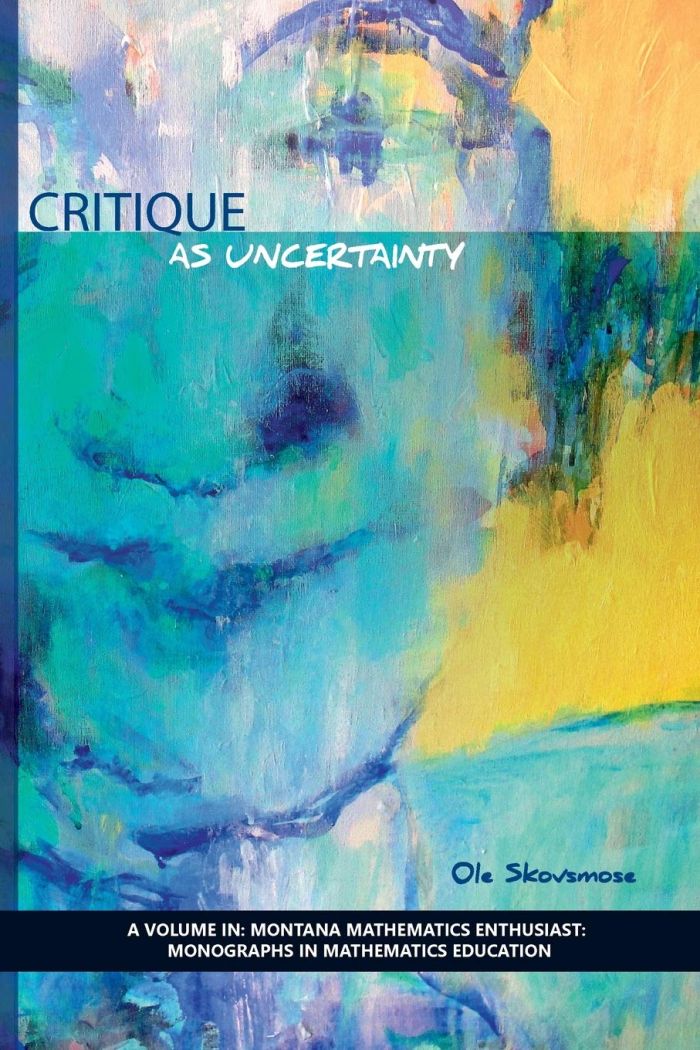
The title of the book is Critique as Uncertainty. Thus Ole Skovsmose sees uncertainty as an important feature of any critical approach. He does not assume the existence of any blue prints for social and political improvements, nor that certain theoretical structures can provide solid foundations for a critical activities. For him critique is an open and uncertain activity. This also applies to critical mathematics education.
Critique as Uncertainty includes papers Ole Skovsmose already has published as well as some newly written chapters. The book addresses issues about: landscapes of investigations, students’ foregrounds, mathematics education and democracy, mathematics and power. Finally it expresses concerns of a critical mathematics education.
Acknowledgments.
- Introduction.
- Part 1. Working with Mathematics.
- Chapter 1. Landscapes of Investigation.
- Chapter 2. How to Drag With a Worn-Out Mouse? Searching for Social Justice Through Collaboration, Miriam Godoy Penteado and Ole Skovsmose.
- Chapter 3. Project Work in Mathematics.
- Chapter 4. Inquiry Gestures, Raquel Milani and Ole Skovsmose.
- Part 2. Foregrounds and Possibilities.
- Chapter 5. Foregrounds and the Politics of Learning Obstacles.
- Chapter 6. Justice, Foregrounds, and Possibilities.
- Chapter 7. Researching Foregrounds: About Motives and Conditions for Learning, Denival Biotto Filho and Ole Skovsmose.
- Chapter 8. Inclusion-Exclusion: An Explosive Problem, Renato Marcone and Ole Skovsmose.
- Chapter 9. Researching Possibilities.
- Part 3. Democracy as a Challenge.
- Chapter 10. Ghettoizing and Globalization: A Challenge for Mathematics Education.
- Chapter 11. Linking Mathematics Education and Democracy: Citizenship, Mathematical Archaeology, Mathemacy, and Deliberative Interaction.
- Chapter 12. Democratic Competence and Reflective Knowing in Mathematics.
- Chapter 13. Mathematics Education and Democracy.
- Part 4: Mathematics and Power.
- Chapter 14. Mathematics as Discourse.
- Chapter 15. Symbolic Power, Robotting, and Surveilling.
- Chapter 16. Can Facts Be Fabricated Through Mathematics?
- Chapter 17. Mathematics as Part of Technology.
- Chapter 18. Reflective Knowledge: Its Relation to the Mathematical Modeling Process.
- Part 5: Critical Mathematics Education.
- Chapter 19. Explosive Problems in Mathematics Education.
- Chapter 20. Critique, Generativity, and Imagination.
- Chapter 21. Beyond Postmodernity in Mathematics Education?
- Chapter 22. Modernity, Aporism, and Mathematics Education.
- Chapter 23. Aporism and Critical Mathematics Education.
- Chapter 24. Mathematics Education Versus Critical Education.
- Name Index.
- Subject Index.