
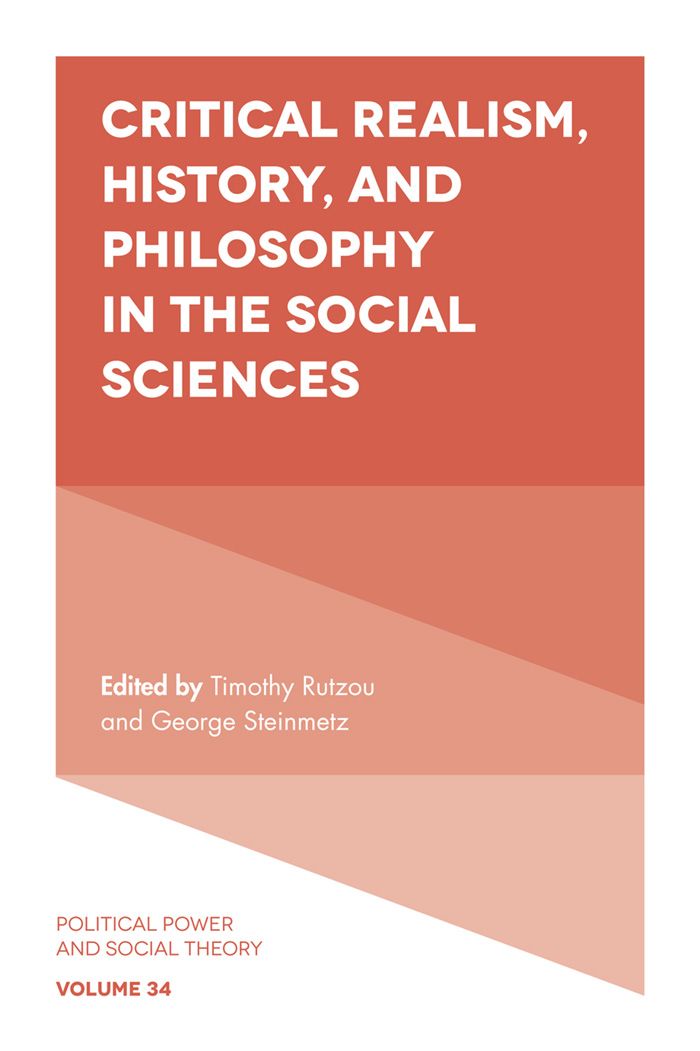
Critical Realism, History, and Philosophy in the Social Sciences

Timothy Rutzou|George Steinmetz
Emerald
Emerald

This book can be opened with

Glassboxx eBooks and audiobooks can be opened on phones, tablets, iOS and Android devices

Hardback
9781787566040
09 August 2018
$134.99
eBook (PDF)
9781787566033
09 August 2018
$134.99
eBook (ePub)
9781787566057
09 August 2018
$134.99

Note on our eBooks and Audiobooks: you can read our eBooks (ePUB or PDF) and listen to audiobooks on the free Emerald Books app on iOS, Android, and desktop. Or read and listen on Emerald's online reader (ePUB eBooks and audiobooks only). To purchase a digital book you will need to create an account if you don’t already have one. After purchasing you will receive instructions on how to get started.

  • Description
  • Contents
  • Reviews
  • About
Social science, history, and philosophy have often been neglect in thinking through their fundamentally intertwined relationship. The result is often an inattention to philosophy where social science and history is concerned, or a neglect of historicity and social analysis where philosophy is concerned. Meanwhile, the place of values in research is often uneasily passed over in silence. The inattention to, and loss of, the intersection between these different disciplines and their subject matters, leaves our investigations all the more impoverished as a result. In resolving these problems, it is not enough to strive for cooperation or integration, but to rethink of the nature of the disciplines themselves; their interests, purposes, and presuppositions.  

In this volume, contributors explore different facets of these relationships, and move beyond the problematics erected by positivism often cast in terms of value-free or value-neutral science, that is, a science obsessed with empirical data, schematic classifications, and the pursuit of law-like forms. While positivism has been subject to critique, the influence and legacy of positivism remains. It remains in the way in which we often think about science; the line drawn between the sciences and the humanities; the norms researchers should follow; what a successful explanation looks like; and the ethical, normative, and political implications of scientific research.  

Aimed at students and researchers of philosophy, history and the social sciences, this book is driven by a desire to revindicate questions concerning ontology and social ontology, to rethink the nature of explanation, and to resituate normativity and values within scientific, social scientific, and historical pursuits.

Introduction: Crisis!? What Crisis!? On Social Theory and Reflexivity; Timothy RutzouChapter 1. After Positivism: Critical Realism and Historical Sociology; Philip S. Gorski  Chapter 2. Uses of Value Judgments in Science: A General Argument, with Lessons from a Case Study of Feminist Research on Divorce; Elizabeth Anderson  Chapter 3. Principles of Reconstructive Social Theory; Frédéric Vandenberghe  Chapter 4. Conjunctures and Assemblages: Approaches to Multicausal Explanation in the Human Sciences; Claire Laurier Decoteau Chapter 5. “Strange Bedfellows? Ontology and Queer Theory”; Timothy Rutzou

    Contributed by researchers from the US and Brazil, the six essays in this volume are based on papers given at a symposium on the "History and Philosophy of the Social Sciences," held at the U. of Michigan and a symposium on "Values and Flourishing in the Humanities and Social Sciences Conference 2017," at Yale U., examining critical realism, history, philosophy, and the social sciences. They discuss the place of theory in sociology; the epistemological crisis within comparative-historical sociology and how critical realism can be used to answer the questions that initiated the crisis; the need for value commitments in social science; principles of reconstructive social theory; causation in the context of assemblage theories; and the relationship between queer theory and ontology.

    - Annotation ©2018
    Timothy Rutzou is Lecturer in the Sociology Department at Yale University, USA with a PhD in philosophy from University College London, UK. His work focuses on science and technology, the sociology of knowledge, continental philosophy, and the philosophy of science and social science.  
    George Steinmetz is the Charles Tilly Collegiate Professor of Sociology at the University of Michigan, USA. He is a social theorist and a historical sociologist of states, empires, and social science and the author of The Devil's Handwriting and Regulating the Social.