
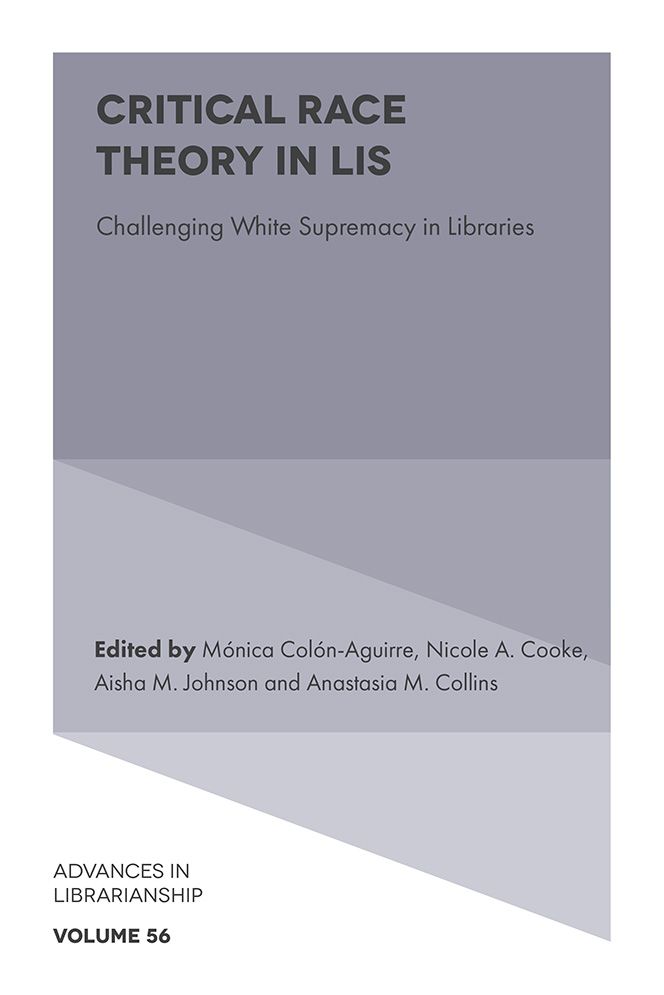

Critical Race Theory in LIS
Challenging White Supremacy in Libraries

This book can be opened with

Note on our eBooks and Audiobooks: you can read our eBooks (ePUB or PDF) and listen to audiobooks on the free Emerald Books app on iOS, Android, and desktop. Or read and listen on Emerald's online reader (ePUB eBooks and audiobooks only). To purchase a digital book you will need to create an account if you don’t already have one. After purchasing you will receive instructions on how to get started.
- Description
- Contents
- About
This volume shares some of the ways that librarians and library scholars are incorporating Critical Race Theory (CRT) into the field of library and information studies. CRT provides a theoretical and analytical lens through which librarians can challenge the ways race and racism harm shape library access, collections, discourses, and services, with the goal of instigating changes that lead to social justice.
Chapter authors represent different points of views related to CRT from their unique perspective as members of minoritized groups and contributions move beyond generalized language and tackle topics directly related to race in America and how these affect the work in libraries. The way in which libraries and other information professions perpetuate racism are explored, alongside racist practices, as well as ideas on how information professionals can move beyond these systems and create institutions that support their patrons and create environments in which all are welcomed.
Critical Race Theory in LIS fulfills a need for LIS literature to focus on race issues in the profession. The work is related to the larger umbrella of DEI work and will advance Social Justice issues in the profession but from a race perspective.
Introduction to the Volume: Critical Race Theory in Library and Information Science (LIS); Mónica Colón-Aguirre
- Section 1. CRT and Navigating the White Spaces of Academia
- Chapter 1. A Brief History of (White) Choices; jaime ding
- Chapter 2. “I'm Sorry You Had to Experience That:” The Unnecessary Emotional Toll Experienced by BIPOC Women at Community College Libraries; Alejandra S. Méndez Irizarry
- Chapter 3. Planting Seeds of Change to Help Grow the Field of Librarianship for Native American Students; Tessa R. Campbell
- Chapter 4. We Have a Problem! Unearthing and Dismantling Whiteness in Instructional Design and Librarianship Practices; Marcia Rapchak, Tinukwa Boulder, Rae Mancilla, and Tasha M. Brown
- Chapter 5. Student-Led CritLib Initiatives: The Creation of The Critical Librarianship Reading Group; LaTesha Velez, Tori Hopper, and Deborah Yun Caldwell
- Section 2. CRT as a Bridge to Practice
- Chapter 6. The CRT Toolkit: Preventing Disinformation Through the Creation of an Open Access Critical Race Theory Toolkit; Cearra N. Harris
- Chapter 7. Intellectual Freedom as Political Pawn: Aligning the Historical Context of Policing Access with Propositions of Critical Race Theory and InfoCrit Theory; Aisha M. Johnson
- Chapter 8. Race-avoidant discourse in school library preparation program standards; Julia Burns Petrella
- Chapter 9. Check Yo’self Before You Wreck Yo’self: Diversity Residents' Experiences Expanding CRT and Antiracism Practices in Collection Development; Mallary Rawls and Amanda M. Leftwich
- Chapter 10. “Faces at the Bottom of the Archive:” Critical Race Theory in Special Collections Librarianship and Archives, A [Counter Story] Review; Kellee E. Warren
- Section 3. Combatting Erasure with CRT
- Chapter 11. The Black Tax: The Impact of Race, Recognition, and Representation in Librarianship; Teneka Williams
- Chapter 12. Metadata as White Ignorance; Jose C. Guerrero
- Chapter 13. Bias in the System: A Case for Catalogers’ Judgment; Annisija W. Hunter
- Section 4. CRT Beyond Libraries
- Chapter 14. A Wolf in Sheep's Clothing: Book Banning Practices Disguised as Parental Rights Advocacy; Shannon Crooks
- Chapter 15. A TribalCrit Analysis of Library Legislation in Idaho; Mandi Lyn Harris
- Chapter 16. “You Can’t Be in That Much Pain”: Navigating Implicit Bias in Women’s Healthcare; Andrea M. Hayes
Mónica Colón-Aguirre is Assistant Professor at the School of Information Science at the University of South Carolina. She is an experienced library and information science educator, focusing on information science and LIS education from a social justice perspective.
Nicole A. Cooke is Augusta Baker Chair and Professor at the School of Information Science at the University of South Carolina. Her research interests include human information behavior, fake news consumption and resistance, and diversity and social justice in librarianship.
Aisha M. Johnson is Associate Dean for Academic Affairs and Outreach at the Georgia Tech Library, and is a revelator of Southern library history. In 2021, the Association for the Study of African American Life and History recognized her impactful work with the Freedom Scholar Award.
Anastasia M. Collins is Instructional Librarian & Geographer-at-Large at Phillips Academy. She developed the Anti-Oppression Guide at Simmons University Library, and delivers talks and workshops on equity work in library and information science.