
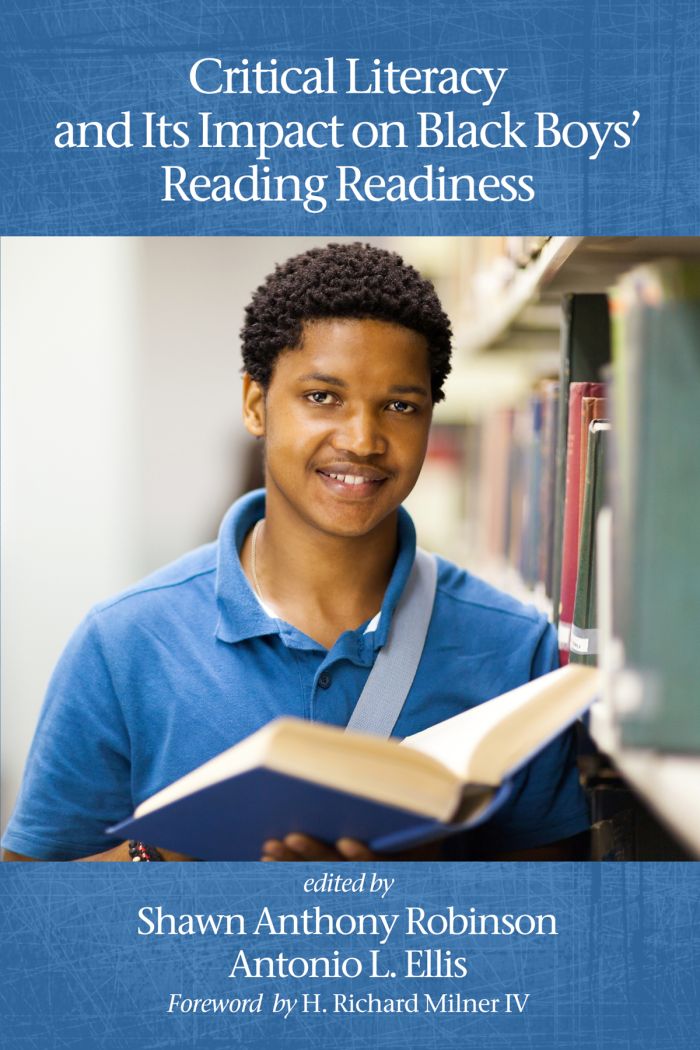
Critical Literacy and Its Impact on Black Boys' Reading Readiness

This book can be opened with

Note on our eBooks and Audiobooks: you can read our eBooks (ePUB or PDF) and listen to audiobooks on the free Emerald Books app on iOS, Android, and desktop. Or read and listen on Emerald's online reader (ePUB eBooks and audiobooks only). To purchase a digital book you will need to create an account if you don’t already have one. After purchasing you will receive instructions on how to get started.
- Description
- Contents
Academic success for African American boys’ in Special Education is frequently elusive as the United States continues to endure the legacy of academic discrimination (Blanchett, 2010; Skiba et al., 2008). Consequently, educational policies have not fully protected the equal rights or adequately responded to the learning needs of students’ academic shortcomings or taken advantage of their strengths (Parkinson & Rowan, 2008; Tatum, 2005). This persistent reading gap has not closed in generations, which is deeply harmful to our American democracy (Wolf, 2019).
With every passing year that goes by without alleviating problems affecting the reading gap, the damage is costly, and no failure is more expensive than the failure to educate African American males in the PK-12 pipeline (Robinson & Thompson 2019). The danger to our students becomes more critical each year, and these are problems that are deeply rooted in America. And, while teachers cannot change the past, we can, and must, change the special education system that shapes the future of students. Thus, a reader’s identity becomes shaped by the intersection of factors that are both inherent and neurologically based, and factors that arise as a result of one’s home and academic environment (Hoyles & Hoyles, 2010; Robinson, Ford, Ellis, & Hartlep, 2016; Wolf, 2007). Reading instruction must be culturally relevant which can strengthen the reader’s identity and capacity for critical thinking (Arya & Feathers, 2012; Flowers, 2007; Robinson, 2017). Critical literacy is grounded in the sociocultural perspective and way of thinking about curriculum, literacies, and honoring students’ lived experiences, especially within the contexts of Special Education (Brooks, 2006; Gay, 2002; Norman, 2011).
This edited book will fill a needed gap in scholarly research, as manuscripts adopts a critical analysis that brings together the latest theoretical, conceptual, quantitative, qualitative, and mixed methods research studies. Chapters will have clear and explicit implications for educational practice and make a significant contribution to the field of special education and reading instruction.
Foreword; H. Richard Milner IV.
- Prelude — We Are Left Out: Literacy for Black Boys; Antonio L. Ellis, Shawn Anthony Robinson, and Gary Hamilton.
- Acknowledgments.
- Chapter 1. Let the Schoolhouse Say, Amen: The Pedagogical Congruency Between the Black Church and Critical Literacy; Marc Antoine Lavarin.
- Chapter 2. Teaching Critical Literacy: Models for Implementing Instruction in All Grade Levels; Casey Medlock Paul.
- Chapter 3. Representation of Afrocentric Superheroes and Building a Reader Identity Through Graphic Novels; Shawn Anthony Robinson and Antonio L. Ellis.
- Chapter 4. Was Blind but Now I See: Addressing Blind Spots in Literacy Instruction to Promote Healthy Self-Concepts; Walter Lee.
- Chapter 5. Starting Young: Emergent Black Masculinity and Early Literacy; Alma Stevenson and Sabrina Ross.
- Chapter 6. Do You Know How to Teach Me? Augmenting the Knowledge of Educators to Address the Literacy Needs of Students With Intellectual Disabilities; Aimeé Cepeda.
- Chapter 7. The Role of School Leaders in Increasing Access to Literacy Interventions; Shareen Feranders and Sarah Irvine Belson.
- Chapter 8. Afterword; Richard C. McGregory, Jr.
- About the Editors.
- About the Contributors.