
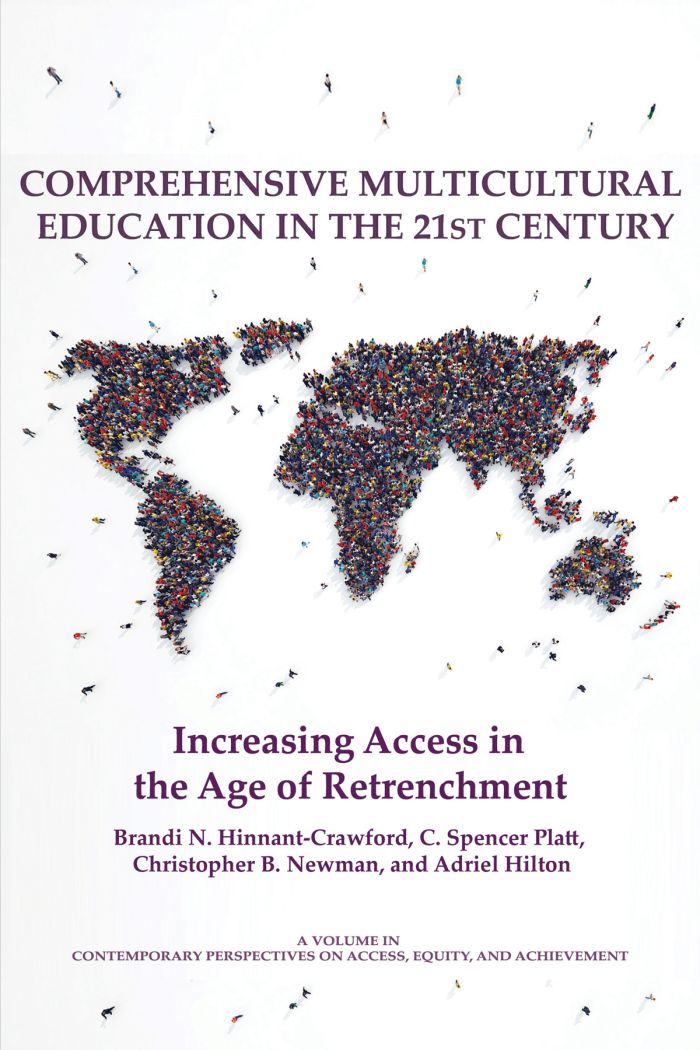
Comprehensive Multicultural Education in the 21st Century
Increasing Access in the Age of Retrenchment

This book can be opened with

Note on our eBooks and Audiobooks: you can read our eBooks (ePUB or PDF) and listen to audiobooks on the free Emerald Books app on iOS, Android, and desktop. Or read and listen on Emerald's online reader (ePUB eBooks and audiobooks only). To purchase a digital book you will need to create an account if you don’t already have one. After purchasing you will receive instructions on how to get started.
- Description
- Contents
Multicultural education has become its own discipline, developed on the shoulders of the work of giants who argued its merit during the attacks of opponents who believed assimilation was the purpose of state sponsored education. In an age of rising populism and nationalism throughout the Western world, again questioned is the merit of multicultural education. In the shadows of Brexit and an America First agenda, where migration patterns across the world have led to demographic shifts, it is evident even in the richest countries in the world that gaps in opportunity (and subsequently achievement) still exist. Disparities in achievement lead some to question whether multicultural education works and others to revert to old notions that ethnically and linguistically marginalized students are in fact deficient. The scholars here believe in the untapped potential of all children and illuminate how educational structures have muffled the cultivation of that potential. Contributors argue the goals of multicultural education have not been achieved in part due to the piecemeal application of its tenants.
The scholarship in this volume illustrates the state of multicultural education and articulates what educators committed to equity, inclusion, and a more just society must do to ensure the goals of multicultural education survive in the current age. The authors of these chapters bridge foundational knowledge with contemporary understandings; making the work both accessible for novices and beneficial for the authorities on multicultural education. With the diverse cast of contributors and topics ranging from mathematics instruction to discipline practices, this volume provides thoughtful discourse on issues of access: access to curricular content, access to opportunities to learn, as well as impediments to access. Containing chapters that speak to discipline specific pedagogical practices, the structures of schooling, teacher education, and research methodologies, the collected work encourages scholars and practitioners to not be discouraged in the age of retrenchment.
Introduction—Nationalism, Terrorism, and the Retrenchment of Multiculturalism: The Challenge of Multicultural Education in the 21st Century; Brandi Hinnant-Crawford, Spencer Platt, Chris Newman, and Adriel Hilton.
- Chapter 1. Situating a Requisite Purple Rain in Multicultural Education; Marjorie Hall Haley, Shamaine K. Bertrand, and Tiffany M. Mitchell.
- Chapter 2. Reading as Emancipation: Using the Literacy as Access Framework to Ensure Cultural Competency in Educators; Dwight Watson and James D. Cryer.
- Chapter 3. Beyond Knowing Your History: Multicultural and Citizenship Education as Necessities for Democracy; Brandi Hinnant-Crawford and Najja Baptist.
- Chapter 4. Critical Family History as a Strategy for Multicultural History Education; LaGarrett King.
- Chapter 5. Fortifying the Intrapersonal Through Attending to the Interpersonal: Motivating Mathematics Self-Concept Through Fruitful Student-Teacher Relationships; C. Vandyke Goings.
- Chapter 6. And How Are the Boys? Towards an "African American Male Pedagogy" to Promote Academic and Social Success Among Black Boys in Early Childhood Education; Nathaniel Bryan and Brian Wright.
- Chapter 7. Responding to Teachers' Perceptions of African American Males: Addressing Bias in the Special Education Referral Process; Charmion Rush and Gretchen Robinson.
- Chapter 8. Students With Disabilities: Making Idea Transition Services Work; Rhonda Sutton-Palmer, James Coaxum, III, and Ted N. Ingram.
- Chapter 9. Just the Bathwater, Not the Baby: Presenting an Alternative Framework to Inclusive Education in the Global South; Maya Kalyanpur.
- Chapter 10. Engaging Biracial Students in Holistic Learning Spaces With a Gendered Perspective; Ashely N. Patterson and James L. Moore III.
- Chapter 11. Law and Disorder: Classroom Management, Discipline, and the Promise of Multicultural Education; Brandi Hinnant-Crawford, C. Spencer Platt, and Dorian Wingard.
- Chapter 12. Our Knowledge, Our Way: The Indigenous Reclamation of Research; Sweeny Windchief (Tatáŋka Tógaheya), Deb (Clairmont) LaVeaux, James M. Del Duca (Chiluubé Akchiá), and William Aderholdt.
- About the Authors.