
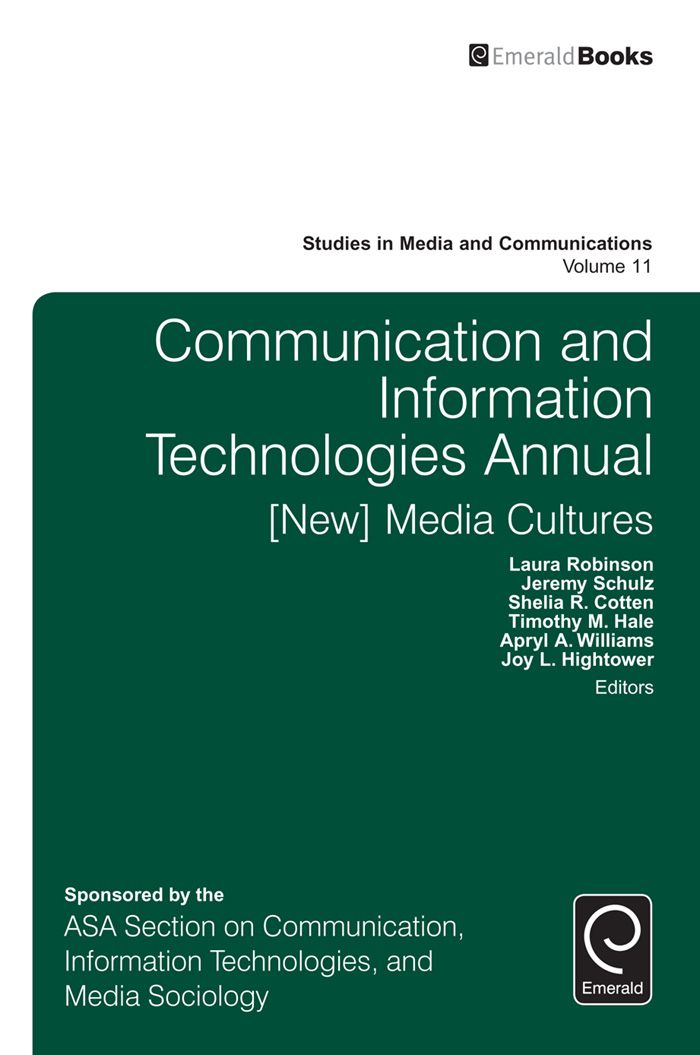
Communication and Information Technologies Annual
[New] Media Cultures

This book can be opened with

Note on our eBooks and Audiobooks: you can read our eBooks (ePUB or PDF) and listen to audiobooks on the free Emerald Books app on iOS, Android, and desktop. Or read and listen on Emerald's online reader (ePUB eBooks and audiobooks only). To purchase a digital book you will need to create an account if you don’t already have one. After purchasing you will receive instructions on how to get started.
- Description
- Contents
- Reviews
- About
Introduction: Volume 11 - Laura Robinson, Jeremy Schulz, Shelia R. Cotten, Timothy M. Hale, Apryl A. Williams and Joy L. Hightower SECTION I: COMMUNICATIVE CULTURES On Violating One’s Own Privacy: N-adic Utterances and Inadvertent Disclosures in Online Venues - Xiaoli Tian and Daniel A. Menchik Couples’ Use of Technology in Maintaining Relationships - Xiaolin Zhuo SECTION II: MEDIA, CULTURE, AND IDENTITY Spectacles of Self(ie) Empowerment? Networked Individualism and the Logic of the (Post)Feminist Selfie - Stephen R. Barnard You’ve Been Catfished: An Analysis of Postemotionalism in “Reality” Television and Audience Response on Twitter - Apryl A. Williams Cultures of Experimentation: Role-Playing Games and Sexual Identity - Ciaran Devlin and Anne Holohan SECTION III: DIGITAL PUBLIC CULTURES Twitter Sentiments: Pattern Recognition and Poll Prediction - Francis P. Barclay, C. Pichandy, Anusha Venkat and Sreedevi Sudhakaran The Limits of Neoliberalism: How Writers and Editors Use Digital Technologies in the Literary Field - Matthew Clair The Role of Mass Media in the Transmission of Culture - Julie B. Wiest SECTION IV: METHODS FOR STUDYING MEDIA AND CULTURE Virtual Tours: Enhancing Qualitative Methodology to Holistically Capture Youth Peer Cultures - Ana Campos-Holland, Brooke Dinsmore and Jasmine Kelekay Sentiment Analysis of Polarizing Topics in Social Media: News Site Readers’ Comments on the Trayvon Martin Controversy - Gabe Ignatow, Nicholas Evangelopoulos and Konstantinos Zougris
Editors Robinson, Schulz, Cotten, Hale, Williams, and Hightower present readers with a collection of academic essays and research papers devoted to the intersection of new media, culture, and society. The selections that make up the main body of the text are focused on communication cultures; the intersection of media, culture, and identity; digital public cultures; and methods for studying media and culture. Laura Robinson is a faculty member of Santa Clara University in California. Jeremy Schulz and Joy L. Hightower are faculty members of the University of California, Berkeley. Shelia R. Cotten is a faculty member of Michigan State University. Timothy M. Hale is a faculty member of Harvard Medical School in Massachusetts. Apryl A. Williams is a faculty member of Texas A&M University.