

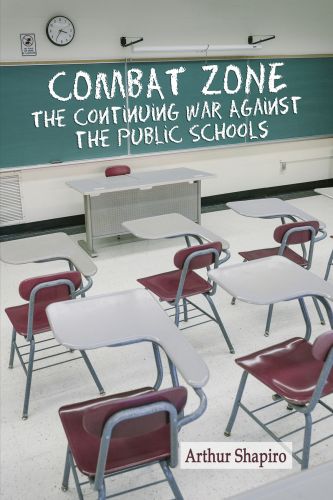
Combat Zone
The Continuing War against the Public Schools

This book can be opened with

Note on our eBooks and Audiobooks: you can read our eBooks (ePUB or PDF) and listen to audiobooks on the free Emerald Books app on iOS, Android, and desktop. Or read and listen on Emerald's online reader (ePUB eBooks and audiobooks only). To purchase a digital book you will need to create an account if you don’t already have one. After purchasing you will receive instructions on how to get started.
- Description
- Contents
Although in plain sight daily, a highly successful war against the public schools has been hidden in the shadows of public consciousness. Only very recently have several people written articles about this war, with the only book calling it a war being written in 2002. Neither the public nor educators have become aware of the far-reaching extent and effectiveness of this war. This book treats this war as part of an extensive social movement that is conducting wars also against government and science, as well as against women, immigrants, the poor (but not against poverty), and, certainly, against unions.
However, the book focuses on the war against the public schools. It sets the stage in Chapter One, Checklist for Destroying Public Education, followed by Chapter Two, How the War Plays Out on the Battlefield – Seven Examples that illustrate and prove the thesis. One example involves a private for-profit company that took over a school district in Michigan, but found that they couldn’t make a profit running the high school. So what did they do? They simply closed it, leaving the students high and dry.
We provide a chapter analyzing the considerable profits being made by entrepreneurs, businessmen, politicians, testing companies and charter schools. We then describe and analyze the overt and covert attacks on our kids, on teachers and on public schools, such as the clever idea of grading schools A, B, C, D, or F, thereby undermining public confidence in their local schools. We focus on the arsenal of weapons aimed at the public schools, such as privatization, intrusion of politicians into educational decision-making, vouchers, using merit pay and Value-Added Models (VAMs) to evaluate teachers, charter schools, extremely intensive testing, the standards movement, etc. We look at unintended consequences and conclude with attempts at peaceful resolutions and developing reconciliation strategies.
Dedication.
- Acknowledgments.
- Preface: Overview.
- Part I. Setting and Background
- Chapter 1. Check List for Destroying Public Education.
- Chapter 2. How the War Plays Out: Eight Battlefield Examples.
- Chapter 3. The Value of Public Education: The Case for the Public Schools as Absolutely Indispensable for Our Modern Democracy.
- Chapter 4. The Wars.
- Chapter 5. Social Movements: What Are They? How Do They Work?
- Part II. Overt Attacks
- Chapter 6. The Arsenal of Weapons in This Battle.
- Chapter 7. The Great Rip-Off: Education as a Corporate Money-Maker, or How to Make a Profit Off Non-Profit, For-Profit and Online Charter Schools - Businesses Pretending to Be Schools.
- Chapter 8. What Weapons Are Being Used to Attack Our Kids?
- Chapter 9. Attacking Public School Teachers: The Teacher as Fall Guy (and Victim).
- Chapter 10. Fire Bombing Public Schools.
- Part III. Covert Attacks (The Stealth Approach)
- Chapter 11. If We Privatize Education, Who's in Charge? A Major Shift in the Control of Our Public Schools.
- Chapter 12. Stealth Attacks: Ambushing Educators and Schools.
- Part IV. Unintended Consequences
- Chapter 13. Peaceful Resolutions: Lessons to Be Learned, Developing Reconciliation Strategies, and Recommendations to Save Our Public Schools.
- Chapter 14. Unintended Consequences - and a Very Quirky Summary, Some Conclusions and a Few Implications.
- References and Resources.