
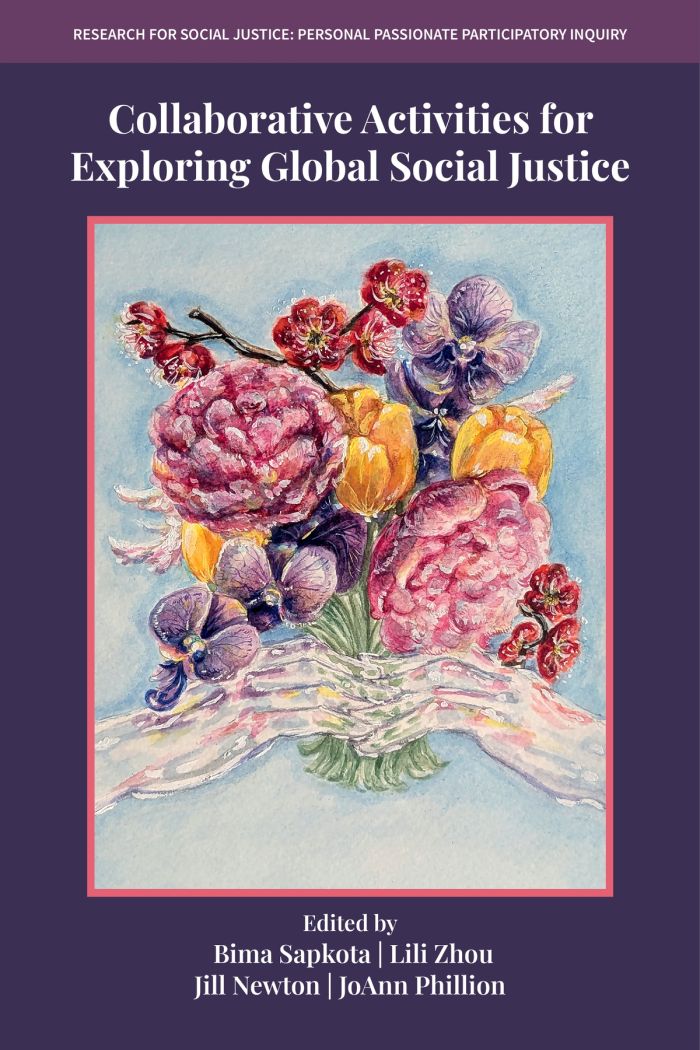
Collaborative Activities for Exploring Global Social Justice

This book can be opened with

Note on our eBooks and Audiobooks: you can read our eBooks (ePUB or PDF) and listen to audiobooks on the free Emerald Books app on iOS, Android, and desktop. Or read and listen on Emerald's online reader (ePUB eBooks and audiobooks only). To purchase a digital book you will need to create an account if you don’t already have one. After purchasing you will receive instructions on how to get started.
- Description
- Contents
- About
Collaborative Activities for Exploring Global Social Justice shares intercultural and social justice-focused activities developed through the Global Social Justice in Education (GSJE) project—a virtual international community of practice launched during the COVID-19 pandemic. The book is grounded in theoretical frameworks such as intercultural competence, cultural humility, and social justice education, and highlights the implementation and impact of these activities across global educational contexts. Designed for educators, researchers, and policymakers, this book offers adaptable, practice-based resources for fostering inclusive and equitable learning environments while promoting dialogue across cultural boundaries.
Built on the experiences of a global virtual community of practice (GSJE), this book provides 23 adaptable activities that guide participants in examining identity, confronting systemic inequities, and imagining their roles as changemakers in educational and social contexts.
Section 1. Digital Media
- Chapter 1. Exploring Social Justice through Memes; Bima Sapkota
- Chapter 2. Sharing School Pictures: Access to Education; Lili Zhou
- Chapter 3. Exploring Social Justice in the News; Daphne Rae Krutulis
- Chapter 4. Social Justice in Digital Learning Platforms; Vikrant Chap
- Section 2. Identity and Self-Reflection
- Chapter 5. Who Am I?; Bima Sapkota
- Chapter 6. What’s in a Name?; Jill Newton and JoAnn Phillion
- Chapter 7. Diversity Investigation; Emmanuel Deogratias and Doris Fulwider
- Chapter 8. Exploring Privilege in International Contexts; Jill Newton and JoAnn Phillion
- Chapter 9. About Me Tree; Amanda Huffman Hayes
- Section 3. Activism and Social Change
- Chapter 10. Spheres of Influence; Amanda Huffman Hayes and Marquetta Strait
- Chapter 11. Social Justice Activists in Local and Global Contexts; Foluke Ajiboye
- Chapter 12. Social Justice Movements in Local and Global Contexts; Xuwei Luo
- Chapter 13. Injustice in the “Justice” System; Fidelis Mumba and Araba Ayiaba Ziekpor Osei-Tutu
- Chapter 14. Social Justice in Development Projects; Muna Sapkota
- Chapter 15. Social Justice Issues in International Organizations; Vikrant Chap
- Chapter 16. Social Justice in Education Success Stories; Muna Sapkota
- Section 4. Social Justice in K-12 Education
- Chapter 17. Social Justice in K-12 Curriculum; Araba Ayiaba Ziekpor Osei-Tutu
- Chapter 18. Social Justice Issues in Standardized Tests; Yangyang Zhu
- Chapter 19. Status and Treatment of Educators Around the World; Xuwei Luo
- Section 5. Cultural Understanding
- Chapter 20. Commemoration; Gerald Mwansa
- Chapter 21. Two Cultural Metaphors: Fence In and Fence Out; Lili Zhou
- Chapter 22. Exploring the Role of the Arts in Social Justice in Global Contexts; Jill Newton and JoAnn Phillion
- Chapter 23. Cultural Iceberg: Surface and Deep Culture; Rose Mbewe
- Conclusion; Bima Sapkota
Bima Sapkota is an Assistant Professor of Mathematics Education at the University of Kentucky.
Lili Zhou is an Assistant Professor of Mathematics Education at California State University, Los Angeles.
Jill Newton is Professor of Mathematics Education at Purdue University.
JoAnn Phillion is Professor of Curriculum Studies at Purdue University.