
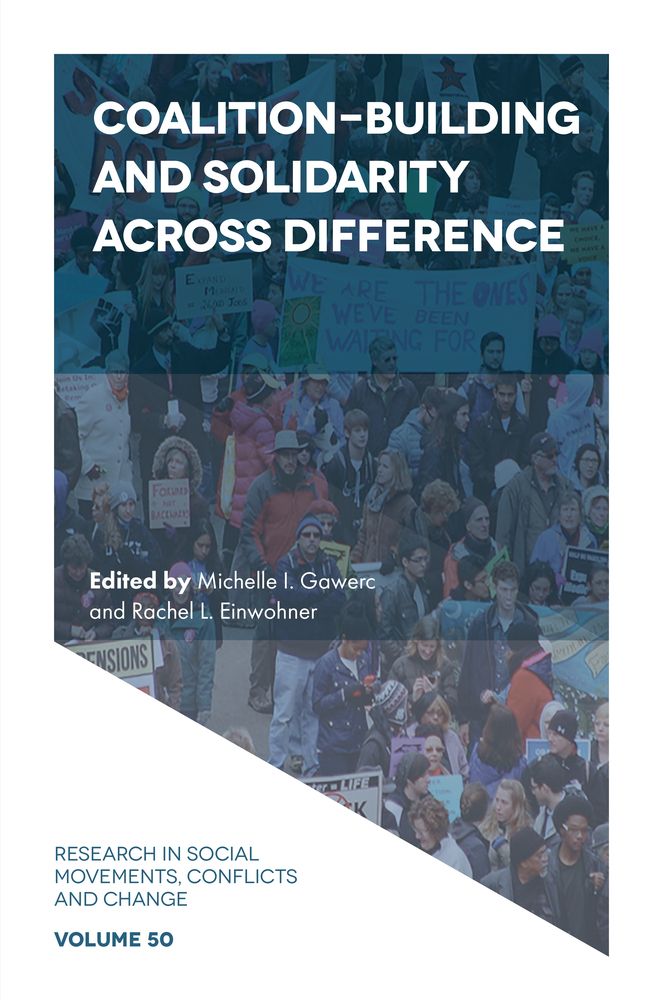
Coalition-Building and Solidarity Across Difference

This book can be opened with

Note on our eBooks and Audiobooks: you can read our eBooks (ePUB or PDF) and listen to audiobooks on the free Emerald Books app on iOS, Android, and desktop. Or read and listen on Emerald's online reader (ePUB eBooks and audiobooks only). To purchase a digital book you will need to create an account if you don’t already have one. After purchasing you will receive instructions on how to get started.
- Description
- Contents
- About
Coalitions across divides are among the most important tactical tools available for social movements, as they enable the sharing of networks, resources, expertise, and information, while simultaneously projecting an image of power through unity and numbers. Yet diverse alliances face tremendous challenges not limited to building a unifying collective identity and forging a common agenda across lines of inequality. Delving into these challenges in the context of social movements, this edited collection focuses on coalition-building, working across difference and inequality, intersectionality practices, and solidarity building across divides.
Seeking to advance the body of literature assessing how alliances form and sustain themselves across difference and inequality, chapters discuss coalitions both between formal organizations, such as social movement organizations, as well as coalition-building within groups and organizations. With a particular interest in studies of diversity and inclusion in social movements, authors address the process and facilitation of coalition work, alongside the subsequent analysis of obstacles, outcomes, and lessons learned.
Communicating the enduring power of diverse coalitions as they hold the potential for drawing in new audiences and building a broader movement, Gawerc and Einwohner expertly collate chapters that make powerful statements around bridging societal divides while also fostering innovation and creativity. Demonstrating that collective liberation is possible when we work across lines of difference, this volume provides a vital roadmap for this essential work. This is compelling reading for scholars of social movements, collective action, and intersectionality.
Introduction: Coalition-Building and Solidarity Across Difference; Michelle I. Gawerc and Rachel L. Einwohner
- Part 1. Coalition Work and Its Facilitators
- Chapter 1. Creative Activism and Intersectional Solidarity in the University of Puerto Rico Occupation of 2010; Katherine Everhart
- Chapter 2. Thin Coherence and Cultural Change in the 1980s Sanctuary Movement; Audrey Augenbraum
- Chapter 3. Home Is at the Heart of Place: Coalition Possibilities at Standing Rock; Kandice L. Grossman
- Chapter 4. The Stop the Sweeps Movement and Collective Identity Formation Across Place; Alex M. Kempler
- Part 2. Obstacles, Outcomes, and Lessons Learned
- Chapter 5. The Shortfall of Sequenced Intersectionality: The Not-Quite Intersectional Solidarity of the National Lesbian Conference; K.L. Broad
- Chapter 6. “Some Differences Emerged”: White Affinity Groups and the Complexities of Enduring Cross-Racial, Cross-Organizational Accountability; Chandra Russo
- Chapter 7. Bridge Building Between Place-Based Organizations: Lessons From Extraction Sites in the Netherlands and Guatemala; Hannah Porada, Nienke Busscher, and Guadalupe García Prado
- Chapter 8. Women of Color Bring Reproductive Justice to the Supreme Court: Social Movement Coalition Framing in Abortion Amicus Briefs; Holly J. McCammon, Whitney Frierson, Shayda Oliaei, Gavin Riley, and Hayoung Seo
Michelle I. Gawerc is Professor of Sociology at Loyola University Maryland, USA.
Rachel L. Einwohner is Professor of Sociology at Purdue University, USA.