
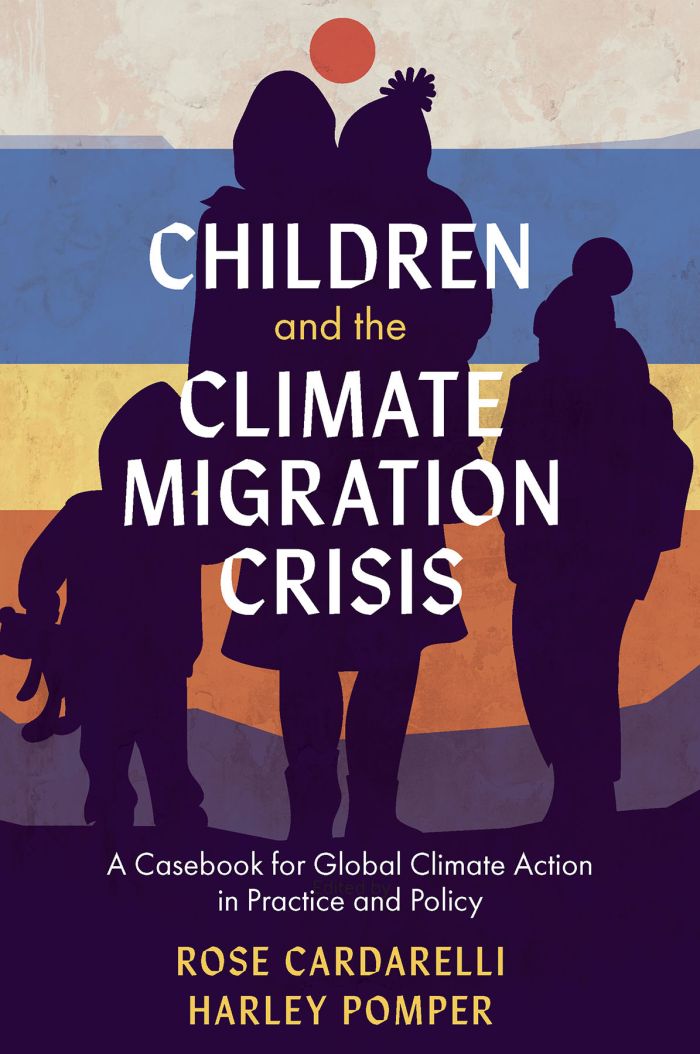

Children and the Climate Migration Crisis
A Casebook for Global Climate Action in Practice and Policy

This book can be opened with

Note on our eBooks and Audiobooks: you can read our eBooks (ePUB or PDF) and listen to audiobooks on the free Emerald Books app on iOS, Android, and desktop. Or read and listen on Emerald's online reader (ePUB eBooks and audiobooks only). To purchase a digital book you will need to create an account if you don’t already have one. After purchasing you will receive instructions on how to get started.
- Description
- Contents
- Reviews
- About
With climate disasters expected to displace millions as the planet continues to warm, we are fast approaching a serious humanitarian crisis. Foregrounding how our children are increasingly shouldering the era-defining effects of climate change, Children and the Climate Migration Crisis chronicles our collective responsibility to address resulting consequences for the wellbeing and future of children everywhere.
Using illustrative case studies to dive deeper into the current situation, Rose Cardarelli and Harley Pomper outline an educational response for mitigating climate migration and stress-related trauma, including how to foster the development of the social and emotional strengths and responses that children need to grapple with a world in jeopardy.
Subverting eco-anxiety and establishing ways we can empower children around the globe, Children and the Climate Migration Crisis takes a holistic approach to bring together the relevancy and impact of forced migration and climate resilience, underpinned by a social emotional approach to overall wellbeing, adjustment, and adaptability.
Part I. The Climate Migration Challenge
- Chapter 1. History, Politics, Policy, and a Global Agenda for Climate Migration
- Part II. Climate Migration Case Studies
- Chapter 2. Climate Driven Migration – Europe (Case Studies of Greece and Germany)
- Chapter 3. Climate Driven Migration – Africa (Case Studies of Malawi and Kenya)
- Chapter 4. Climate Driven Migration – Middle East (Case Studies of Lebanon and Yemen)
- Chapter 5. Climate Driven Migration – the Americas (Case Studies of Venezuela, Columbia and the Northern Triangle Countries: El Salvador, Honduras, and Guatemala)
- Chapter 6. Climate Driven Migration – Asia (Case Studies of the Maldives and Bangladesh)
- Part III. Solutions
- Chapter 7. Climate and Migration Trauma
- Chapter 8. Climate Resilience Education and Socio-Emotional Learning
- Chapter 9. Responsibilities of the International Community, Aid Agencies and Governments
- Chapter 10. A Call to Action
This is an absolute must read for anyone concerned about the climate crisis and its effects on children’s lives. Not only does it provide the information and resources desperately needed by those supporting children in forced climate migration situations, it serves as a critical call to action for building better approaches to climate resilience and education in emergencies.
Through this book, [Cardarelli and Pomper] explore the pressing issue of how climate crises affect children. By combining contextual information, real-life examples, and the intersection of Social-Emotional Learning (SEL) and trauma-sensitive strategies, the book emphasizes the importance of climate education. The authors emphasize the need for active participation and policy development to protect children's well-being in the face of climate-related challenges.
[This] book is a critical call to action for all stakeholders, especially policy makers, to address fundamental gaps in climate action. The trauma of forced migration and displacement of children, families, and communities can destroy life and entire societies. It is prudent for policy makers, decision-makers, and global citizens to care and learn about the social and emotional learning and mental and physical wellbeing of humans impacted by climate change through the valuable lessons shared in this book.
Detachment is said to be essential to scholarship, but there are subjects where research and the framing of possibilities are enhanced by unhidden emotional involvement and unconcealed anger. This is a volume that vindicates that truth. As it attests, the trauma of children forced to migrate because of climate can no longer be destroyed. But it can be minimized, through actions that are realistic leading to solutions that are enduring. Like the rosebud slowly emerging from a thicket of thorns, it offers a hope that can be realized.
Children are our future. Everything happening to our world today impacts their lives tomorrow – and today. Children are also some of the most vulnerable, and with growing climate change forcing people from their homes - whether due to drought, floods, rising sea levels, or collapsing food availability – the children did not create this, and we who did have a moral obligation to support them. They could be the inventors and entrepreneurs who create change and stabilise our world. But to do so they need support and education now. This book offers a roadmap for how we can – and must – offer today’s children the support and education they require for the world they are inheriting.
Climate migration is a pressing topic of discussion amongst policymakers and government agencies worldwide, and this book places children’s wellbeing at the forefront of these conversations. Providing a holistic approach on how to integrate social-emotional learning, trauma responsive training, and climate resilience education programs in real world settings, this book is truly a call to action for building better responses to climate migration.
Rose Cardarelli is the Founder and CEO of the Education for All Coalition, an international NGO supporting refugee education worldwide. A former senior military commander, healthcare executive, and professor of human security, she is a recognized expert in strategy, global education, and sustainable development. Dr. Cardarelli serves as an NGO representative to the UN and the UNHCR, the Rotary International Representative to UNICEF, and a SEL Representative to UNESCO.
Harley Pomper is an M.A. Student in Anthropology and Franklin Research Fellow at the University of Chicago, USA, working to empower access to education for underserved, disabled, and incarcerated students. From climate resilience curriculum to trauma-responsive training for educators, Pomper is devoted to creating equitable, just, and compassionate learning environments rooted in community care.