
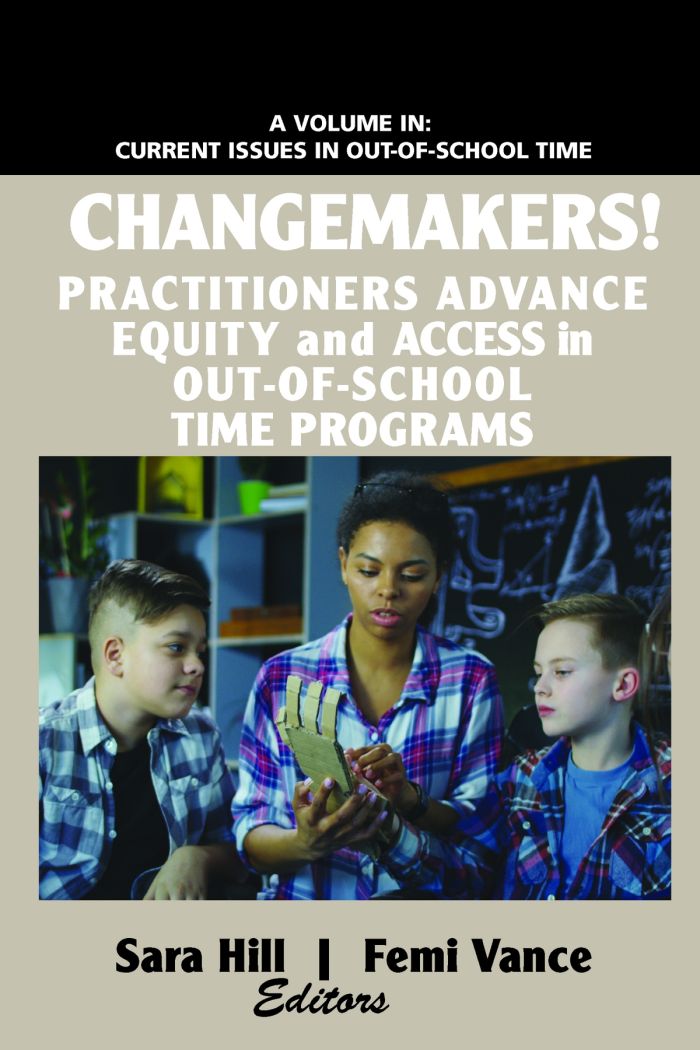
Changemakers! Practitioners Advance Equity and Access in Out-of-School Time Programs

This book can be opened with

Note on our eBooks and Audiobooks: you can read our eBooks (ePUB or PDF) and listen to audiobooks on the free Emerald Books app on iOS, Android, and desktop. Or read and listen on Emerald's online reader (ePUB eBooks and audiobooks only). To purchase a digital book you will need to create an account if you don’t already have one. After purchasing you will receive instructions on how to get started.
- Description
- Contents
A foundational tenet of the Out-of-School Time (OST) field is that all youth deserve impactful and engaging learning experiences. That requires that organizations, programs, and OST professionals remain responsive to the emerging needs of their diverse youth populations and the communities in which they live. This book illustrates the tensions that arise when organizations and OST professionals try to engage all youth, especially the traditionally underserved populations — when infrastructure, funding, and mindsets have not kept pace with the evolving needs of youth and their communities. The issues raised in this book — funding, outreach, engagement of immigrant families — have yet to be fully explored with an equity lens. Within these broad topics, this book brings to the surface the equity and access challenges as well as posit solutions and strategies.
Each chapter is written from an insider’s perspective, by practitioners themselves, who articulate some of the key and relevant issues in the field. Each chapter ends with a Research-Practice Connection section written by the editors, which discusses the topic from a research lens and generates a set of questions that can be used by researchers in future studies to explore the topic in a more in-depth, expansive manner.
Access in Out-of-School Time Programs; Sarah Zeller-Berkman.
- Part I. Introduction.
- Introduction; Sara Hill and Femi Vance.
- Part II. Shaping Organizations For Access And Equity.
- Chapter 1. Putting Our Minds to It: Implicit Bias and Advancing Equity in Youth Development; Kathryn Sharpe.
- Chapter 2. On the Level: Local Networks Creating Deeper and More Equitable School-Community Partnerships; Ken Anthony.
- Chapter 3. Extending a Mighty Hand: Outreach and Retention Strategies to Help Our Least Supported Youth; Rachel Loeper.
- Chapter 4. Rooted in Scarcity and Deficit: Time to Reconsider the Funding Process; Rebecca Fabiano.
- Chapter 5. What Does it Take to Provide Disabled Youth Access to Out-of-School Time Programs? Suzanne Stolz.
- Part III. Equity Through Critical Practice.
- Chapter 6. Critical Youth Development: Living and Learning at the Intersections of Life; Merle McGee.
- Chapter 7. Maintaining Momentum to Empower Boys and Young Men of Color in the Out-of-School Time Field; Jon Gilgoff.
- Chapter 8. Engaging Immigrant Families in Out-of-School Time Activities; Andrés Henríquez and Sonia Bueno.
- Part IV. Summary And Conclusion.
- Summary and Conclusion; Sara Hill and Femi Vance.
- Biographies.