
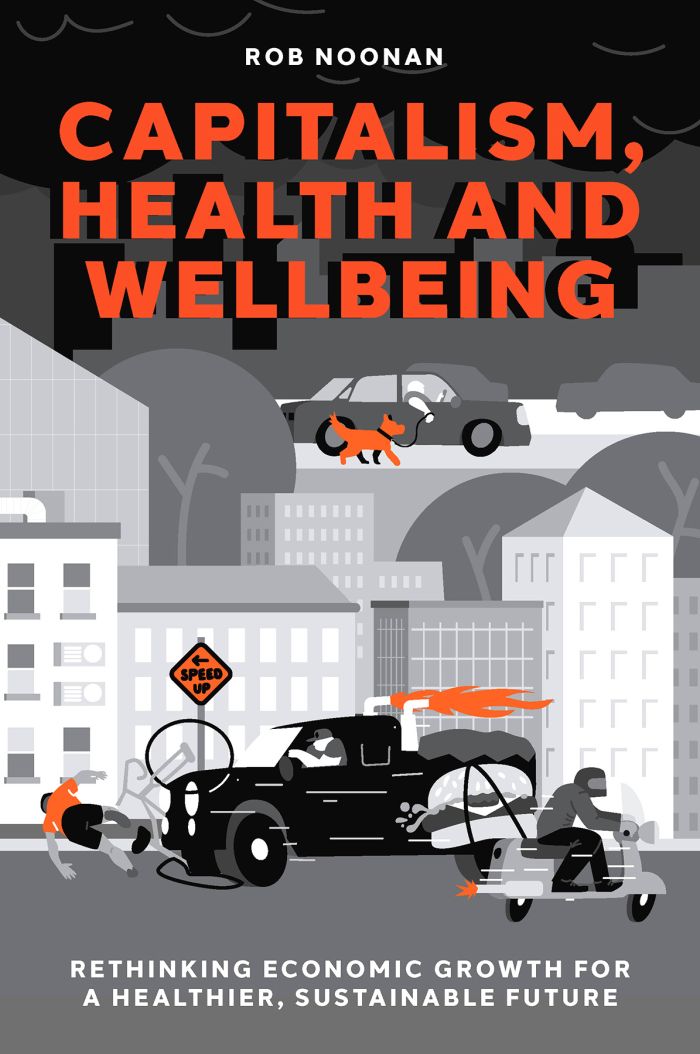

Capitalism, Health and Wellbeing
Rethinking Economic Growth for a Healthier, Sustainable Future

This book can be opened with

Note on our eBooks and Audiobooks: you can read our eBooks (ePUB or PDF) and listen to audiobooks on the free Emerald Books app on iOS, Android, and desktop. Or read and listen on Emerald's online reader (ePUB eBooks and audiobooks only). To purchase a digital book you will need to create an account if you don’t already have one. After purchasing you will receive instructions on how to get started.
- Description
- Contents
- Reviews
- About
Health inequalities are widening, and crises of obesity, physical inactivity and mental health are worsening around the world. Yet there remains a reluctance to discuss the threat capitalism poses to health and wellbeing. Offering a unique contribution to the field, Capitalism, Health and Wellbeing: Rethinking Economic Growth for a Healthier, Sustainable Future addresses the elephant in the room: economic growth.
Challenging this crucial yet overlooked issue, author Rob Noonan contends that the drive for economic growth is at odds with the United Nations' Sustainable Development Goals to achieve a better and more sustainable future. He argues that if the ‘health for all’ goal is to be achieved, it is imperative to redesign the economic system and social progress metrics that promote productivity and consumption at the expense of health and wellbeing. While clearly outlining the challenges governments face, Noonan offers solutions on how we can reverse the accelerating trends of obesity, physical inactivity and poor mental health, as well as how we can use scientific understanding and history to improve public health and reduce health inequalities.
Rooted in thoughtful evidence and achievable actions, this work empowers readers to contribute to positive transformation and create a healthier, more just and more sustainable world.
Introduction
- PART ONE-Canaries in the coal mine
- Chapter 1. Balance: Too much of anything is bad for us
- Chapter 2. Gross domestic product, productivity and social progress
- Chapter 3. The psychological toll
- Chapter 4. The physical toll
- PART TWO-Externalities and underpinning drivers
- Chapter 5. Income inequality
- Chapter 6. Disruption and uncertainty
- Chapter 7. Consumption and the drive to acquire
- Chapter 8. The rat race: keeping up and getting ahead
- Chapter 9. Working harder and for longer
- Chapter 10. The drive for productivity drives physical inactivity
- Chapter 11. Walking is great for health but not capitalism
- Chapter 12. The success game drives productivity and consumption
- PART THREE-Making better use of history and scientific evidence
- Chapter 13. The environment shapes our health
- Chapter 14. Thinking long-term
- Chapter 15. Conclusion
For those interested in health and wellbeing, this book is a must read. Drawing upon a wide range of sources, and through his simple and accessible writing style, Noonan explains how our current economic system drives many of the health and wellbeing issues we now face. Whether one speaks about growing income inequality or physical inactivity, one needs to understand the root causes of such problems. By eloquently explaining such causes – and offering solutions – Noonan enlightens the reader on how we can change society for the better.
Capitalism, Health and Wellbeing is a book aimed at health professionals, students who aspire to work in health promotion and the general public. While individual responsibility for modern health problems continues to be invoked, this book demonstrates that it is, on the contrary, collective choices, in particular of an elite, which make us sick. The link between capitalism and poor health no longer needs to be proven. We feel through Noonan's words the author's deep desire to fight against inequities. It is remarkable scientific work that he shares with us.
While there is now an extensive literature on how economics and politics drive the health – for better or worse – of populations, Rob Noonan of the University of Bolton has provided an accessible volume that brings all of this work together and links it to how we live our everyday lives. How is it that in nations such as the UK wealth has never been greater, yet at the same time the numbers of poor are increasing? For Noonan, the answer is our economic system with its relentless drive for growth that leads to excessive consumption for some and deprivation for many others. Such an analysis is long overdue, and the volume will open up many eyes to the sources – and possible solutions – of our growing health and social problems.
Robert Noonan has written an engaging and robust book which explains how the current economic system is damaging our health. It is a rebuke to those who argue that simply achieving more economic growth will improve the health of populations. It is essential reading for local and central government officials who want to understand how to make our populations healthier and how to reduce health inequalities.
Rob Noonan has written a book that should be read by all those of us who struggle to make sense of the economic model that governs how we live our lives. He describes in detail how governments have acquiesced in a system that disregards the welfare of the vast majority of their citizens while complaining about the growing cost of fixing the damage that their policies inflict on health and wellbeing. This book provides an excellent agenda for the things that must change.
A vital and sobering analysis of the impact of rising affluence: why is economic growth exacerbating health crises and how can the issue be fixed?
We are living at a time of multiplying crises in which the economic, social and environmental converge; global conflict is back to haunt us. This timely contribution challenges the capitalist paradigm that frames our health choices and offers a way out.
Rob Noonan is Reader in Health and Education at the University of Bolton, UK.