
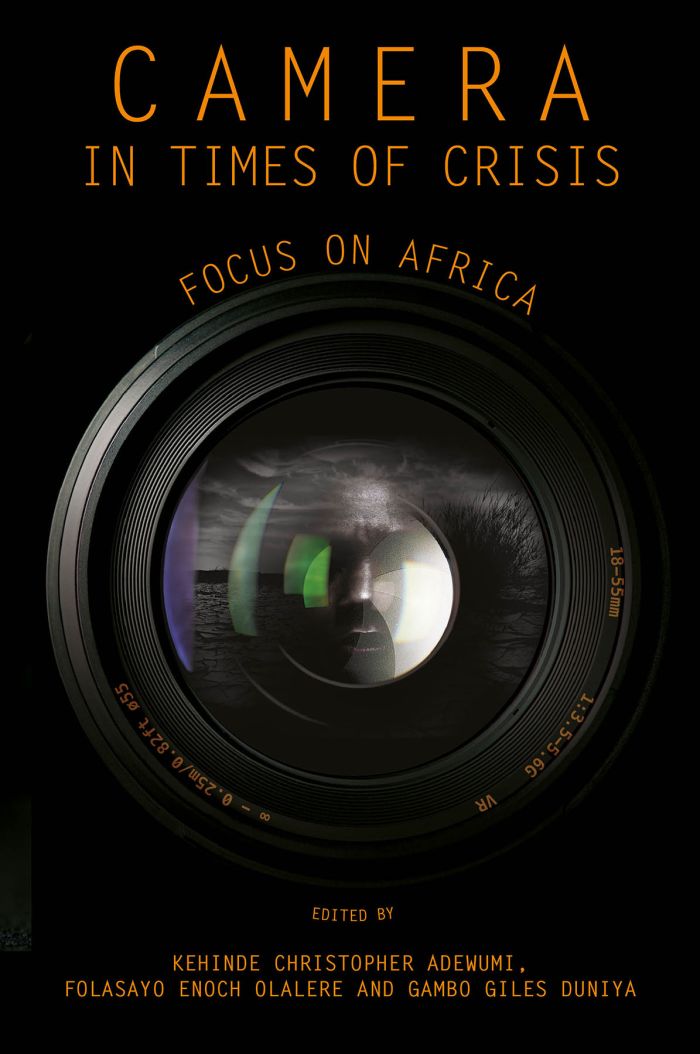

Camera in Times of Crisis
Focus on Africa

This book can be opened with

Note on our eBooks and Audiobooks: you can read our eBooks (ePUB or PDF) and listen to audiobooks on the free Emerald Books app on iOS, Android, and desktop. Or read and listen on Emerald's online reader (ePUB eBooks and audiobooks only). To purchase a digital book you will need to create an account if you don’t already have one. After purchasing you will receive instructions on how to get started.
- Description
- Contents
- About
Since the late 20th century, postcolonial Africa has faced various crises, from political and economic instability to public health and environmental emergencies, to inter-tribal conflicts. Throughout, the camera has remained a constant spectator, participant, and collaborator. With the advent of new media, the camera has become ubiquitous; Closed-Circuit Television (CCTV) cameras in private and public buildings, body cameras worn by the police, and in the hands of journalists, participants, or bystanders. The camera presents multiple narratives and counternarratives, sometimes corroborating or challenging the carefully curated reports offered to the public by governments. Through a combination of anecdotal evidence, case studies, and imagery,
Camera in Times of Crisis thoroughly investigates how the camera has participated in crises across the continent. Edited by communication experts Kehinde Christopher Adewumi, Folasayo Enoch Olalere, Gambo Giles Duniya, this timely work is reinforced by each academics’ unique expertise, covering the practical, historical, and artistic aspects of visual media in crisis.
Camera in Times of Crisis is an essential read for academics and general educated readers alike, discussing the ability of the camera as a tool to document historical events; to verify and legitimise narratives; to represent the other; and act as a beacon of hope, aid, and change.
Chapter 1. The Construction and Interrogation of Visual Narratives through the Camera in Times of Crisis: An Introduction; Gambo Giles Duniya
- Part I. Visual Narratives of Crises
- Chapter 2. Visualised Liminality: Images of an Empty African City; Hein Grové and Selma Schiller
- Chapter 3. Nigeria’s 2023 Currency Redesign Crisis: Evidential Photos and Comments; Chukwuemeka Nwigwe
- Chapter 4. The Role of the Camera in the (In)Validation of Narratives on Africa's Crises; Terkura Matthew Kunde
- Part II. Representation and Agency
- Chapter 5. Dichotomy of the Camera as a Tool for Representation and Agency in Times of Crises; Folasayo Enoch Olalere
- Chapter 6. Visualising Border Experiences through Participatory Filmmaking at the Moroccan-Spanish Border; Rhea M. Dehn Tutosaus
- Chapter 7. ‘He Who Pays the Piper’: Questioning Crises Framings and Visualities; Kehinde Christopher Adewumi and Samuila Rabo Ezra
- Chapter 8. The Endometriosis Experience: Narratives of Personal Crisis Utilising the Camera as a Tool of Validation; Micaela Scholtz
- Part III. Activism and Advocacy
- Chapter 9. Counting the Cost: Visual Activism and Advocacy in Times of Crisis in Africa; Kehinde Christopher Adewumi
- Chapter 10. Protest Photography: #Endsars Movement in Nigeria; Chike Chinazom Obeagu and Blaise Gundu Gbaden
- Chapter 11. Visual Crisis: A Thematic Analysis of Selected Protest Images; Adiwu Talatu Onkala and Abdulkadir Aliyu Yakubu
- Chapter 12. Communicating Peace in Benin City, Nigeria through the Lens of the Camera; Daniel Eromosere Omoruan, Sam Erevbenagie Usadolo, and Tanya Van Der Walt
Kehinde Christopher Adewumi is a Postdoctoral Research Fellow at the Durban University of Technology, South Africa. He is also the Curator-in-Chief and Co-founder of NowExpressions, a Curatorial Collective.
Folasayo Enoch Olalere is a Lecturer in Design at the Open University, UK, and an Honorary Research Fellow in the Faculty of Arts and Design at the Durban University of Technology, South Africa.
Gambo Giles Duniya is a Professor of Art History and Criticism at Ahmadu Bello University, Zaria, Nigeria.