
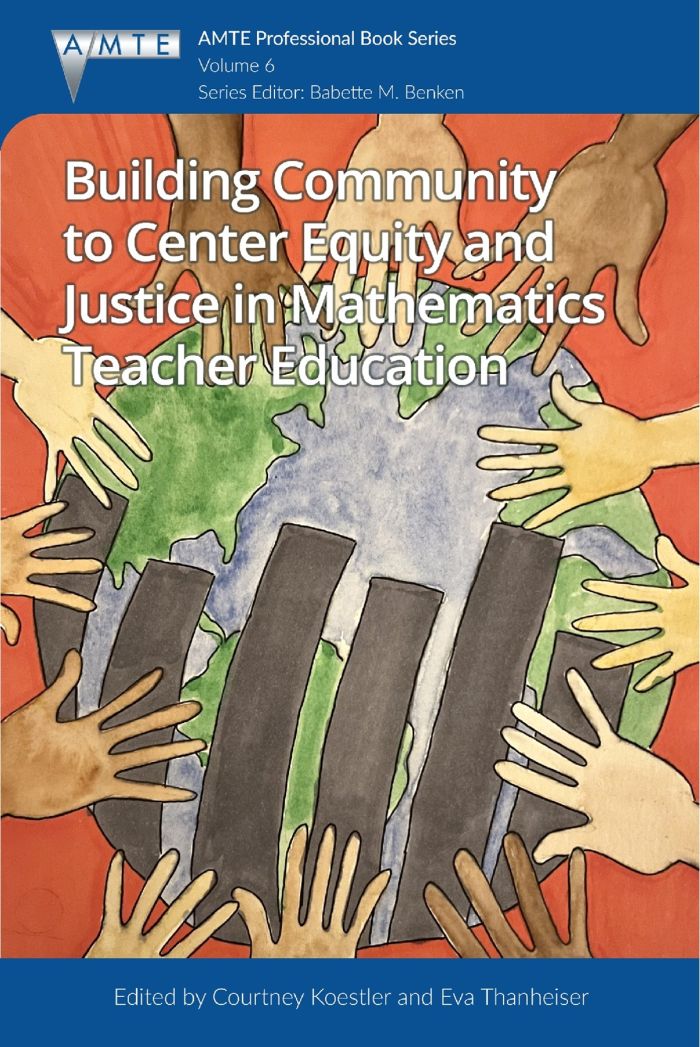

Building Community to Center Equity and Justice in Mathematics Teacher Education

This book can be opened with

Note on our eBooks and Audiobooks: you can read our eBooks (ePUB or PDF) and listen to audiobooks on the free Emerald Books app on iOS, Android, and desktop. Or read and listen on Emerald's online reader (ePUB eBooks and audiobooks only). To purchase a digital book you will need to create an account if you don’t already have one. After purchasing you will receive instructions on how to get started.
- Description
- Contents
- About
This new volume of the Association of Mathematics Teacher Educators (AMTE) Professional Book Series provides mathematics teacher educators practical ideas of how to build community to center conversations and action on equity and justice in mathematics teacher education. This 24-case collection of experiences from mathematics teacher educators (MTEs) expresses how they build community in the following kinds of settings in order to provide examples of how this work can be done in a variety of MTE contexts: Cases to Build Community with Prospective Teachers; Cases to Build Community in Professional Development with Practicing Teachers; and Cases to Build Community with Graduate Students and Fellow Mathematics (Teacher) Educators.
This book is written from and with a critical, practitioner stance and provides a variety of research-based cases (e.g., scenarios, tasks, modules, activities) to support MTEs to build community in mathematics teacher education courses and professional development collaborations. Creating learning communities that center on the joy, beauty, resiliency and variety of experiences and ways of knowing community members, particularly marginalized communities, is critical to promote agency and action that can support critical conversations that disrupt oppression in mathematics and mathematics teacher education.
Foreword; Enrique Galindo and Farshid Saf
- Chapter 1. Building Community to Center Equity and Justice in Mathematics Teacher Education: An Introduction; Eva Thanheiser and Courtney Koestler
- Section I: Cases To Build Community With Prospective Teachers
- Chapter 2. Cases to Build Community With Prospective Teachers: An Introduction; Crystal A. Kalinec-Craig
- Chapter 3. Case 1—Building a Community Through Equitable Noticing; Jonathan Thomas, Cindy Jong, Molly H. Fisher, Edna O. Schack, and Walker Mask
- Chapter 4. Case 2—Revealing Community Connections Through Slow Reveal Graphs; Amy Brass
- Chapter 5. Case 3—Embracing and Grappling With Dissent: Reflections on Community Building in a Mathematics Methods Course; José Martínez Hinestroza
- Chapter 6. Case 4—Designing for Dignity, Joy, and Solidarity Through Collective Mathematical Activity; Sandra Zuniga Ruiz and Mallika Scott
- Chapter 7. Case 5—Reexamining Prospective Teachers’ Experiences to Build Community for and Around Equity Work in P–2 Mathematics Classrooms; Jennifer Ward
- Chapter 8. Case 6—Community Journals in the Pre-Service Classroom: Creating Space for Growth; Lisa Poling and Cacey Wells
- Chapter 9. Case 7—Designing Inviting Spaces for Teacher Candidate Learning About Equitable Teaching Practices; Catherine Kaduk
- Chapter 10. Case 8—From Letters to Learning: Fostering Community Through Labor-Based Grading; Joshua T. Hertel
- Chapter 11. Case 9—Establishing the “We” With Prospective Elementary Teachers: Conversation Grids as Teaching Mathematics Methods as Agape; Joel Amidon and Jennifer A. Wolfe
- Chapter 12. Case 10—Centering Community Care and Love in the Preparation of Prospective Secondary Teachers: A Collective Responsibility Approach to Mathematics Teaching and Learning; Jennifer A. Wolfe and Joel Amidon
- Section II: Cases To Build Community In Professional Development With Practicing Teachers
- Chapter 13. Cases to Build Community in Professional Development With Practicing Teachers: An Introduction; Naomi A. Jessup
- Chapter 14. Case 11—Broken Circles: Building Inclusive Mathematics Communities; Joy A. Oslund, Lisa Jilk, Marcy B. Wood, and Sandra Crespo
- Chapter 15. Case 12—Creating an Inclusive Community: Professional Collaborations Between General and Special Education Teachers; Stefanie D. Livers and Kristin E. Harbour
- Chapter 16. Case 13—Developing Equitable Teaching Practices Through Facilitated Teacher Learning Communities; Lindsay Goldsmith-Markey, and Joy Anderson Davis
- Chapter 17. Case 14—Building Community Through Collaborative Observation: Structures and Moves to Intervene on Biases and Support More Equitable Instruction; Nicole Garcia, Meghan Shaughnessy, Deborah Loewenberg Ball, Darrius Robinson, and Simona Goldin
- Chapter 18. Case 15—A Journey From Content and Pedagogy to Justice: The Evolution of a Mathematics and Science Teacher Community of Practice; Michael D. Steele and Jenny Sagrillo
- Chapter 19. Case 16—Developing Critical Praxis in a Learning Community: A Case of Using the Acknowledgement, Action, and Accountability Framework to Interrogate Issues of Justice; Candace Joswick, Robin Keturah Anderson, Lisa Skultety, and Melissa Troudt
- Chapter 20. Case 17—(Re)Claiming Sacred Spaces: Male Educators of Color Speaking Truth to Power in the Classroom; Rajeev Virmani, Damien Mason, and Michael Suarez
- Section III: Cases To Build Community With Graduate Students And Fellow Mathematics (Teacher) Educators
- Chapter 21. Cases to Build Community With Graduate Students and Fellow Mathematics (Teacher) Educators: An Introduction; Anita A. Wager
- Chapter 22. Case 18—The Road to Find: Poetry as a Tool for Developing a Productive Community; Kate R. Johnson
- Chapter 23. Case 19—The ICUCARE Equity Framework: A Tool for Building Community to Center Equity and Justice With Doctoral Students; Pamela A. Seda and Laura R. Van Zoest
- Chapter 24. Case 20—A Novice Mathematics Teacher Educator Reading Group Devoted to Disrupting Systemic Racism in Teacher Education; Starlie Chinen, Michael Jarry-Shore, Sara Dozier, Faith Kwon, Miriam S. Leshin, and Hannah Nieman
- Chapter 25. Case 21—A Sense of Belonging: Building a Mathematics Teacher Educator Learning Community to Support Ourselves and Our Students; Amy Hillen, Darolyn A. Flaggs, Wendy B. Sanchez, Belinda P. Edwards, and Alison Hedrick
- Chapter 26. Case 22—Building Solidarity in Academic Borderlands: Developing Community and Political Conocimiento in a Mathematics Education Discussion Group; Alexa W. C. Lee-Hassan, Catherine Kaduk, Anita Kursell, and Elizabeth Rossiter
- Chapter 27. Case 23—Building Critical Community Through Identity Sharing; Molly Robinson, Eva Thanheiser, Courtney Koestler, Amanda Sugimoto, Simon Byeonguk Han, Matt Felton-Koestler, Jen Thompson, Laura Wolfe, and Howard Bartels
- Chapter 28. Case 24—Building Community to Advocate for Equity in Connecticut; Jillian M. Cavanna and Megan Staples
Courtney Koestler, PhD, is the director of the OHIO Center for Equity in Mathematics and Science and an associate professor of teacher education in the Patton College of Education at Ohio University, USA.
Eva Thanheiser, PhD, is a professor of mathematics education and the chair in the Fariborz Maseeh Department of Mathematics and Statistics at Portland State University, USA.