
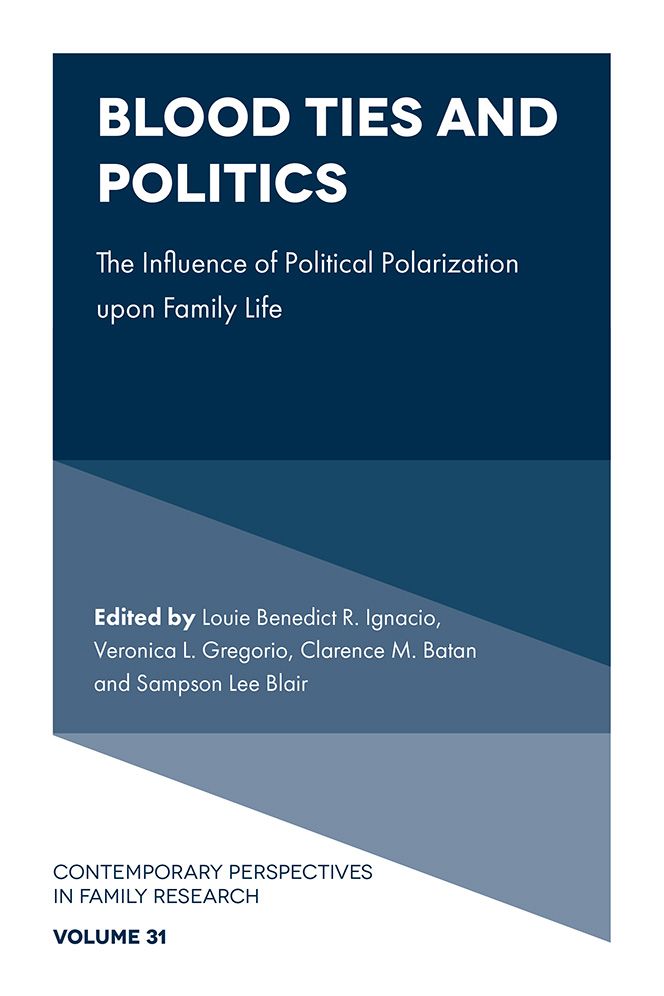

Blood Ties and Politics
The Influence of Political Polarization upon Family Life

This book can be opened with

Note on our eBooks and Audiobooks: you can read our eBooks (ePUB or PDF) and listen to audiobooks on the free Emerald Books app on iOS, Android, and desktop. Or read and listen on Emerald's online reader (ePUB eBooks and audiobooks only). To purchase a digital book you will need to create an account if you don’t already have one. After purchasing you will receive instructions on how to get started.
- Description
- Contents
- About
Over recent years, the nature of politics in nations around the globe has become increasingly heated and polarized, with much of this change being attributed to a variety of sources, including news outlets, online websites, social media, and various forms of communication technology. While researchers have long recognized how political beliefs are often passed on from one generation to the next within families, little is known about how the more disruptive and turbulent nature of contemporary politics is affecting families and family relationships. Blood Ties and Politics addresses the relationship between politics and the family.
Topics of discussion include political socialization within the family, the influence of extremist online websites, marital quality and political ideologies, political disagreement and family relationships, the impact of propaganda upon family relationships, intergenerational patterns of political beliefs, and other related issues. Encompassing the vast array of political beliefs, governmental forms, along with the multitude of family structures and relationships, the chapters come from a diversity of regions of the world, as well as of theoretical and methodological perspectives.
Part I. Family Influence on Political Participation and Leadership
- Chapter 1. The Pivotal Role of Family History in Writing Local History: The Case of the Barzagas in Dasmariñas City, Cavite (1986-2022); Elieser Nicolas and Jesus Medina
- Chapter 2. Pagnakura of the Bangsamoro Women in Tawi-Tawi, Philippines: How Dynastic Politics Enable Women’s Political Participation in Muslim Communities; Madzween Joy K. De Asis
- Chapter 3. ‘It’s in the Family’: Narratives of Learning and Doing Politics; Soumodip Sinha
- Part II. Family Dynamics and Political Polarization
- Chapter 4. Navigating Divergent Perspectives: Deconstructing Filipino Children’s Reddit Narratives on Having Parents with Opposing Political Views during the 2022 Presidential Election; Mark Christian J. Acido and Danica Mai N. Bernal
- Chapter 5. Respect My Opinion: A Case Study on the Political Relational Dialectics between Parent and Child; Gabriel S. Balerio, Kenosis Willer R. Capistrano, Ashley Corrine B. Eisma, Marwin C. Ignacio, and Kryzyll Laika Yvette T. Manoguid
- Chapter 6. Education during Polarisation: Investigating the Family Experiences of Students of NLM and MLN; Ankush Pal, Mohammad Ali, and Amber
- Part III. Transmission of Political Values across Generations
- Chapter 7. A Family Affair: A Systematic Review of Intergenerational Transmission Mechanisms of Political Values; John Mark H. Villanueva
- Chapter 8. Socialization into Politics: Parental Position-Taking and Value Formation in Children among Elite and Non-Elite Groups; Modesto Gayo and María Luisa Méndez
- Chapter 9. Uncovering the Dark Side: Social Capital and Political Beliefs in Filipino Families; Louie Benedict R. Ignacio, Paola Mari V. Jamola, Mark David C. Derayunan, and Quinito M. Gonzales
- Part IV. Cultural and Institutional Influence on Family and Politics
- Chapter 10. The Priority of Family over Justice: A Reflection of the Impact of the Cultural Revolution in China from the Perspective of Confucian Familism; Andrew Tsz Wan Hung
- Chapter 11. Conceptualizing Family Members as “Bantay”: Intersections with and Implications of Philippine Healthcare Policy; Jaconiah Shelumiel T. Manalaysay
- Chapter 12. Religion, Family, and Politics: Anti-Genderist Discourses in Singapore Muslim Friday Sermons from State-Supported Religious Organizations; Mohamed Hafiz
Louie Benedict R. Ignacio is a political sociologist and an Assistant Professor of Political Science and Sociology at the University of Santo Tomas (UST), Manila, Philippines.
Veronica L. Gregorio is a Lecturer at the College of Humanities and Sciences (Sociology and Anthropology), National University of Singapore.
Clarence M. Batan is a youth sociologist, Professor of the Department of Sociology, and Research Associate of the Research Center for Social Sciences and Education (RCSSED) at the University of Santo Tomas (UST), Manila, Philippines.
Sampson Lee Blair is a Family Sociologist and Demographer at The State University of New York, Buffalo, USA.