
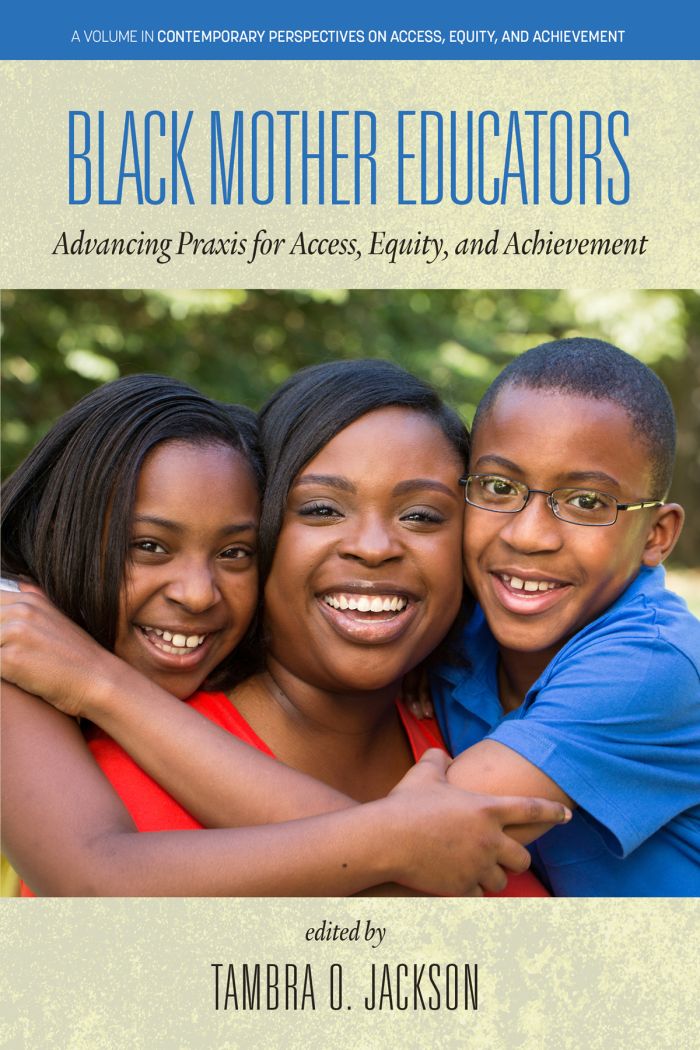
Black Mother Educators
Advancing Praxis for Access, Equity and Achievement

This book can be opened with

Note on our eBooks and Audiobooks: you can read our eBooks (ePUB or PDF) and listen to audiobooks on the free Emerald Books app on iOS, Android, and desktop. Or read and listen on Emerald's online reader (ePUB eBooks and audiobooks only). To purchase a digital book you will need to create an account if you don’t already have one. After purchasing you will receive instructions on how to get started.
- Description
- Contents
Drawing upon the theoretical frameworks of Beauboeuf-Lafontant (2002), Collins (2009), Crenshaw (1991), and Dillard (2012), this volume makes a case for centering the voices and experiences of Black women in the protection and educational uplift of Black children. While examinations of how Black educators articulate and enact a need to protect Black students from racialized harm exist (McKinney de Royston et. al., 2020), this book is a collection of autoethnographic narratives from Black mother educators who work at the intersections of their personal and professional identities to protect Black children. Intersectionality allows us to look at the nexus of our identities in regards to race, gender and occupation, as Black, women and educators. Our goal for this volume was to bring together scholars who can support theorizing the intersectionality of our identities as Black mothers and educators, particularly its influence on our pedagogical practices and the safekeeping of Black children. This volume explicates stories of motherwork from Black mother educators whose professional spaces span K-12 to higher education contexts. Collectivity, this volume expounds upon the dimension of 'protector' within the literature on Black women teachers.
Foreword: Black Mother Educators—Advancing Praxis for Access, Equity, and Achievement; Arnetha F. Ball.
- Introduction: Black Mother Educators—The Dora Milaje of Black Children in Schools; Tambra O. Jackson.
- Acknowledgments.
- Part I. Black Mother Educator Praxis In PK-12 Contexts.
- Chapter 1. Teaching Others How to Love Black Children: Insights From Early Childhood Educators and Teacher Educators; Gloria Swindler Boutte, Kamania Wynter-Hoyte, Janice Baines, and Mukkaramah Smith.
- Chapter 2. Advocate or Accomplice? School Counseling and Disproportionate Conduct Referrals of Young Black Boys; Jasmine Graham.
- Chapter 3. Black Women Principals as Protectors of Black Children: Othermothering, Resistance, and Leadership for Community Survival; Leana Cabral and Sonya Douglass Horsford.
- Chapter 4. The Guardians of Black Joy: Freedom Schools as Spaces of Healing and Protection for Black Children; Valerie Bass-Adams and Chonika Coleman-King.
- Part II. Black Mother Educator Praxis In Higher Education Contexts.
- Chapter 5. Caring for Those Who Are Not Always Cared About: Black Mother Educators Ensuring Access for Black Students With Dis/abilities; Mercedes Cannon.
- Chapter 6. Channeling Queen Nzinga in the Fight Against Dysconsciousness at Historically Black Colleges and Universities; Gwenda Greene and Damara Hightower Mitchell.
- Chapter 7. Becoming Mama K: Accepting the Responsibility of Protecting Black Children in Higher Education Institutions; Khalilah Shabazz.
- Chapter 8. Formalizing Black Othermothering Practices in the Academy: Establishing and Maintaining Nurturing and Supportive Mentoring Relationships With Black Students at Predominantly White Colleges and Universities; Ronda C. Henry Anthony.
- Part III. Black Mother Educator Praxis As Resistance.
- Chapter 9. Put Your Mask On First: Intensive Black Mothering in Personal and Professional Spaces; Rhonda Baynes Jeffries.
- Chapter 10. Distractions Cannot Be Bigger Than the Mission: Black Women's Motherwork in Urban Education; Tambra O. Jackson and Ayana Allen-Handy.