
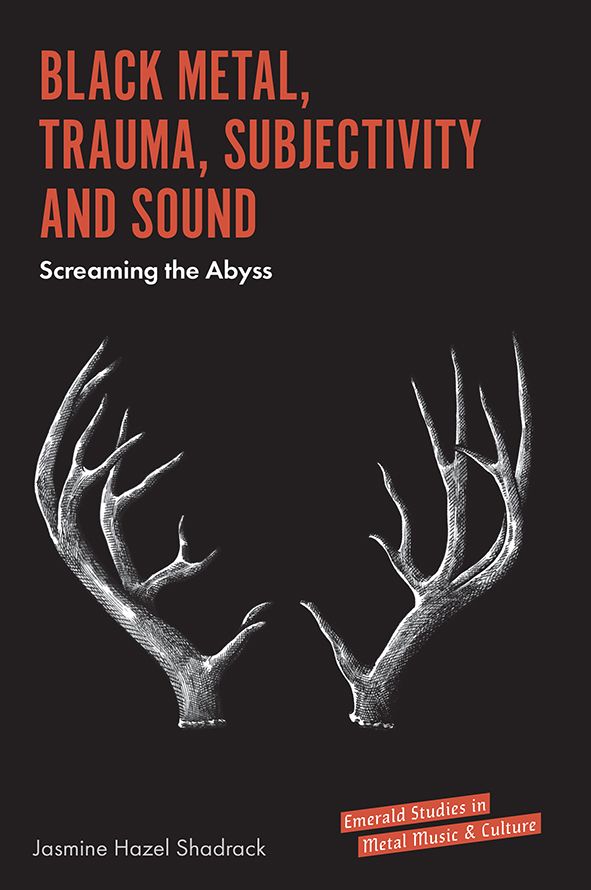

Black Metal, Trauma, Subjectivity and Sound
Screaming the Abyss

This book can be opened with

Note on our eBooks and Audiobooks: you can read our eBooks (ePUB or PDF) and listen to audiobooks on the free Emerald Books app on iOS, Android, and desktop. Or read and listen on Emerald's online reader (ePUB eBooks and audiobooks only). To purchase a digital book you will need to create an account if you don’t already have one. After purchasing you will receive instructions on how to get started.
- Description
- Contents
- Reviews
- About
Chapter 1. Interpretive Performance Autoethnography Chapter 2. “Women! Stop Ruining Metal!” Mapping Extreme Metal Chapter 3. Black Metal’s Historical Analysis: The Story of Male Metal Chapter 4. The Feminine Absent Chapter 5. Of Wolves and Witches Chapter 6. Denigrata as Performance Chapter 7. Conclusion. Liber Sum: Restorative Visibility and the Feminine Present Epilogue from Rebecca Lamont-Jiggens Peroration: Dying Words as Abominable Lifeblood
'Shadrack's brave usage of autoethnography to explore how black metal is a movement beyond music presents a new and refreshing paradigm through the exploration of an often-misunderstood subculture. Her skill in intertwining methodology with her own subjective reflexivity is an important and much-needed addition to gender, music, and performance studies.'
'Seldom do we as scholars get to interact with a professional musician who sees their work as autoethnographic; even more seldom do we see that valuable and difficult work coming from women in genres such as heavy metal. With an eye on both critical theory and musical performance, Dr Shadrack creates an interwoven story of personal experience, gender studies and women’s studies, sexual oppression and sexual violence, and brings forth deep discussions of religion, iconography, existentialism, women’s voices in and out of metal, and the many ways in which women are symbolized, represented and delimited. It is a ground-breaking work, one that continues a line of work in gender and heavy metal that represents some of the best work on gender in publication right now. The image of Denigrata Herself, the horned goddess screaming into the patriarchy, is an icon for our times.'
Dr Jasmine Shadrack has accomplished a tremendous feat in this book: as an autoenthnographic study, she has combined the rigours of academic research with an unsurpassed level insight that sets a new standard in how reflection and experience can be expressed. Despite its complexity, the text is extremely accessible and weaves a narrative making it a guide for others on how music and the arts can be a friend to those suffering from the effects of trauma and abuse where the two intersect. This is a book of hope and a source of healing. Even though it articulates a principled stand through Shadrack’s use of Black Metal, the relevance of her discussion reaches far beyond the music culture where she finds her solace. Her work will resonate with a wide ranging audience, not only those working in the field of gender, feminism, metal studies and cultural studies, but also the many victims of abuse, marginalization and those suffering oppression.
Jasmine Hazel Shadrach’s Black Metal, Trauma, Subjectivity, and Sound: Screaming the Abyss takes a personal look at experiences of misogynistic violence, disability, and the powerful cathartic potential of musical performance.
Make no mistake - this is a tough and complex subject and this book is characterized by unflinching emotional honesty; it is also beautifully written and exquisite in its richness, depth, and academic rigor. Despite the autoethnographic framework, Black Metal, Trauma, Subjectivity and Sound: Screaming the Abyss is not insular and inward-looking but rather remarkably far-reaching in its insight and relevance. It will resonate particularly with those working within the fields of music, gender, feminism, disability or cultural studies. It is an account of healing, of restoration, of reconstitution of self through music. I cannot recommend it highly enough.