
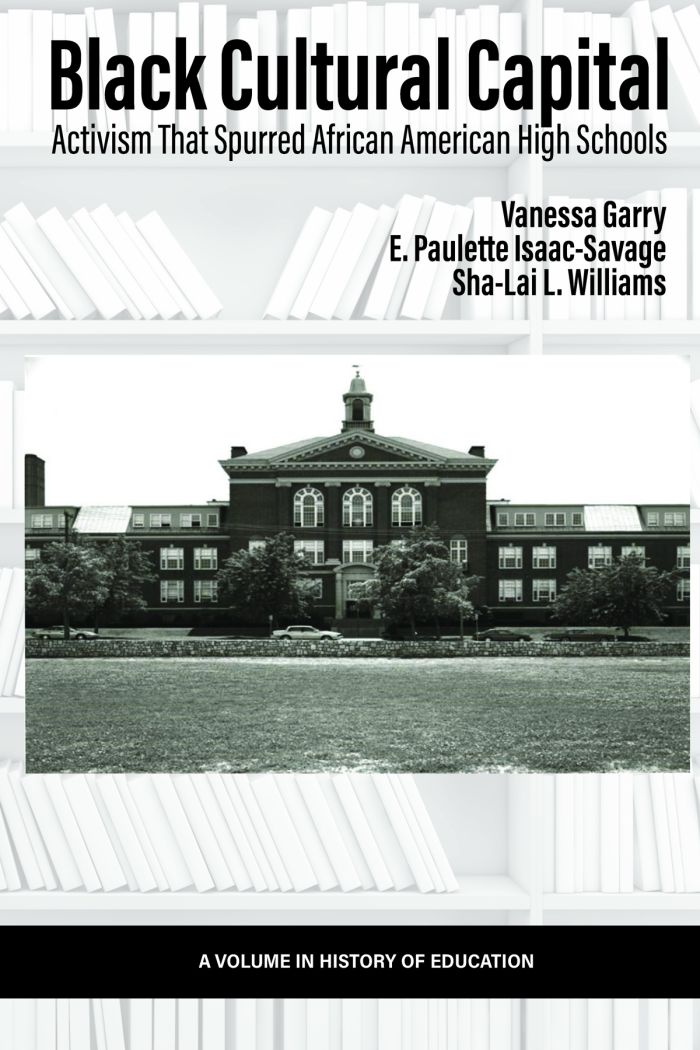

Black Cultural Capital
Activism That Spurred African American High Schools

This book can be opened with

Note on our eBooks and Audiobooks: you can read our eBooks (ePUB or PDF) and listen to audiobooks on the free Emerald Books app on iOS, Android, and desktop. Or read and listen on Emerald's online reader (ePUB eBooks and audiobooks only). To purchase a digital book you will need to create an account if you don’t already have one. After purchasing you will receive instructions on how to get started.
- Description
- Contents
In antebellum America, Black children, even those of tax-paying Blacks in most states could not attend White public schools or in some states any schools. Nevertheless, with the signing of the Emancipation Proclamation in 1863, Blacks assumed they would receive all inalienable rights granted to them as American freedmen. For most, the right to a proper public education for their children was paramount. Nevertheless, White educators often neglected or poorly implemented Black schools, especially secondary schools. With their reluctance to provide schools for Blacks, African American communities organized and petitioned school districts to develop Black schools on par with those for Whites. In the book, Black Cultural Capital: Activism that Spurred African American High Schools, authors describe the role of the Black community in the development of high schools. Their narratives reveal White educators’ unwillingness to implement state laws requiring the education of all children. Their lack of engagement galvanized Blacks to petition boards to adhere to the law. Additionally, they forced school districts to hire Black teachers and provide facilities for Black children equal to those of White children. The fruits of their labor enabled Black children to attend suitable facilities, as well as learn from Black teachers who attended outstanding White and Black colleges and universities. Furthermore, stories of the high schools illustrate how communities sprouted up around them during their heydays as well as, for some, their demise as laws and court decisions eradicated Jim Crow and enabled all Americans to live and learn where they desired.
Preface; Jared R. Stallones.
- Introduction: Black Cultural Capital: Activism That Spurred African American High Schools; Vanessa Garry, E. Paulette Isaac-Savage, and Sha-Lai L. Williams.
- Chapter 1. Institute for Colored Youth (Cheyney University): Philadelphia, PA; Molly E. O'Connor.
- Chapter 2. Lincoln High School during De Jure Segregation: Exploring the Importance of Social and Cultural Capital; Bradley Poos, Loyce Caruthers, and Marceline Cooley.
- Chapter 3. The Sumner High School: An Educational Landmark Made by the Black Community; E. Paulette Isaac-Savage and Vanessa Garry.
- Chapter 4. A Historical Study of I.M. Terrell High School: Its Legacy and Implications for Improved Education of Black Students; Tasha Coble Ginn.
- Chapter 5. Frederick Douglass High School, Baltimore; William P. Kladky.
- Chapter 6. We're Your Sons and Daughters¦Guide Us as We Go: The Role of Harbison Junior College, Richlex School, and Their Communities in the Development of Cultural Capital; Vann Holden.
- Chapter 7. Douglass High School (1891-): A Place of Justice and Hope in Oklahoma City; Autumn B. Brown and Lucy E. Bailey.
- Chapter 8. A Labor of Love: The Origin, Development, and Legacy of A.H. Parker High School in Birmingham, Alabama; Penny S. Seals.
- Chapter 9. A Portrait of Como High School, Fort Worth, Texas; Altheria Caldera.
- Chapter 10. Beyond the Years: Dunbar High School 1916-1968; M. Francyne Huckaby, Stephanie Cuellar, Michelle Nguyen, Leslie Ekpe, Rachel Brooks, Kellton Hollins, and Jonathan W. Crocker.
- Chapter 11. For the Good of the Whole: Restor(y)ing the History of Georgia's First Black Public High School; Amber M. Neal-Stanley.
- Chapter 12. Turn Around, Reach Back, Lead: Legacy and Lives of the Howard W. Blake High School; Vonzell Agosto, Jacqueline K. Haynes, and Ann Marie Mobley.
- Epilogue; Vanessa Garry, E. Paulette Isaac-Savage, and Sha-Lai L. Williams.
- Biographies.