
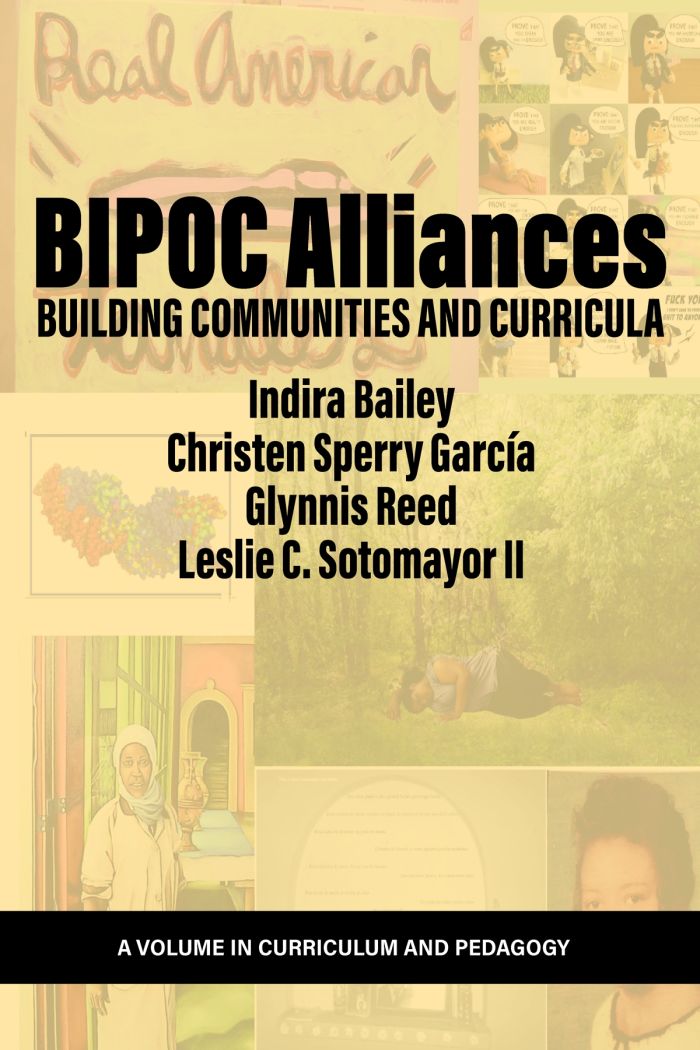
BIPOC Alliances
Building Communities and Curricula

This book can be opened with

Note on our eBooks and Audiobooks: you can read our eBooks (ePUB or PDF) and listen to audiobooks on the free Emerald Books app on iOS, Android, and desktop. Or read and listen on Emerald's online reader (ePUB eBooks and audiobooks only). To purchase a digital book you will need to create an account if you don’t already have one. After purchasing you will receive instructions on how to get started.
- Description
- Contents
BIPOC Alliances: Building Communities and Curricula is a collection of reflective experiences that confront, challenge, and resist hegemonic academic canons. BIPOC perspectives are often scarce in scholarly academic venues and curriculum. This edited book is a curated collection of interdisciplinary, underrepresented voices, and lived experiences through critical methodologies for empowerment (Reilly & Lippard, 2018). Gloria Anzaldua’s (2015) autohistoria-teoría is a lens for decolonizing and theorizing of one’s own experiences, historical contexts, knowledge, and performances through creative acts, curriculum, and writing. Gloria Anzaldua coined, autohistoria-teoría, a feminist writing practice of testimonio as a way to create self-knowledge, belonging, and to bridge collaborative spaces through self-empowerment. Anzaldua encouraged us to focus towards social change through our testimonios and art, '[t]he healing images and narratives we imagine will eventually materialize' (Anzaldua & Keating, 2009, p. 247).
For this collection, we use lived experience or testimonios as an approach, a method, to conduct research and to bear witness to learners and one’s own experiences (Reyes & Rodríguez, 2012). Maxine Greene’s (1995) concept of an emancipated pedagogy merges art, culture, and history as one education that empowers students with Gloria Anzaldua’s (2015) autohistoria-teoría to re-imagine individual and collective inclusion by allowing students '... to read and to name, to write and to rewrite their own lived worlds' (Greene, 1995, pp. 147). Greene and Anzaldua reach beyond theorizing and creating curriculum for awareness and expand the crossings into active and critical self- reflective work to rewrite one’s own empowered stories and engage in a healing process.
Introduction; Indira Bailey, Leslie C. Sotomayor II, Christen Sperry Garcia, and Glynnis Reed.
- Part I. Testimonios.
- Chapter 1. Testimonios and Microaggressions: BIPOC Student Experiences in Academia Through a Creative Collaborative Series of Letters; Leslie C. Sotomayor II, Kelvin K. Boakye, Maya Ilayne Kirkland, Bianca Isabela Rodriguez, and Chloe Grace Ferrer.
- Chapter 2. Claiming/Reclaiming Space: Chicana/x Latina/x Working Group (CLWG) Experience; Esther Medina De León.
- Chapter 3. Visual Testimonios: Artist/Writer Acts of Resistance and Recovery; Christen Sperry García, Leslie C. Sotomayor II, Alexis Marie Ramos, Elizabeth Gonzalez, Ricky Sullivan, Lourdes Garcia, Adilene Rosales, Rocio Guerrero, Mandy Wilson, and Nydia Salinas.
- Chapter 4. Home, Family, and History: Highlighting an Underrepresented Geographic and Cultural Narrative; Gina Gwen Palacios.
- Chapter 5. A Chicano-ish, Chicano, Chican@, or ChicanX Artist Statement; Paul Valadez.
- Chapter 6. (Re)membering, (Re)constructing, and (Re)imagining Experience: Decolonizing Epistemological and Ontological Assumptions Formed in the Academy Through the Use of Autohistoria-Teoría in the Classroom; Kristin Alder.
- Part II. Lived Experiences/identities.
- Chapter 7. Black Art Visuality: (Re)Directing the Black Gaze in Art Education; Indira Bailey.
- Chapter 8. Paper Thin Boundaries; Glynnis Reed.
- Chapter 9. When and Where I Enter: A Reflective Essay on the Photographic History of Three Generations of Black Women Educators; Meghan Green.
- Chapter 10. ode to cymone and will (ode is a really white, really funny word); Samuel Jaye Tanner.
- Chapter 11. Defining Belonging in Classrooms: Collected Narratives From Two Educators in Art and Science at Higher Education Institutions; Kyungeun Lim and Soon Goo Lee.
- Chapter 12. Centering Asian Women's Feminist Anger Using Zines in Art Education; Eunkyung Hwang.
- Part III. De-centering White Curricular Canons.
- Chapter 13. Witnessing Calls to Action: An Anti-Racist Education Through a Public Curriculum of the Arts; Addyson Frattura and Yotam Ronen.
- Chapter 14. Building Better Curriculum Through Black Hair; Linda Hoeptner Poling and Juliann Dorff.
- Chapter 15. BIPOC Perspectives and Subaltern Voices: The Doubly Oppressed Subject of the Marginalized Feminist Artist; Maia Toteva.
- Chapter 16. Disrupting and Transgressing the Canon: Including BIPOC Voices; Rochonda L. Nenonene, Novea A. McIntosh, and R. Darden Bradshaw.
- Chapter 17. Reclaiming our Indigeneity: Deconstructing Settler Myths Through Micro-Activism; Rosalva Resendiz, Lucas Enrique Espinoza, and Luis Enrique Espinoza.
- Contributors.