
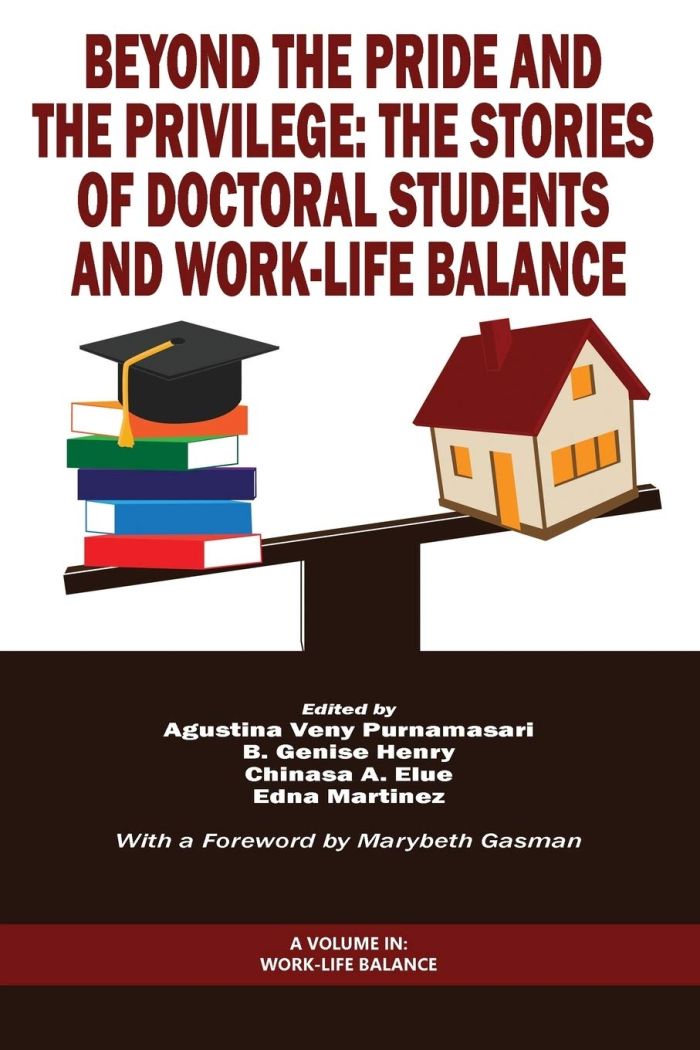
Beyond The Pride and The Privilege
The Stories of Doctoral Students and Work-Life Balance

This book can be opened with

Note on our eBooks and Audiobooks: you can read our eBooks (ePUB or PDF) and listen to audiobooks on the free Emerald Books app on iOS, Android, and desktop. Or read and listen on Emerald's online reader (ePUB eBooks and audiobooks only). To purchase a digital book you will need to create an account if you don’t already have one. After purchasing you will receive instructions on how to get started.
- Description
- Contents
Attrition among doctoral students has become a perennial issue in higher education (Gardner, 2009; Golde, 2000) as 40 to 60 percent of doctoral students do not complete their program of study (Bair &Haworth, 2005). Such outcomes are inconsistent with the rigorous evaluation that occurs prior to being accepted into a doctoral program (Bair & Haworth, 2005). Despite deemed levels of student excellence, promise and efforts made by programs to counter student departure (Offerman, 2011), attrition rates remain alarmingly high (Bair & Haworth, 2005; Gardner, 2009).
The purpose of this book is to provide a view into doctoral student work-lives and their efforts to find a balance between often seemingly conflicting responsibilities. In addition to contributing to the ongoing dialogue on work-life balance in doctoral studies (Brus, 2006; Golde, 1998; Moyer, Salovey, & Casey-Cannon, 1999), the intention of this book is to provide other doctoral students with potential coping mechanisms, guidance, and assurance that they are not alone in this process.
Lastly, we anticipate that these doctoral student narratives will help illuminate potential strategies that doctoral programs, departments, and institutions can incorporate in their efforts to help students successfully complete their program of study. As such the intended audience is doctoral students, higher education professionals, faculty members, and educational leaders.
Foreword, Marybeth Gasman.
- Introduction, Agustina Purnamasari.
- Chapter 1. Rearranging My Plate: A Doctoral Journey, Paul Artale.
- Chapter 2. Learning to Inhale, Charlotte Achieng-Evensen.
- Chapter 3. Flying, Falling, and the Space Between, David M. Brown.
- Chapter 4. Living to Learn and Learning to Live: A Story of Perspective, Professionalism, Purpose, and Perseverance, Melissa R. Byrne.
- Chapter 5. Difficult Choices, Simple Decisions, Keith Cunningham.
- Chapter 6. Tying Life Together, Taurean Davis.
- Chapter 7. Tick, Tock-Clock: The Never-Ending Clock, Chinasa A. Elue.
- Chapter 8. Piecing the Puzzle Together and Decorating Our Lives: Work-Life Balance and the Sacredness of Everyday Experiences, B. Genise Henry.
- Chapter 9. Deseando Todo (Desiring It All): Balancing Work and Life as a Latina in the Academy, Olga Martinez Hickman.
- Chapter 10. Finding Balance by Authoring Your Own Life, Jennifer M. Horace.
- Chapter 11. Maintaining Work-Life Balance at the Crossroads of Culture, Éva Kardos.
- Chapter 12. Late Night Pillow Talk: A Couple's Reflections on Balancing Marriage, Parenthood, and PhDs, Daniel Lipe and Kaiwipuni Lipe.
- Chapter 13. The Juggling Act: Finding Work-Life Balance with a Little Help! Bibiana Mancera.
- Chapter 14. Mi Vida Loca: My Crazy Life as a Full-Time Doctoral Student, Edna Martinez.
- Chapter 15. Raising Diego: Work Is Work, Family Is Everything, Marlen Kanagui-Muñoz and José Muñoz.
- Chapter 16. Once Upon a Time (There Was a Balanced Life), Agustina Veny Purnamasari.
- Chapter 17. Using the Skills at the Ecologies to Balance Work, Home, and School as a Doctoral Student, Dagoberto Eli Ramirez.
- Chapter 18. Soaring on the Wings of Sankofa: Ethnographical Retrospective of a Black Woman Pursuing the PhD, Juhanna Rogers.
- Chapter 19. Write, Run, Repeat: A Rewarding Marathon to the PhD and Wellness, Leslie Jo Shelton.
- Chapter 20. Menudo for the Spirit, Marissa Vásquez Urias.
- Chapter 21. Deadlines and Trying to Survive: My Life as a Doctoral Student, James Vines.
- Notes.
- Author Biographies.