
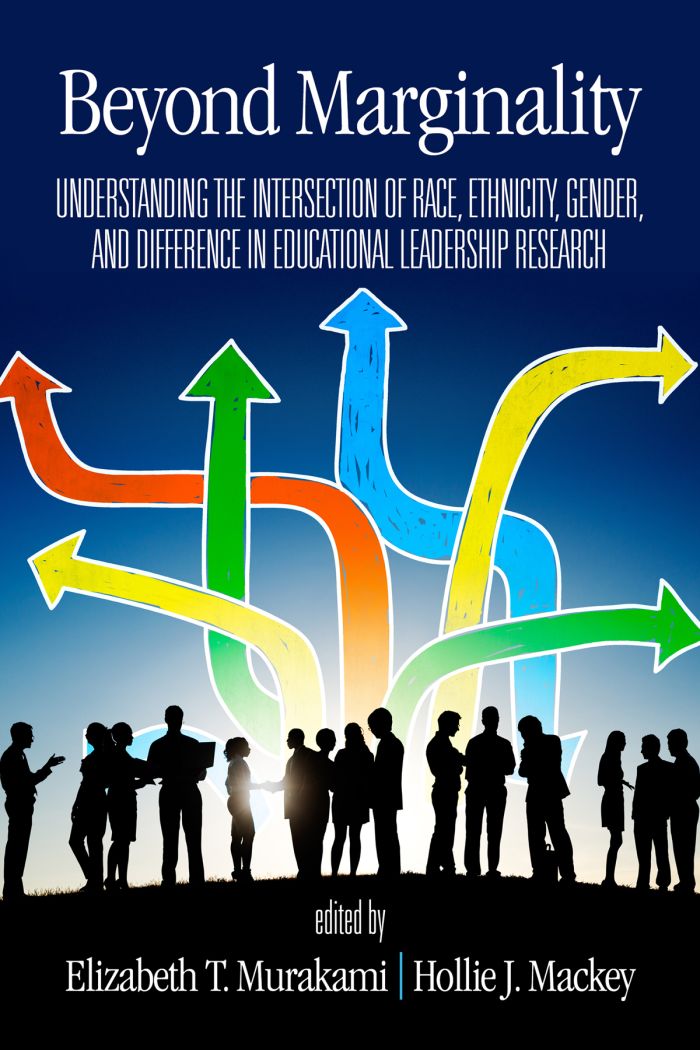

Beyond Marginality
Understanding the Intersection of Race, Ethnicity, Gender and Difference in Educational Leadership Research

This book can be opened with

Note on our eBooks and Audiobooks: you can read our eBooks (ePUB or PDF) and listen to audiobooks on the free Emerald Books app on iOS, Android, and desktop. Or read and listen on Emerald's online reader (ePUB eBooks and audiobooks only). To purchase a digital book you will need to create an account if you don’t already have one. After purchasing you will receive instructions on how to get started.
- Description
- Contents
The book Beyond Marginality: Understanding the Intersection of Race, Ethnicity, Gender and Difference in Educational Leadership Research promotes new theoretical and conceptual frameworks for the study of race and ethnicity in educational leadership. In this volume, new generations of scholars of color are moving beyond research that has not been necessarily focused or generated by diverse groups. The authors are purposeful in transcending systemic inequities and injustices in the stratified representation of practitioners and researchers by bringing in a new movement with innovative and impactful theoretical and conceptual frameworks in educational leadership.
Preface: Honoring Difference — The New Norm in Educational Research? Susan C. Faircloth (Coharie).
- Introduction: The Need for Alternative Theoretical and Conceptual Frameworks for the Study of Race, Gender, and Ethnicity in Educational Leadership; Elizabeth T. Murakami and Hollie J. Mackey.
- Section I. Conceptualizing Frameworks That Considers Race, Gender, Ethnicity, and Difference in Educational Leadership.
- Chapter 1. Access to Opportunity Framework: Conceptualizing Class to Race; Hugh M. Potter and Brian Boggs.
- Chapter 2. Preparing Educational Leaders for Queer Inclusion in Schools; Valerie Royaltey-Quandt.
- Chapter 3. Conceptualizing Indigeneity and Gender in Educational Leadership Inquiry: Applying a Framework for Systemic Critique to Problems of Practice; Hollie J. Mackey.
- Chapter 4. Developing Culturally Responsive Mentoring in the Professoriate: A Theoretical Model; Brenda Lloyd-Jones and Marilyn Y. Byrd.
- Chapter 5. Grappling With Methods and Methodologies: The Tug of War of Following Our Heart and the Research Process; Liliana E. Castrellón, Rudy Medina, and Nereida Oliva.
- Chapter 6. American Indian/Alaska Native Graduate Student Experience in STEM: Conceptual Perspectives; Catherine M. Johnson, Carrie B. Myers, Kelly A. Ward, Dusten R. Hollist, and Nick Sanyal.
- Section II. Theory to Practice Frameworks That Considers Race, Gender, Ethnicity and Difference in Educational Leadership.
- Chapter 7. Employing an Affective, Linguistic, and Cognitive (ALC) Framework: An Asset-Based Approach to School Leadership; Fernando Valle, Irma Almager, and Vanessa de León.
- Chapter 8. A Cross-National Framework for the Study of Latina/o School Leaders in Mexico and Texas; Elizabeth T. Murakami, Carmen Celina, and Torres Arcadia.
- Chapter 9. A Proposition for a Holistic Approach to Adaptation and a Unified Sense of Self: A Conceptual Framework in Educational Settings; Detra D. Johnson.
- Chapter 10. Conceptual Model of Traditional and Nontraditional Forms of Parental Involvement of English Language Learners; Joseph N. Cerna.
- Chapter 11. The Role of Gender and Transformational Leadership: A Synopsis; Janelle C. Simmons.
- Chapter 12. Galvanizing Inclusivity: A Conceptual Framework for Actionable Strategies to Cultivate Inclusive Schools; Rana Tasnin Razzaque.
- Chapter 13. Leadership in Practice: A Paradigm to Support Educational Leaders of African American Male Students; Lawrence L. Scott II.
- Section III. Conclusion.
- Chapter 14. Conclusion: Guiding Frames and Centering Context for Race, Ethnicity, Gender, and Difference in Educational Leadership Research; Hollie Mackey and Elizabeth T. Murakami.
- Chapter 15. Epilogue: Moving Beyond Marginality; Gaïtane Jean-Marie.
- About the Editors.
- About the Contributors.