
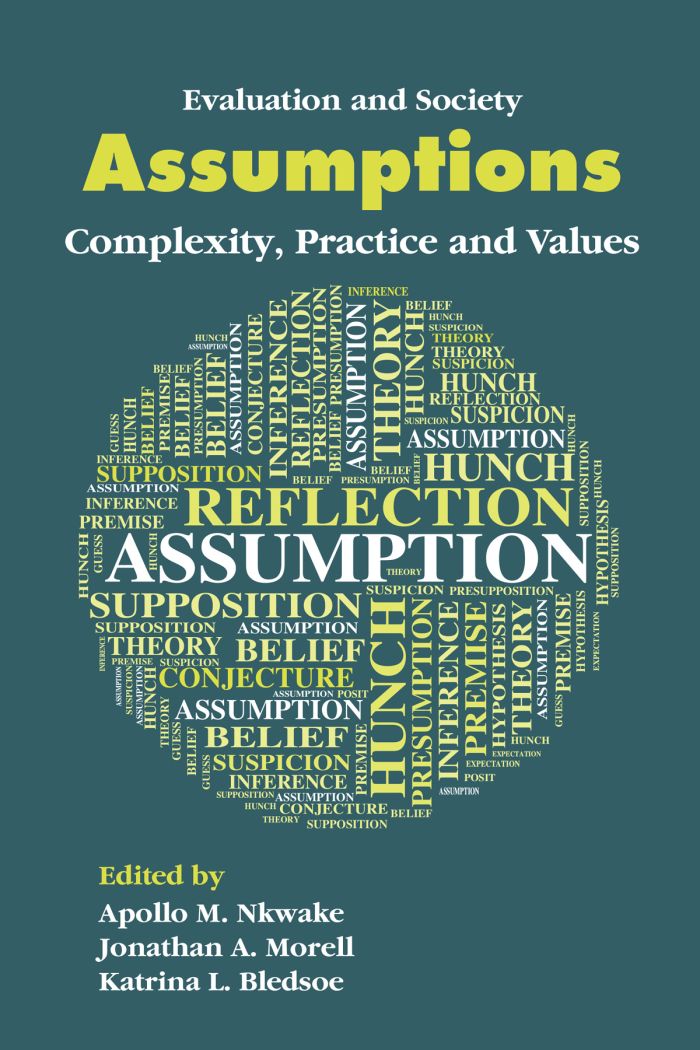

Assumptions
Complexity, Practice and Values

This book can be opened with

Note on our eBooks and Audiobooks: you can read our eBooks (ePUB or PDF) and listen to audiobooks on the free Emerald Books app on iOS, Android, and desktop. Or read and listen on Emerald's online reader (ePUB eBooks and audiobooks only). To purchase a digital book you will need to create an account if you don’t already have one. After purchasing you will receive instructions on how to get started.
- Description
- Contents
- About
Assumptions: Complexity, Practice and Values delves into the empirical and theoretical aspects of assumptions in evaluation, offering methodologies to identify and categorize them, and exploring how they influence evaluations and each other. It provides practical guidance for evaluators to help stakeholders identify priorities and plan effective programs, while also presenting conceptual insights into the nature of assumptions and their impact on both programs and evaluations. The chapters push the boundaries of our understanding of assumptions in the field and propose a research agenda to deepen our knowledge and improve evaluation practices.
Addressing assumptions is a cornerstone of evaluative thinking, crucial for uncovering the beliefs that guide stakeholders' decisions and actions. This book emphasizes how these assumptions shape the evaluation process, determining the questions asked and the answers sought. By examining these underlying beliefs, evaluators can conduct more meaningful evaluations that truly reflect the needs and realities of the programs they assess.
This book also equips methodologists with the tools to design evaluations that yield actionable insights for decision-makers. Practitioners will learn to monitor their own and their stakeholders' assumptions to avoid biases and leverage deeper understanding in their work. Program funders and designers will gain the knowledge to implement more effective programs and avoid unintended consequences. Evaluation educators will find valuable content to enhance their teaching, and researchers will discover new directions for their studies. Ultimately, Assumptions aims to enrich evaluators' ability to reveal and prioritize the most consequential assumptions in their work.
Chapter 1. Introduction: Assumptions: Complexity, Practice and Values; Apollo M. Nkwake
- Chapter 2. Assumptions Through a Complexity Lens; Jonathan A. Morell
- Chapter 3. Evolving Evaluation Premises and Principles for Working with Assumptions in the Polycrisis; Michael Patton
- Chapter 4. Adaptation of Assumptions Based Evaluation to deal with Complexity, Values and Different Perspectives; Osvaldo Néstor Feinstein
- Chapter 5. Working smartly with assumptions in programs: Results from a Survey on Assumptions; Godfrey Senkaba
- Chapter 6. Working with program theory assumptions in a school related gender-based violence (SRGBV) prevention intervention; Apollo M. Nkwake and Daniel Lavan
- Chapter 7. How do we begin? Practices and tools for examining evaluator positionality, assumptions, and bias; Min Ma
- Chapter 8. Concluding Impressions About Research on Evaluation / Assumptions; Jonathan A. Morell
Dr. Apollo M. Nkwake is a Global Lead-Senior Technical Advisor for Monitoring, Evaluation and Learning (MEL).
Dr. Jonathan A. Morell is an expert in Evaluation and Complexity Science, known for his work on complexity constructs, agent-based modeling, and hidden assumptions.
Dr. Katrina L. Bledsoe is a Principal at Abt Global, an advisor at Strategic Learning Partners 4 Innovation, and a consultant at Katrina Bledsoe Consulting.