
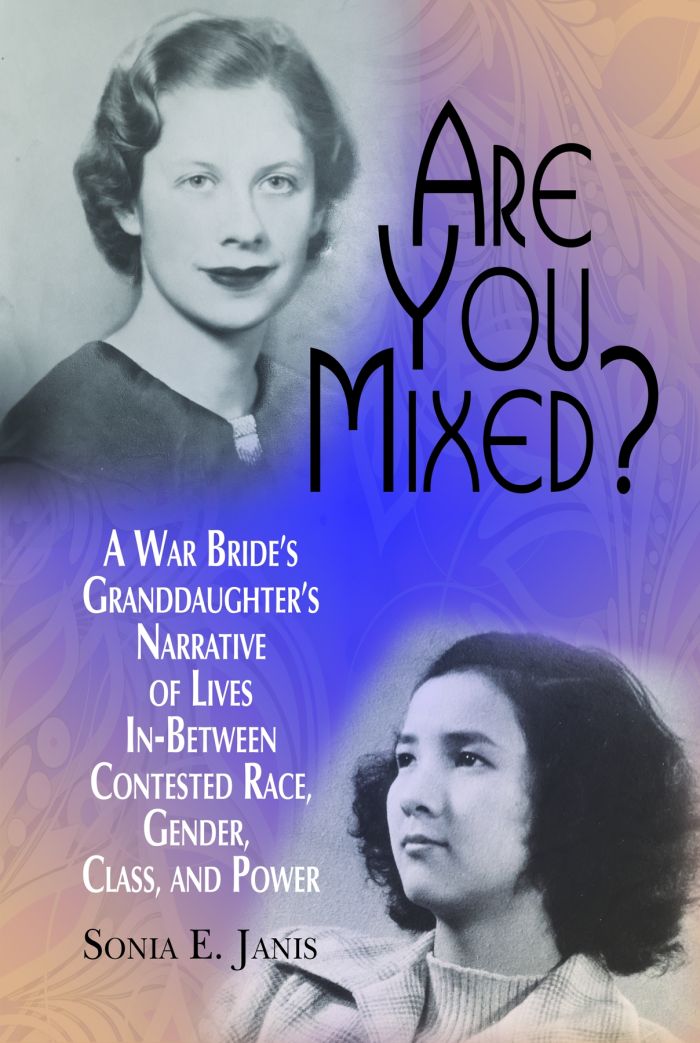
Are You Mixed? A War Bride's Granddaughter's Narrative of Lives In-Between Contested Race, Gender, Class, and Power

This book can be opened with

Note on our eBooks and Audiobooks: you can read our eBooks (ePUB or PDF) and listen to audiobooks on the free Emerald Books app on iOS, Android, and desktop. Or read and listen on Emerald's online reader (ePUB eBooks and audiobooks only). To purchase a digital book you will need to create an account if you don’t already have one. After purchasing you will receive instructions on how to get started.
- Description
- Contents
In Are You Mixed?, Sonia Janis explores the spaces in-between race and place from the perspective of an educator who is multi-racial. As she reflects on her own experiences as a seventh grade student up to her eventual appointment as a school administrator, she learns of the complexity of situating oneself in predetermined demographic categories. She shares how she explores the intricacies of undefined spaces that teach her to embrace differences, contradictions, and complexities in schools, neighborhoods and communities.
Exploring the in-betweenness (Anzaldua & Keating, 2002; He, 2003, 2010) of her life as a multi-race person problematizes imbedded notions of race, gender, class, and power. The power of this memoir lies in its narrative possibilities to capture the contradictions and paradoxes of lives in-between race and place, 'to honor the subtleties, fluidities, and complexities of such experience, and to cultivate understanding towards individual ... experience and the multicultural/multiracial contexts that shape and are shaped by such experience' (He, 2003, p. xvii). This memoir creates new ways to think about and write about in-between experience and their relevance to multicultural and multiracial education.
Janis challenges educators, teachers, administrators, and policy makers to view the educational experience of students with multiracial, multicultural, and multilingual backgrounds by shattering predetermined categories and stereotyped classifications and looking into unknown and fluid realms of the in-betweenness of their lives. This challenge helps create equitable and just opportunities and engender culturally responsive and inspiring curricular and learning environments to bring out the best potential in all diverse schools, communities, neighborhoods, tribes and societies.
Acknowledgments.
- Prologue.
- Chapter 2. One-Half Polish, One-Quarter Russian, One-Quarter Japanese.
- Chapter 3. My (Non-White or White?) Friends.
- Chapter 4. Three States and Six Schools.
- Chapter 5. Relocating to the Segregated South.
- Chapter 6. Culturally Clueless.
- Chapter 7. Multirace Stories as Curriculum.
- Epilogue.
- Reference.
- About the Author.