
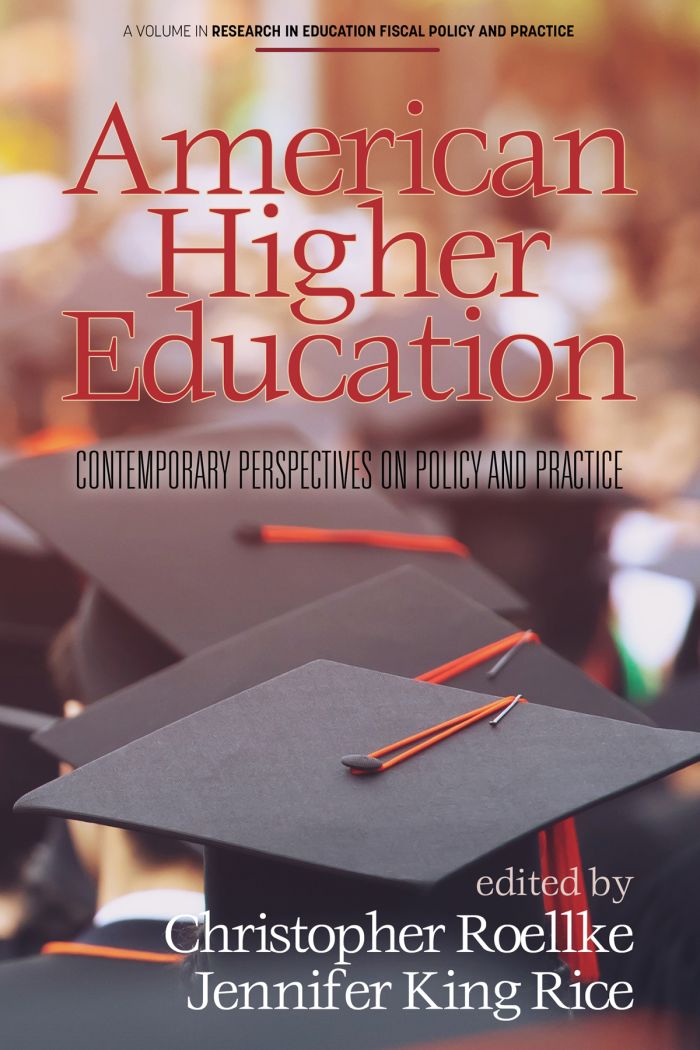
American Higher Education
Contemporary Perspectives on Policy and Practice

This book can be opened with

Note on our eBooks and Audiobooks: you can read our eBooks (ePUB or PDF) and listen to audiobooks on the free Emerald Books app on iOS, Android, and desktop. Or read and listen on Emerald's online reader (ePUB eBooks and audiobooks only). To purchase a digital book you will need to create an account if you don’t already have one. After purchasing you will receive instructions on how to get started.
- Description
- Contents
This series provides a scholarly forum for interdisciplinary research on the financing of public, private, and higher education in the United States and abroad. The series is committed to disseminating high quality empirical studies, policy analyses, and literature reviews on contemporary issues in fiscal policy and practice. Each themed volume is intended for a diversity of readers, including academic researchers, students, policy makers, and school practitioners.
In this fourth volume, attention is turned to both theoretical and pragmatic concerns in American higher education. During the final stages of the preparation of this manuscript, our schools, colleges, and universities have been confronted with what can be referred to as a “once in a century” set of challenges. As the global COVID 19 pandemic penetrated the United States in early 2020, colleges and universities have scrambled to address this ongoing public health crisis. Emergency task forces were established, campuses were shut down, faculty moved their instruction to virtual formats, and the entire higher education industry braced itself for the financial fallout. In addition to having to invest additional resources in classroom technology, ventilation, and personal protective equipment, colleges and universities continue to respond to revenue shortfalls, including reductions in both tuition and room and board revenue. This financial landscape requires judicious policy-making and research informed practice.
With this in mind, contributing authors were asked to pay specific attention to contemporary challenges and opportunities during a pivotal period in America’s colleges and universities. The contributing authors were asked to think of policymakers and practitioners at local, state, and national levels as the intended audiences for their work. Our contributors responded with a collection of studies examining the impact of federal and state policymaking on higher education finance and on specified educational outcomes and practices. Throughout the volume, particular attention is paid to issues of equity and adequacy in American higher education, including the deployment of incentives and structures that support the access and achievement of traditionally underrepresented students.
Chapter 1. The American Higher Education Landscape; Christopher Roellke and Jennifer King Rice.
- Chapter 2. Aligning Questions and Data: Using IPEDS Data to Analyze Higher Education Finance and Costs; Tammy Kolbe and Robert Kelchen.
- Chapter 3. Bachelor's Degree Production and State Higher Education Finance Policy in the Pre- and Post-Recessionary Period; Marvin A. Titus, Steffon M. Gray, and Kristyn Lue.
- Chapter 4. State Merit-Aid Programs and Student Major Choice; Zackary B. Hawley and Jonathan C. Rork.
- Chapter 5. Toward Equitable and Adequate Public Funding for Community Colleges: Lessons from K-12 Education Finance; Bruce Baker, Tammy Kolbe, and Jesse Levin.
- Chapter 6. Education Finance in Our New Context: Is Financial Decision-Making Headed in the Wrong Direction? Neil D. Theobald and Douglas Priest.
- Chapter 7. Bachelor's Degree Production and State Higher Education Finance Policy in the Pre-and Post-Recessionary Period: Managing Change Towards Racial Equity in Higher Education Through Competing Institutional Logics; Keith A. Witham, Cheryl D. Ching, and Alicia C. Dowd.
- Chapter 8. Title IX and Sexual Assault and Violence Prevention: Implications for Higher Education; Rachel Pereira.
- Chapter 9. Students' Experiences With Academic Advising in a 4-Year Centralized Advising Center; Nik Rowan and Ketevan Mamiseishvili.
- About the Editors.
- About the Contributors.