
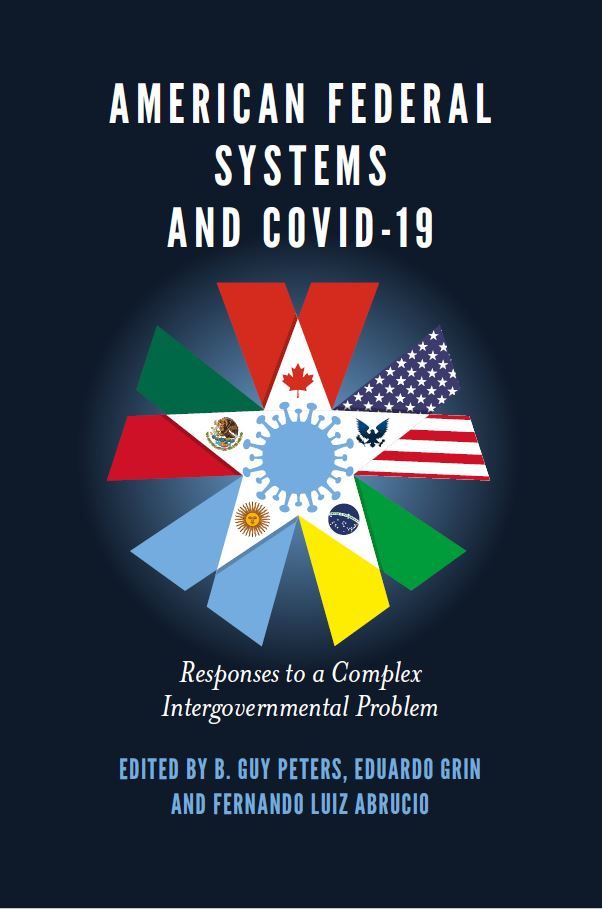

American Federal Systems and COVID-19
Responses to a Complex Intergovernmental Problem

This book can be opened with

Note on our eBooks and Audiobooks: you can read our eBooks (ePUB or PDF) and listen to audiobooks on the free Emerald Books app on iOS, Android, and desktop. Or read and listen on Emerald's online reader (ePUB eBooks and audiobooks only). To purchase a digital book you will need to create an account if you don’t already have one. After purchasing you will receive instructions on how to get started.
- Description
- Contents
- About
The COVID-19 pandemic struck as a global problem, a virus spreading without respect for territorial boundaries. National responses to mitigate the multi-dimensional effects provoked by the pandemic have been varied. What factors within federal systems could be related to the success or failure of their attempts to face this crisis? How have political leaders been performing in the intergovernmental arena, along with subnational levels of government?
American Federal Systems and COVID-19 analyzes five American federations – Argentina, Brazil, Canada, Mexico, and United States – and how they have responded to a complex intergovernmental problem (CIP) such as the COVID-19 pandemic. Using an analytical model based on two dimensions – institutional design and political agency – this study shows how the combination between federal design and political leadership stances can develop different policy responses to face the challenge of the COVID-19.
American Federal Systems and COVID-19 expands the current theoretical and empirical lens and learn what effective and ineffective actions implemented, giving essential insight to face boundary-spanning intergovernmental complex problems whose effects are very unlikely to cease anytime soon.
Chapter 1. Federal Systems: Institutional Design and Political Agency; Eduardo Grin, B. Guy Peters, and Fernando Luiz Abrucio
- Chapter 2. American Federalism in the Pandemic; B. Guy Peters
- Chapter 3. Argentine Federalism in the COVID-19 Pandemic; Daniel Alberto Cravacuore
- Chapter 4. Brazilian Federalism in the Pandemic; Fernando Luiz Abrucio, Eduardo Grin, and Catarina Ianni Segatto
- Chapter 5. Canadian Federalism in the Pandemic; Catarina Ianni Segatto, Daniel Béland, and Shannon Dinan
- Chapter 6. Mexican Federalism in the Pandemic; Edgar E Ramirez de la Cruz and D. Pavel Gómez Granados
- Chapter 7. Conclusions; Eduardo Grin, B. Guy Peters, and Fernando Luiz Abrucio
B. Guy Peters is Maurice Falk Professor of Government at the University of Pittsburgh, USA, was founding president of the International Public Policy Association and is now editor of the International Review of Public Policy.
Eduardo Grin holds a PhD in Public Administration and Government and is Professor and Researcher at Fundação Getulio Vargas/São Paulo, Brazil, where he teaches on local government, federalism, and public policies.
Fernando Luiz Abrucio holds a PHD in Political Science and is Professor at São Paulo School of Business Administration/Fundação Getulio Vargas in Brazil, where he teaches Public Administration, Federalism, and Public Policies, especially Education Policy.