
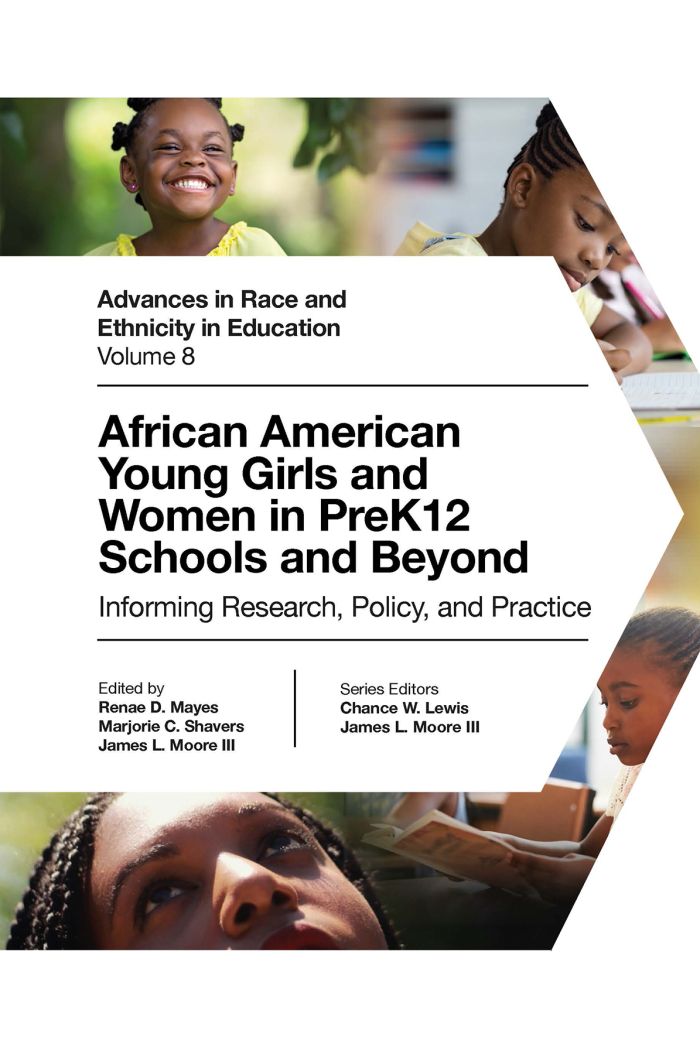

African American Young Girls and Women in PreK12 Schools and Beyond
Informing Research, Policy, and Practice

This book can be opened with

Note on our eBooks and Audiobooks: you can read our eBooks (ePUB or PDF) and listen to audiobooks on the free Emerald Books app on iOS, Android, and desktop. Or read and listen on Emerald's online reader (ePUB eBooks and audiobooks only). To purchase a digital book you will need to create an account if you don’t already have one. After purchasing you will receive instructions on how to get started.
- Description
- Contents
- About
African American Young Girls and Women in PreK12 Schools and Beyond presents a comprehensive viewpoint on preK-12 schooling for African American females. Including theoretical, conceptual, and research based chapters, this volume offers readers compelling evidence of the educational challenges and successes for this student population.
The expert authors in this collection provide rich perspectives on the experiences of African American females throughout their elementary and secondary education. Each chapter includes strong implications for education research, practice, and policy, as well as concrete recommendations to important stakeholders, such as educators, school counsellors, and parents. Collectively, the contributors communicate throughout that educational change is needed and that educational success is attainable for all African American females. It is intended that this work will help inform education research, practice, and policy as they relate to African American females. Equally important, it is envisioned that the readers will develop a greater interest in the education of African American females.
Introduction to Book; Renae D. Mayes, Marjorie C. Shavers, and James L. Moore III
- Chapter 1. Making the Unique Experiences of Young Black Girls Visible; Iheoma U. Iruka and Celeste Hawkins
- Chapter 2. “I Feel Like This School is Changing the Best Parts of Who She is”: Reflections from Black Educators on their Experiences Developing Growth-Promoting Environments for Black Girls During Early Childhood; Lauren C. Mims, Cierra Kaler-Jones, Abigail A. Amoako Kayser, and David J. Johns
- Chapter 3. Sisterhood as a Supportive Network in the Black Girl Experience; Antoinette Halsell Miranda, Halima Alhassan, and Maureen Joyce Myrtil
- Chapter 4. Seeing Through Her Eyes: Learning from the School Experiences of Black-White Biracial Girls; Ashley N. Patterson
- Chapter 5. Moving from Underprepared to Prepared: Educators’ Facilitating Conversations about Race with Black Girl Student-Athletes; Tomika Ferguson and Mahauganee Shaw Bonds
- Chapter 6. Postsecondary Planning for Black Girls with Disabilities: The Role of School Counselors and School Psychologists; Renae D. Mayes and Desireé Vega
- Chapter 7. Considering Race, Culture, and Gender in P-16 Education: A Film-Based Inquiry of Black African Immigrant Girls’ and Women’s Experiences; Meseret F. Hailu and Maima Chea Simmons
- Chapter 8. Black Undergraduate Women: Intersectionality and Engagement with High Impact Practices; Tiffany Y. Halsell and Dorinda J. Gallant
- Chapter 9. Hair, Identity, and Community: Black Women’s Experiences Going Natural in College; Robin Phelps-Ward and Jimmy L. Howard
- Chapter 10. The Radical Possibility in Becoming Black Women Leaders; Cynthia M. Sims and Angela D. Carter
Renae D. Mayes is Associate Professor in the Department of Disability and Psychoeducational Studies at the University of Arizona.
Marjorie C. Shavers is Associate Professor and Department Head of the Department of Counseling, Leadership, and Special Education at Missouri State University.
James L. Moore III is the Executive Director of the Todd Anthony Bell National Resource Center on the African American Male at The Ohio State University. Additionally, Dr. Moore is a Distinguished Professor of Urban Education in the College of Education and Human Ecology.