
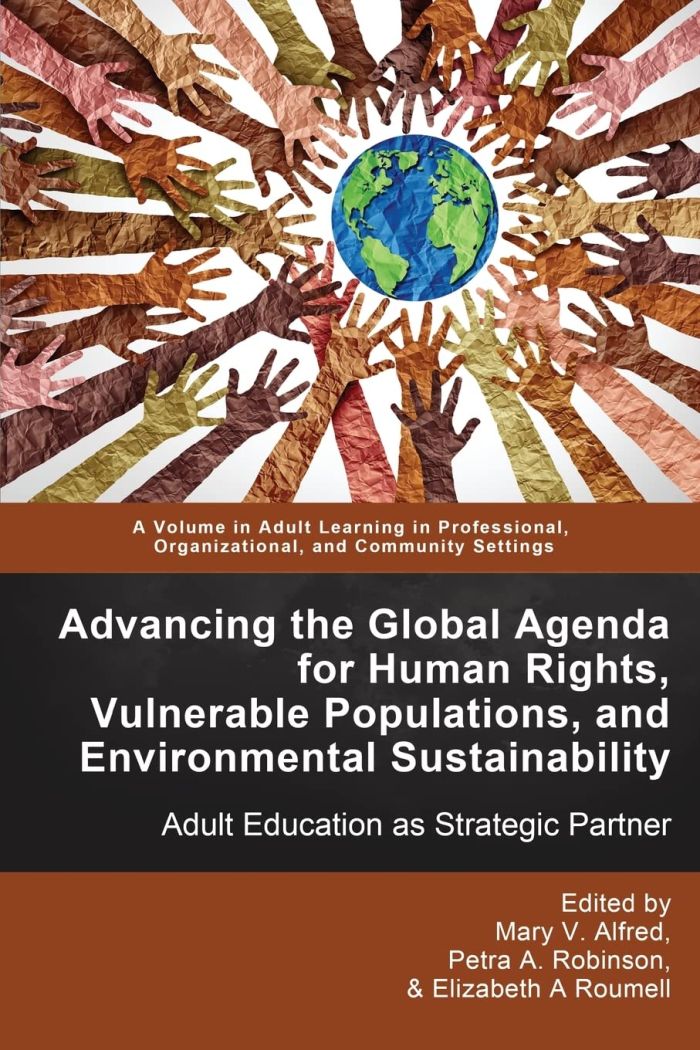
Advancing the Global Agenda for Human Rights, Vulnerable Populations, and Environmental Sustainability
Adult Education as Strategic Partner

This book can be opened with

Note on our eBooks and Audiobooks: you can read our eBooks (ePUB or PDF) and listen to audiobooks on the free Emerald Books app on iOS, Android, and desktop. Or read and listen on Emerald's online reader (ePUB eBooks and audiobooks only). To purchase a digital book you will need to create an account if you don’t already have one. After purchasing you will receive instructions on how to get started.
- Description
- Contents
For over 70 years, the United Nations has worked to advance human conditions globally through its historic agenda for a more peaceful, prosperous, and just world. Through the work of the General Assembly and other programs like the UNESCO World Conferences on Adult Education, the organization has taken a leading role in bringing world leaders together to dialogue on world issues and to set agendas for advancing social and economic justice among and within the regions of the world. The underlying themes of the United Nations’ agenda over the years have been world peace, economic justice, addressing the needs of the world’s most vulnerable populations, and protecting the environment. We draw from the two last two declarations from which the Millennium Development Goals (September 2000) and the Sustainable Development Goals (September 2015) were adopted by world leaders with a focus on addressing the needs of the most vulnerable populations. In this declaration, world leaders committed to uphold the long-standing principles of the organization and to combat extreme poverty, hunger, disease, illiteracy, environmental degradation and discrimination and violence against women.
The overall objective of the book is to highlight the conditions of vulnerable populations from various contexts globally, and the role adult and higher education can play (and is playing) in advancing the United Nations agenda of social and economic justice and environmental sustainability. Adult education, through research, teaching, and service engagements is contributing to this ongoing effort but as many scholars have noted, our work remains invisible and undocumented. Therefore, this book highlights adult education’s critical partnership in addressing these global issues. It will also begin to fill the void that exists in adult education literature on internationalization of the field.
Foreword; Marcie Boucouvalas.
- Preface; Elizabeth Roumell, Mary V. Alfred, & Petra A. Robinson.
- Introduction—Human Rights, Sustainable Development, and Adult Education: History, Foundation, and Context; Mary V. Alfred.
- Section I. Human Rights.
- Chapter 1. The Critical Literacies Advancement Model (CLAM) as a Tool for Curriculum Development: Advancing Human Rights in Adult Education; Petra A. Robinson and Maja Stojanović.
- Chapter 2. Integral Global Leadership Education for Human Rights, Transformation, and Sustainability; Wanda Krause.
- Chapter 3. Promoting Antibullyism to Advance Human Rights and Social Justice for Sexual Minorities Through Adult and Higher Education: An Antibullyist Approach; Mitsunori Misawa.
- Chapter 4. Migration and Human Dignity: Rhetoric and Practice; Chad Hoggan and Tetyana Kloubert.
- Chapter 5. Nexus of Vulnerability of Internally Displaced Persons (IDPs) in Africa, and Socioeconomic Development of the Black Nations; Debora A. Egunyomi and Kofo A. Aderogba.
- Chapter 6. Community-Based Adult Education to Promote Human Rights & Health Equity in a Stigmatized Community in Canada; Roula Kteily-Hawa and Joseph Roy Gillis.
- Chapter 7. Adults With Disabilities Need More and Better Learning Opportunities Around the World; Ashley Stepanek Lockhart, Ricardo Sabates, Nidhi Singal, and Thilanka Wijesinghe.
- Chapter 8. North Koreans' Human Rights and the Situation of Foreign Popular Culture: An Adult Education Perspective; Jinhee Choi.
- Section II. Economic Empowerment: Laboring To Learn, Laboring To Earn.
- Chapter 9. A Human Capabilities Development Perspective in Adult Education; Elizabeth A. Roumell and Bora Jin.
- Chapter 10. Unrealized Potential: Marginalized Youth Around the Globe, With a Focus on Turkey; Aydın Yücesan Durgunoğlu and Fatoş Dayıoğlu.
- Chapter 11. Adult Students in Community Colleges and Economic Justice; Kyung-Hwa K. Yang.
- Chapter 12. Looking for Educational Needs in the Community: Adult Educators' Roles Matter; Isaac Kofi Biney.
- Chapter 13. Leveraging Continuing Medical Education in Addressing Health Disparities: Case Studies From the Republic of Ghana; Linda D. Caples and Christopher M. Dodgion.
- Chapter 14. Strategies of Engagement and Support: Addressing the Holistic Needs of Veterans Pursuing Higher Education; Yvonne Hunter-Johnson, Sharlene Smith, Geleana Alston, and Aynur Charkasova.
- Chapter 15. Life Status and Prospects of Community Education Workers; Lixin Sun, Shuo Li, and Yuxin Song.
- Section III. Environmental Sustainability And Adult Education.
- Chapter 16. Learning to Recreate the World: Adult Education for Environmental Sustainability; Wendy Griswold.
- Chapter 17. Citizen Science: Adult Education for Environmental Sustainability and Conservation; Jill Zarestky and Lauren Vilen.
- Chapter 18. Millennium Fellows as Catalysts for Global Climate Change; Hilary Landorf, Yenisleidy Simon Mengana, and Birgitta Rausch-Montoto.
- Chapter 19. (Mis)perceptions of Aboriginal Fishing: Why Adult Education Must Confront the Environmental Indian Stereotype; Stanford T. Goto.
- Chapter 20. Man-Environment Interaction in the Rainforests and Sustainable Development: Practical Implications for Adult Education; Kofo A. Aderogba.
- Chapter 21. Conclusion—Adult Education for Human Rights and Sustainable Development: The Path Forward; Petra A. Robinson, Mary V. Alfred, and Elizabeth Roumell.
- About the Authors.