
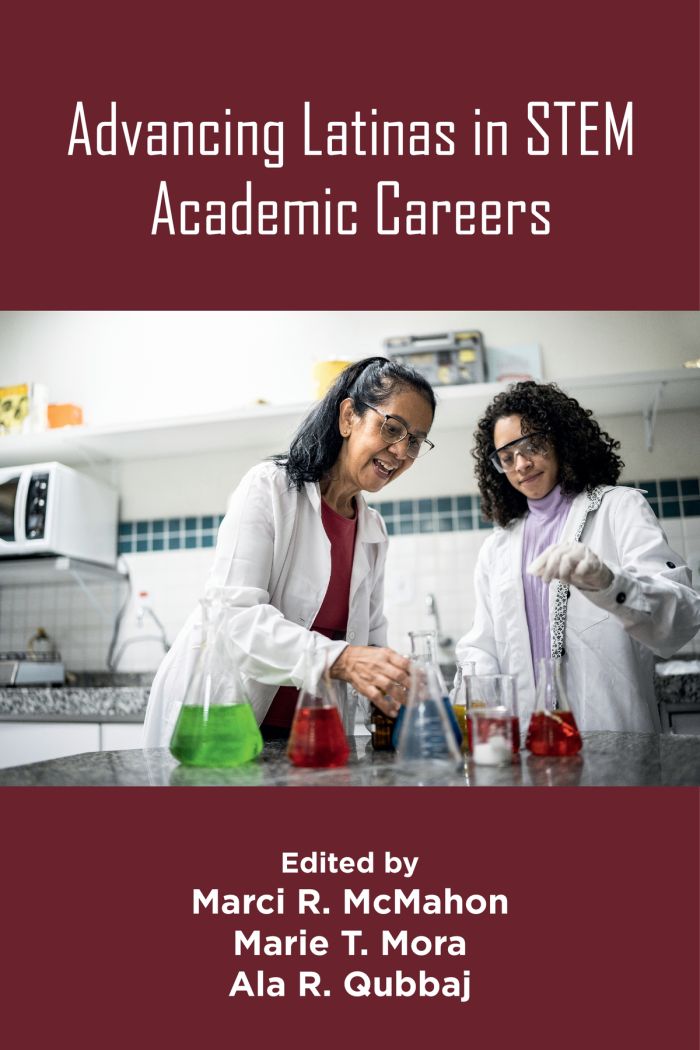
Advancing Latinas in STEM Academic Careers

This book can be opened with

Note on our eBooks and Audiobooks: you can read our eBooks (ePUB or PDF) and listen to audiobooks on the free Emerald Books app on iOS, Android, and desktop. Or read and listen on Emerald's online reader (ePUB eBooks and audiobooks only). To purchase a digital book you will need to create an account if you don’t already have one. After purchasing you will receive instructions on how to get started.
- Description
- Contents
- About
This book contains an Open Access Chapter.
Latinas represent one of the fastest-growing populations in the US, yet Latina faculty in science, technology, engineering, and mathematics (STEM) careers remain underrepresented. Advancing Latinas in STEM Academic Careers shares ideas, strategies, and best practices in the following areas: (1) work-life issues, policies/practices, mentoring, and climate that affect the pathways/pipelines, recruitment, retention, and advancement/leadership of Latinas in academic STEM careers; (2) challenges and opportunities for STEM Latinas across faculty rank and within and outside academia; (3) best practices and lessons learned in the recruitment and advancement of STEM Latinas; (4) intersectionality issues, particularly those related to gender and ethnic diversity in STEM; and (5) pipeline/pathways for advancing Latinas in STEM.
Academic research in STEM is often conducted without the perspectives of members of underrepresented groups, including Latinas. An increase in the number and representation of underrepresented minorities and women in STEM has the capacity to build more informed public policy formulation, discussion, and implementation. Having an inclusive STEM faculty that advances Latinas exposes students to a range of perspectives and experiences, counters stereotypes students might have about Latinas and BIPOC populations, strengthens the pipeline for Latina/o students, and prepares non-Latina/o students to work productively in an increasingly diverse and competitive workforce. This book will serve researchers in STEM equity and Latina/o studies, college and university administrators, and faculty, especially Hispanic Serving Institutions seeking knowledge, best practices, and resources for advancing Latinas in STEM academic careers.
Advancing Latinas in STEM Academic Careers: An Overview; Marci R. McMahon, Marie T. Mora, and Ala R. Qubbaj
- Section I. Contexts for Inclusion
- Chapter 1. Latinas in the Academy: Achieving Inclusive Institutions; Abigail J. Stewart and Virginia Valian
- Chapter 2. Intersectionality in National Science Foundation’s ADVANCE Program; Erika Tatiana Camacho and Jessie A. DeAro
- Section II. The Role of Mentoring in Fostering STEM Latina Advancement
- Chapter 3. An Intersectional Framework for Effectively Mentoring Latinas in STEM Fields; Rosalynn Vega
- Chapter 4. Taking Mentorship into Your Own Hands: Lessons and Strategies for Latina Doctoral Students Navigating STEM Academia from a Latina Perspective; Stephanie K. Ramos
- Chapter 5. Mujeres en STEM: Strategies for Navigating the Chilly Climate y Entre Fronteras; Tatiana M. Vera, Marie L. Miville, Patricia Arredondo, and Christina M. Capodilupo
- Chapter 6. GeoLatinas Mentoring Program: The Process of Creating a Safe Space to Grow Professionally by Co-Leadership; Daniela Navarro–Pérez, Dinosca Rondón–Rivera, Maria Beatriz de Santa Anna, Carolina Morales–Fernández, Gabriela Gonzalez Arismendi, and Pamela Yupa–Incalla
- Section III. Pathways to Advancing Latinas in STEM in Regional Contexts
- Chapter 7. Caminos a la Ciencia: Creating Partnerships to Attract, Recruit, and Retain Latinas in STEM in the Central Virginia Region; April D. Hennis Marchetti, Rebecca R. H. Michelsen, and Molly K. Smith
- Chapter 8. Improving the STEM College Experience of Latinas at an Urban Public College; Lissette Delgado-Cruzata
- Chapter 9. Provisioning School Counseling Professionals for Advancing Latina Girls in Science, Technology, Engineering, and Mathematics (STEM) Careers; Yih-Jiun Shen and Liang Zeng
- Chapter 10. Promoting Success for Latinas in STEM: Community of Care at Mount San Antonio College; Maura Palacios Mejia and Diana Felix
- Section IV. Personal Perspectives for Advancing Latinas in STEM
- Chapter 11. Alborotapueblos/Disrupting Villages and Making Good Trouble to Advance Equity for Women and Latinas in Academia; Penelope Espinoza and Ivonne Santiago
- Chapter 12. Breaking Barriers, Inspiring Futures: Destigmatizing Engineering for Latinas in STEM; Edna Orozco and Laura Benitez
- Chapter 13. Breaking Ceilings and Healing Corazónes: Confronting Racial Trauma in Academia; Judelysse Gomez, Lillian Polanco-Roman, Regina Miranda, and Jhovelis Mañaná OPEN ACCESS
- Lessons Learned and the Path Forward for Latinas in STEM; Marci R. McMahon, Marie T. Mora, and Ala R. Qubbaj
Marci R. McMahon is a Professor of English and Assistant Vice Provost for Faculty Affairs at Kansas State University, USA.
Marie T. Mora is a labor economist and Provost and Vice Chancellor of Academic Affairs at Purdue University Northwest, USA.
Ala R. Qubbaj is a Professor and Director of the Center for Broadening Participation in Engineering at The University of Texas Rio Grande Valley, USA.