
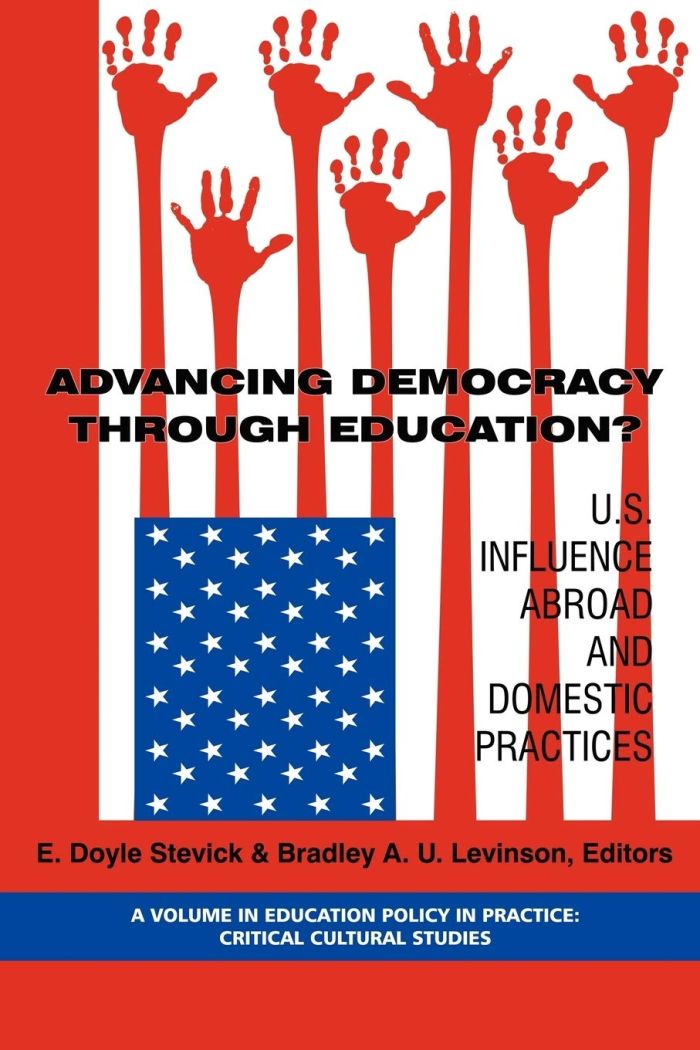
Advancing Democracy Through Education? U.S. Influence Abroad and Domestic Practices

This book can be opened with

Note on our eBooks and Audiobooks: you can read our eBooks (ePUB or PDF) and listen to audiobooks on the free Emerald Books app on iOS, Android, and desktop. Or read and listen on Emerald's online reader (ePUB eBooks and audiobooks only). To purchase a digital book you will need to create an account if you don’t already have one. After purchasing you will receive instructions on how to get started.
- Description
- Contents
This book explores the diversity of American roles in such cross-cultural engagement in education for democracy, both within the United States and around the world. Cross-cultural engagement in education for democracy inevitably bears the impressions of each culture involved and the dynamics among them.
Even high-priority, well-funded U.S. government programs are neither monolithic nor deterministic in their own right, but are rather reshaped, adapted to their contexts, and appropriated by their partners. These partners are sometimes called recipients, although that label is problematic. “Recipient” both gives a misleading impression that partners are relatively passive in the overall process, and its use is a reflection of some outside donors’ or experts’ stance that they are delivering goods or expertise. The authors of these chapters pay close attention to the cultures, contexts, structures, people, and processes
involved in education for democracy. Woven throughout this volume’s qualitative studies are the notions that contacts between powers and cultures are complex and situated, that agency matters, that local meanings play a critical role in the dynamic exchange of peoples and ideas. The authors span an array of fields that concern themselves with understanding languages, cultures, institutions, the close view of daily life, and the broad horizon of the past that shapes the present: history,anthropology, literacy studies, policy analysis, political science, and journalism.
Together, these 10 chapters provide a rich sampling of the diverse contexts and ways in which American ideas, practices, and policies of education for democracy are spread, encountered, appropriated, rejected, or embraced around the world. While not meant to provide a complete or systematic overview of the American influence on education for democracy around the world, the volume nevertheless introduces concepts, identifies processes, notes obstacles and challenges, and reveals common themes that can help us to understand American influence on education for democracy more clearly, wherever it occurs.
Preface; Bradley A. U. Levinson.
- Introduction: Education Policy, National Interests, and Advancing Democracy; Doyle Stevick and Bradley A. U. Levinson.
- Chapter 1. Beyond Nationalism: The Founding Fathers and Educational Universalism in the New Republic; Benjamin Justice.
- Chapter 2. Becoming American in Time?: The Educational Implications of Binary Discourse on Immigration; Patricia Buck with Rachel Silver.
- Chapter 3. Higher Education and Civic Engagement in the United States: Budgetary, Disciplinary, and Spatial Borders; Kathleen Staudt.
- Chapter 4. Discourse Versus Practice in Civic Education for Development: The Case of USAID Assistance to Palestine; Ayman M. Alsayed.
- Chapter 5. Foreign Influence and Economic Insecurity in International Partnerships for Civic Education: The Case of Estonia; Doyle Stevick.
- Chapter 6. Civic Education Reform for Democracy: U.S. Models in Mexico and Indonesia; Bradley A. U. Levinson and Margaret Sutton.
- Chapter 7. Developing Citizenship Education Curriculum Cross-Culturally: A Democratic Approach With South African and Kenyan Educators; Patricia K. Kubow.
- Chapter 8. Putting Equity Into Action: A Case Study of Educators' Professional Development in Twenty-First Century Kazakhstan; David Landis and Sapargul Mirseitova.
- Chapter 9. From Monsoons to Katrina: The Civic Implications of Cosmopolitanism; Payal P. Shah.
- Chapter 10. Building Towards Democracy in Apartheid South Africa: A Pioneering Partnership for Training Black School Leaders, 1989–95; Ronald R. Atkinson and Judy L. Wyatt.
- Index.
- About the Authors.