
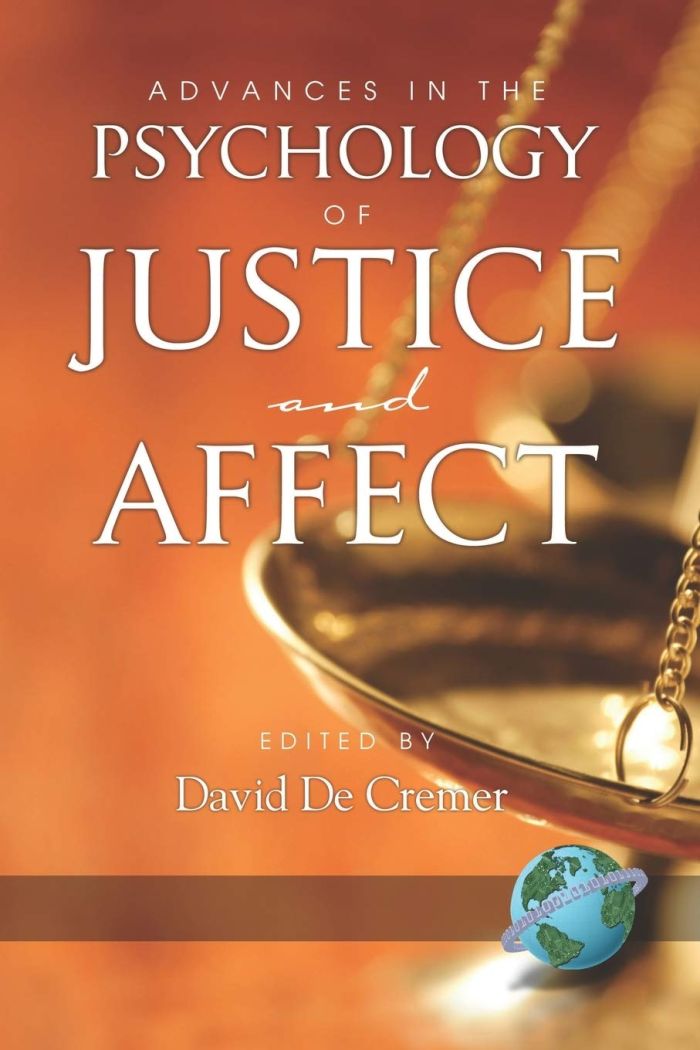

Advances in the Psychology of Justice and Affect

This book can be opened with

Note on our eBooks and Audiobooks: you can read our eBooks (ePUB or PDF) and listen to audiobooks on the free Emerald Books app on iOS, Android, and desktop. Or read and listen on Emerald's online reader (ePUB eBooks and audiobooks only). To purchase a digital book you will need to create an account if you don’t already have one. After purchasing you will receive instructions on how to get started.
- Description
- Contents
Leading scholars attempting to illuminate the developing trends in explaining and understanding the role that affect plays in justice and vice versa. The book comes at a particular fitting time as it is recognized that justice is in the eye of the beholder, but, unfortunately clear theoretical perspectives have not been clearly outlined yet. This book addresses this need by presenting a variety of perspectives advocating the further integration between both fields and how this may be achieved. Moreover, the book also provides a discussion of what we know as yet and where this integrative field should be going. The book is divided in three parts discussing the nature of justice and affect, justice, morality and affect, and justice and affect at work.
The market for this book is students, researchers in social psychology, organizational behavior and management, behavioral economics, philosophy, and other related social sciences fields. Graduate students and upper level undergraduates can make use of the book as a supplementary text.
Chapter 1. Justice and Affect: When Two Friends Meet; David DeCremer
- Part I. The Nature of Justice and Affect.
- Chapter 2. Justice Violations, Emotional Reactions, and Justice-Seeking Responses; Alicia F. Bembenek, Denise R. Beike, and David A. Schroeder
- Chapter 3. Do the Emotions of Others Shape Justice Effects? An Interpersonal Approach; David De Cremer, Gerben A. van Kleef, and Maarten J. J. Wubben
- Chapter 4. Hot Cognition and Social Justice Judgments: The Combined Influence of Cognitive and Affective Factors on the Justice Judgment Process; Kees van den Bos
- Chapter 5. The Role of Emotions in Cross-Cultural Justice Research; Seger Breugelmans and David De Cremer
- Part II. Justice, Morality and Affect.
- Chapter 6. Emotional Responses Uncover the Contextual Meaning of Acting (Un)Fairly; Celia Gonzalez and Tom R. Tyler
- Chapter 7. Justice, Fairness, and Strategic Emotional Commitments; Timothy Ketelaar and Bryan Koenig
- Chapter 8. Passions for Justice; Elizabeth J. Horberg and Dacher Keltner
- Part III. Justice and Affect at Work.
- Chapter 9. Scholarly Biases in Studying Justice and Emotion: If We Don't Ask, We Don't See; Thomas M. Tripp and Robert J. Bies
- Chapter 10. The Interplay between Justice and Affect in Groups; Barbara van Knippenberg, Daan van Knippenberg, and David De Cremer
- Chapter 11. A Cognitive-Emotional Theory of Customer Injustice and Emotional Labor: Implications for Customer Service, Fairness Theory, and the Multifoci Perspective; Deborah E. Rupp, A. Silke Holbu, and Alicia A. Grandey
- Chapter 12. Consequences of Interactional (In)justice: A Look at Leader Behaviors and Follower Perceptions; Nicole E. Kohari and Robert G. Lord
- Part V. Conclusion.
- Chapter 13. Justice and Affect: Where Do We Stand?; Jerald Greenberg and Deshani B. Ganegoda