
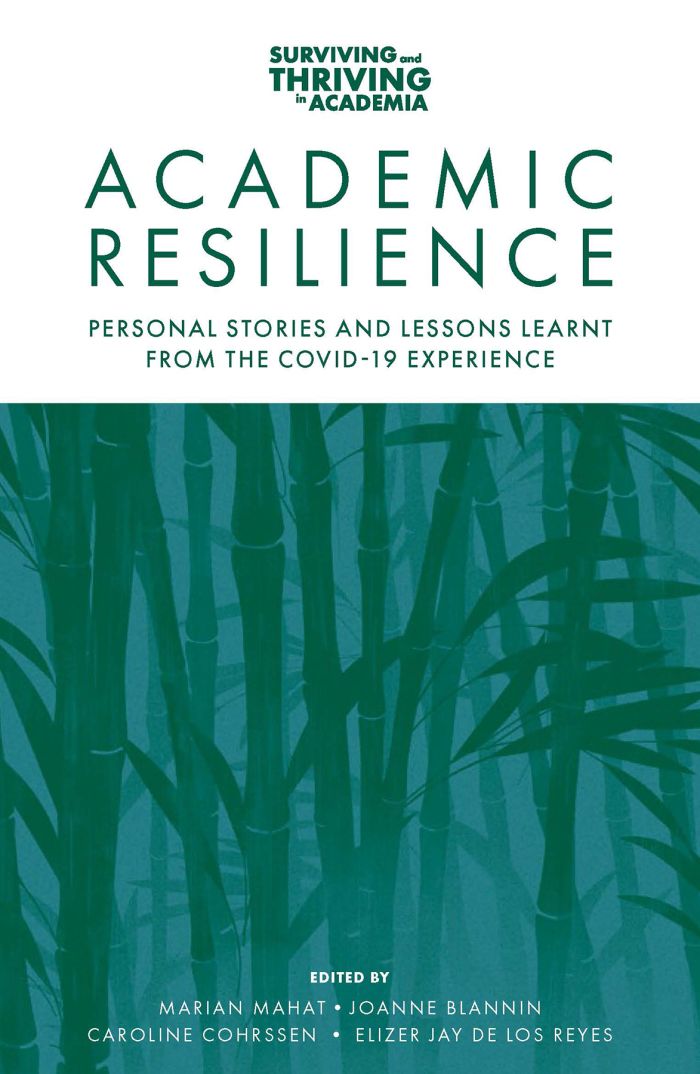


Academic Resilience
Personal Stories and Lessons Learnt from the COVID-19 Experience

This book can be opened with

Note on our eBooks and Audiobooks: you can read our eBooks (ePUB or PDF) and listen to audiobooks on the free Emerald Books app on iOS, Android, and desktop. Or read and listen on Emerald's online reader (ePUB eBooks and audiobooks only). To purchase a digital book you will need to create an account if you don’t already have one. After purchasing you will receive instructions on how to get started.
- Description
- Contents
- Reviews
- About
The COVID-19 pandemic undoubtedly tested the resilience of academics in higher education. Many universities were severely affected by reduced student enrolment, with widespread job losses reported across universities. For many academics, the impact of the pandemic has been worrying, financially crippling and overwhelming.
The virus has also exposed academic inequalities and impacted heavily on vulnerable people. The individual and collective heroic spirit of many academics has been nothing short of extraordinary. Overcoming the initial hurdles of COVID-19 takes one kind of energy; the resilience needed to remain engaged despite the continuing changes and uncertainties is quite another challenge. It is one that demands sustained resilience.
This timely book provides perspectives across disciplines, career stages and global contexts on how to develop resilience in academia. These personal stories may empower others not only to survive, but to thrive in times of adversity.
Setting the Scene
- Chapter 1. Academic Resilience: An Uncharted Terrain; Caroline Cohrssen; Joanne Blannin; Elizer Jay de Los Reyes, and Marian Mahat
- Personal Experiences of Resilience
- Chapter 2. Impostor Syndrome Magnified: Experiences of an Early Career Academic; Matt Harrison
- Chapter 3. “We’re All in This Together”: International Academic Cooperation as an Indication of Resilience during the COVID-19 Crisis; Bárbara Fernández-Melleda
- Chapter 4. Academia in the pandemic: The challenges and experiences in the work environment; Tabassum Amina
- Chapter 5. The Resilience of South African Academic Staff during the COVID-19 Pandemic; Raj Mestry
- Resilience Within and Beyond the Academy
- Chapter 6. Collective Resilience among Scholars and Businesses: A Brazilian University in the COVID-19 Crisis; Lisiane Closs, Daniela Brauner, Fernanda Reichert, Raquel Janissek-Muniz, and Sofia Gelain da Cunha
- Chapter 7. Civic Engagement during COVID-19: Conversation, Contribution and Collaboration as a mode of Resilience; Kathleen Riach
- Chapter 8. Building Academic Resilience: Lessons for Academics and Institutions; Elizer Jay de Los Reyes, Joanne Blannin, Marian Mahat
- Looking Forward
- Chapter 9. Academic Resilience Model: Thriving in Times of Adversity ; Marian Mahat; Joanne Blannin, Caroline Cohrssen, and Elizer Jay de Los Reyes
An insightful and comforting selection of stories that explore the challenges overcome and the communities built during a time of global crisis. If you are an academic, this book offers ideas, strategies, and the sense that we are not alone in the difficulties of pandemic and post-pandemic academic life.
In 2020-2021 the global pandemic has challenged us all in different ways. This timely volume on Academic Resilience is underpinned by the strengths-based approach with contributions from academics around the globe and highlights that it is possible for individuals to thrive using strengths to cope with whatever life dishes up. The authors present a conceptual framework, the Academic Resilience Model (ARM), that addresses factors that help us do well despite adversity. The model should be highly useful for both researchers and practicing academics
This book is an excellent reminder that despite the shockingly high rate of mental health issues among academics, pandemic or not, there are ways to overcome challenges and thrive in academia. These are the stories worth sharing, especially for early career academics, such as myself, who feel daunted by the prospect of starting a career in an already competitive field that has been further complicated by the COVID-19 pandemic. Thank you and congratulations to the team for providing that sliver of hope for many of us!
Marian Mahat is a Senior Research Fellow in the Learning Environments Applied Research Network at the University of Melbourne. Marian is the recipient of a number of awards, including Early Career Research Excellence Award and Research Partnership Excellence Award. She is also recipient of the 2022 Asia-Pacific Women in Leadership Program.
Joanne Blannin is Senior Lecturer in Digital Transformations at Monash University, Australia. Joanne is also Board Member and Conference Chair for Digital Learning & Teaching Victoria and the Victorian representative for the Australian Council for Computers in Education.
Caroline Cohrssen is Associate Professor in Teacher Education and Learning Leadership at The University of Hong Kong. Caroline has been appointed Professor of Early Childhood at The University of New England in Armidale, NSW and will be returning home to Australia in mid-2022.
Elizer Jay de los Reyes is a Postdoctoral Fellow at the Department of Communications and New Media, National University of Singapore. Jay combines global ethnography and digital ethnography to examine transnational connections between migrant Filipina domestic workers in Singapore and their left behind families in rural Philippines.