
A Trace for the Next Generation
Young Black Theorists Confronting Transnational Racism

This book can be opened with

Note on our eBooks and Audiobooks: you can read our eBooks (ePUB or PDF) and listen to audiobooks on the free Emerald Books app on iOS, Android, and desktop. Or read and listen on Emerald's online reader (ePUB eBooks and audiobooks only). To purchase a digital book you will need to create an account if you don’t already have one. After purchasing you will receive instructions on how to get started.
- Description
- Contents
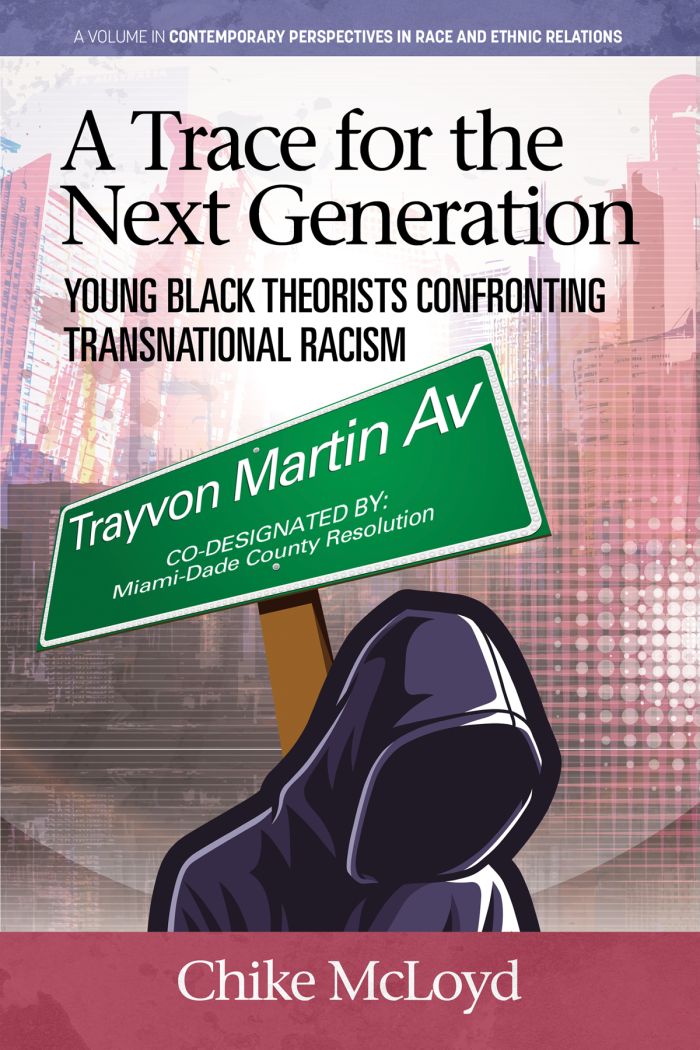
Based on eighteen months of ethnographic research in a high school E.L.L. classroom, this study contributes to the fields of new literacies studies and critical pedagogy by showing how transnational Black youth theorize and negotiate intersections of racism, justice, and education. Drawing on a multidimensional approach for understanding how racism is reproduced and resisted across various domains of power, the author shows how two young men from Haiti theorize the U.N. and INGO occupation of post-earthquake Haiti; a disjuncture between how Africa and Haiti are (mis)known in the U.S. and students’ lived realities in their respective countries of origin; and finally, students’ analysis of structural racism in the U.S. through a Justice for Trayvon unit that was co-taught from March-May 2012, when Trayvon Martin, George Zimmerman, and Stand Your Ground became household names.
The author concludes by suggesting that we move toward a “lessons against white supremacies” framework for critical pedagogy. This framework draws on centering counter–narratives and thinking through the notion of decolonial love to reframe everyday classroom praxis. Culturally informed, antiracist pedagogies must begin with students’ theoretical work and experiential knowledge. Such an approach transforms classrooms into spaces for students to not only interrogate racism but also create (counter) texts that represent their subjectivities as young Black people in the 21st century.
Preface; Paul Fine and Carter Mathes.
- Foreword; Kathleen Hall.
- Acknowledgments.
- Chapter 2. Towards a Transnational Black Youth Framework.
- Chapter 3. Black Youth Navigating Migration, Globalization, and Diaspora.
- Chapter 4. Researching Transnational Black Youth in Context.
- Chapter 5. Theorizing Beyond Disaster: Multimodal Storytelling as a Lesson Against White Supremacy.
- Chapter 6. Justice for Trayvon(s): An Ethnographic Case Study of a Teachable Movement.
- Chapter 7. Toward a Global L.A.W.S. (Lessons Against White Supremacies) Framework for Teaching and Learning.
- References.