
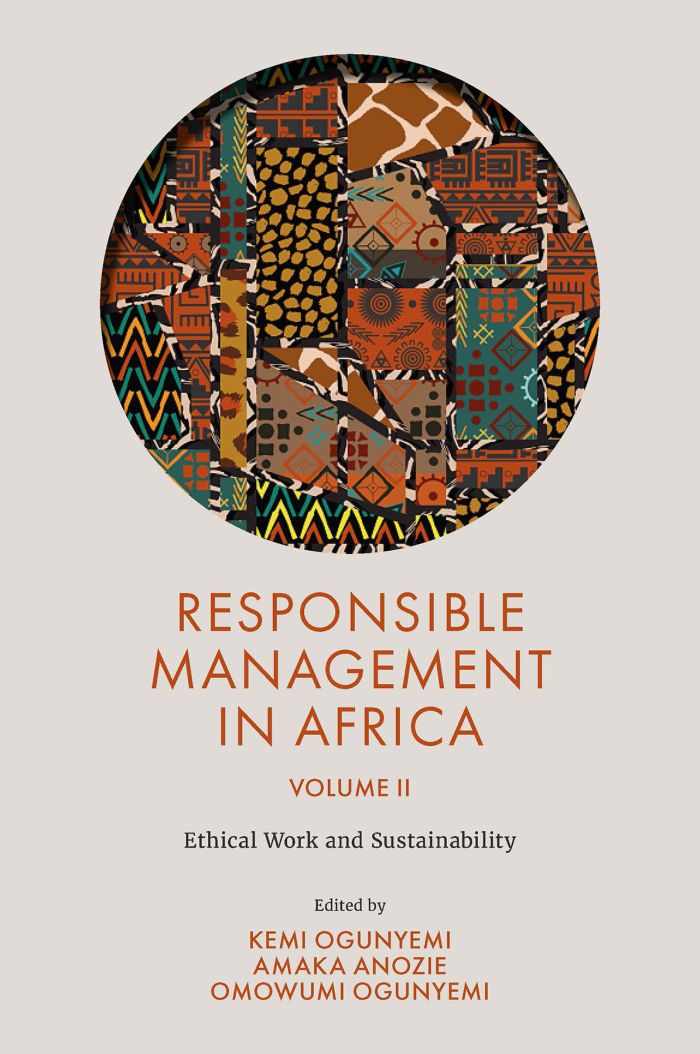

Responsible Management in Africa, Volume 2
Ethical Work and Sustainability

This book can be opened with

Note on our eBooks and Audiobooks: you can read our eBooks (ePUB or PDF) and listen to audiobooks on the free Emerald Books app on iOS, Android, and desktop. Or read and listen on Emerald's online reader (ePUB eBooks and audiobooks only). To purchase a digital book you will need to create an account if you don’t already have one. After purchasing you will receive instructions on how to get started.
- Description
- Contents
- Reviews
- About
Africa is one of the world’s oldest economies, yet little is known about the wisdom that traditionally guided responsible management, with most work in the field employing Western perspectives. Responsible Management in Africa brings African voices to complement existing knowledge and practice by presenting indigenous values and practices that promote responsible business.
Following on the first volume of Responsible Management in Africa which brought together insights from Zimbabwe, South Africa, Nigeria, Ghana, Egypt, Lesotho and Uganda, this volume brings unique perspectives from another set of varied African contexts: traditions, culture, and values guiding business in Mauritius, Zambia and Namibia, the sustainability orientation of the Igbo Apprenticeship System in Nigeria, and principled social responsibility practices in Algeria. It also highlights the CSR experience in Kenya and inclusive trust-based credit systems in Tanzania and explains the viability of traditional African health systems. The chapters present academic perspectives and hands-on applications of approaches to managing responsibly, especially regarding integrating ethical practices into business and assuring sustainability through ethical profitability.
Responsible Management in Africa delivers a rich reservoir of indigenous value-narratives based on a well-balanced philosophical anthropology, with the aims of enriching global knowledge, in the philosophy of management and in business ethics, and of contributing much-needed insights for leaders around the world to manage enterprise responsibly, be it public or private sector.
Chapter 1. Sustainable Human Ecologies: Principles for Ethical Work in Africa; Kemi Ogunyemi, Omowumi Ogunyemi, and Amaka Anozie
- Chapter 2. Fighting Corruption in Africa: The ‘Sine Qua Non’ for Responsible Management; Franco Manni
- Chapter 3. Social Responsibility Discretion in Algeria: A Case of Local Brands; Hamza Koudri and Amina Djedidi
- Chapter 4. An Anecdotal Examination of Corporate Social Responsibility through an African eye. The Kenyan Experiences; Prottus Murunga
- Chapter 5. Traditions, culture, and values in businesses in Mauritius: Evolution across two centuries; Yashwantrao Ramma and Ajeevsing Bholoa
- Chapter 6. Customary System and Business Sustainability in Namibia; Eno Akpabio
- Chapter 7. Responsible Management: The Igbo Apprenticeship System; Nneka Udeh
- Chapter 8. Principled Sustainable Entrepreneurship - The Case of Trust-based and Emotional Intelligence Approaches in Tanzania; Peter Mhando and Lindah Mhando
- Chapter 9. Sustainable Traditional African Health Systems and Responsible Health Education; Adaora I Onaga and Joy Odimegwu
- Chapter 10. Zambia – The Melting Pot of Trade and Culture; Mfikeyi Makayi
- Chapter 11. Wisdom from Africa: Solidarity and Inclusion for an Ethical Economy; Kemi Ogunyemi, Omowumi Ogunyemi, and Amaka Anozie
Responsible Management in Africa offers such an insightful and fascinating 'glocal' perspective. It reveals the topic's local roots on the African continent, from which we can learn much for responsible management globally.
A few years ago, we witnessed the consolidation of many African Business schools and the creation of some new ones. On that occasion, there was a raging discussion: Should African business schools follow the paths set by further advanced Western business Schools? Should they rather strive to creatively develop some new, original, peculiarly African concepts and points of view? Could “ubuntu” and other traditional concepts be considered important elements contributing to the growth of African and non-African businesses? Maybe! The contribution of Dr. Kemi Ogunyemi and her co-editors in their new book is a powerful claim and statement that the second and third options are not only viable but very much alive and productive. The contributions give a deep insight to the treasures of indigenous wisdom and how they contribute to growth and development.
Kemi Ogunyemi has a degree in law from University of Ibadan, an LLM from University of Strathclyde, and MBA and PhD degrees from Pan-Atlantic University. She teaches business ethics, managerial anthropology, self-leadership, and sustainability management at Lagos Business School, Pan-Atlantic University, Nigeria.
Omowumi Ogunyemi obtained her first degree in medicine and surgery. She worked as a medical practitioner in Nigerian hospitals before her post-graduate studies in Philosophy. She holds a licentiate degree (masters) and a PhD (Anthropology and Ethics). She currently teaches at the Institute of Humanities, Pan-Atlantic University, Nigeria.
Amaka Anozie holds a bachelor’s degree in electrical engineering and a Bachelor of Theology (summa cum laude) from the Pontifical University of the Holy Cross, Italy. She works at Lagoon School, Lagos, while leading and facilitating sessions in youth leadership programmes for tertiary institutions across the country.